Python Development Outsourcing Business Guide: How Not to Miss a Thing
Published: – Updated:
Key takeaways
- Companies have to use Python because of the developers’ choice. Know more about its special nature that engages giants to rely on the technology.
- Reasons to outsource Python development vary but have lots in common. Know more about similarities across domains and application areas.
- The Python app development business model that fits your needs: read the difference to decide rightly.
- Approach where to find and how to choose dedicated developers to complete your project without problems.
- How we work: Aimprosoft’s Python project examples with delivered business value.
The arrival of Guido van Rossum at Microsoft a few years ago was almost impossible, given the company’s attitude towards open source software. However, a Python creator joined Microsoft to take on a deeper implementation of the language in Microsoft projects.
Amazon–backed CodeWhisperer, an AI pair programming tool similar to GitHub’s Copilot.
$4.3M seed round for Proper to help fintechs wrangle fragmented data.
Databricks launches Project Lightspeed, its next-gen Spark streaming engine.
TruEra got investments of $25 million to grow their AI quality management solution for ML model optimization, explanation, and monitoring.
$5 million in seed funding for Desipad, a no-code ‘interactive notebook’ for non-technical people who want to do data modeling.
This is a partial list of the recent announcements of projects where Python drives tech processes one way or another.
Do you still think that Microsoft lured a retired Python developer for nothing?
Why Python is important?
The Python language is important to businesses for several reasons:
- Python’s simple and easy-to-understand syntax and its extensive standard library and third-party packages allow developers to build applications quickly.
- Python is known for its scalability, which allows companies that use Python to start small and scale their applications as their needs grow.
- Cost-effective: Python is an open-source language, meaning it is freely available and does not require licensing, making it cost-effective.
- Python has become the primary language for analyzing and manipulating data; with it, large data sets can be efficiently processed and analyzed, valuable insights can be derived, and decisions can be made based on the data.
- Python has excellent integration capabilities, allowing companies to connect their applications to a variety of systems, databases, APIs, and services.
- Python’s versatility and ease of use make it a powerful tool for automation and scripting to optimize business processes.
- Python’s broad support for web development and its scalability and security make it an ideal choice for companies looking to establish an online presence and interact with customers through web applications.
- Python has a large and active community of developers and enthusiasts who provide support, share knowledge, and contribute to developing and improving the language.
As you see, Python plays a critical role in the business world due to its simplicity, scalability, cost-effectiveness, data analysis capabilities, integration options, automation potential, and web development support.
Let’s proceed with the nature of applications written in Python.
Special nature of Python-based projects
Python is widely used in various environments. Python makes it easy to develop and maintain multiple complex projects as a highly adaptable programming language. Python’s greatest strengths are flexibility, rapid development, scalability, and excellent performance. Most likely, your project is one of those requiring one of these features.
NASA uses Python in projects related to mathematical calculations of flight parameters. Also, a Workflow Automation System (WAS) has a core based on this programming language as well as the rest of NASA’s 400 open-source projects rely on the same technology.
Python’s footprint in Netflix’s environment continues to increase, powering data analysis on the server side and tracking security changes and history with monkey apps.
The position of Google towards Python is to use the language where they can and C++ where they must. It is evidence of the high reliability of the technology.
Facebook made Python one of the most popular languages in social network development, relying on its libraries to manage multiple infrastructure services.
The reputation for simplicity and practicality made Instagram software engineers opt for Python, which led to running the Django web framework (the world’s largest deployment).
Dropbox made a shift from proprietary philosophy to open-source Python employed in a very efficient API and server-side code enrichment.
Industrial Light and Magic (ILM), a special effects studio, uses Python to track and audit pipeline functionality and maintain a single database of images created for each film.
Audio streaming requires fast processing of data analysis and back-end services. Thus, Spotify narrowed down on Python to enable a fast development pipeline.
Reddit’s lead techies love Python for its wide range of code libraries, development flexibility, and code readability. The platform was recoded from Lisp.
Quora takes C++ to perform critical sections, while the choice for Python was made because of their Django and Pylons frameworks and server-client interaction convenience in case of partial page loads.

As you see, leaders choose this programming language to power complex tech stacks, process data from various sources, and maintain core business processes. The variety of applications impresses, including search engines and web scrapers, social networks, workflow automation, DevOps, etc. Application areas are web development, scientific computing, data science, AI and ML, NLP, the Internet of Things, embedded applications, and even fintech for fintech.
Read more about how to build an IoT application to respond evolving market.
Hence, the attractiveness of Python for developers all over the world is defined by the following:
- rich batteries-included standard library;
- concise and clean syntax;
- a wide range of third-party libraries;
- large developer community.
Python runs on almost all popular operating systems, including Linux/UNIX, Windows, Macintosh, Solaris, macOS, iPhone OS, Palm OS, Windows Mobile, Symbian, and Android.
Its attractiveness and proliferation are hard to underestimate. You probably have your reasons for python development outsourcing. Still, you are unsure how to approach it correctly: where to find developers or partner with a niche outsourcing company with relevant expertise, and how to set up profitable collaboration?
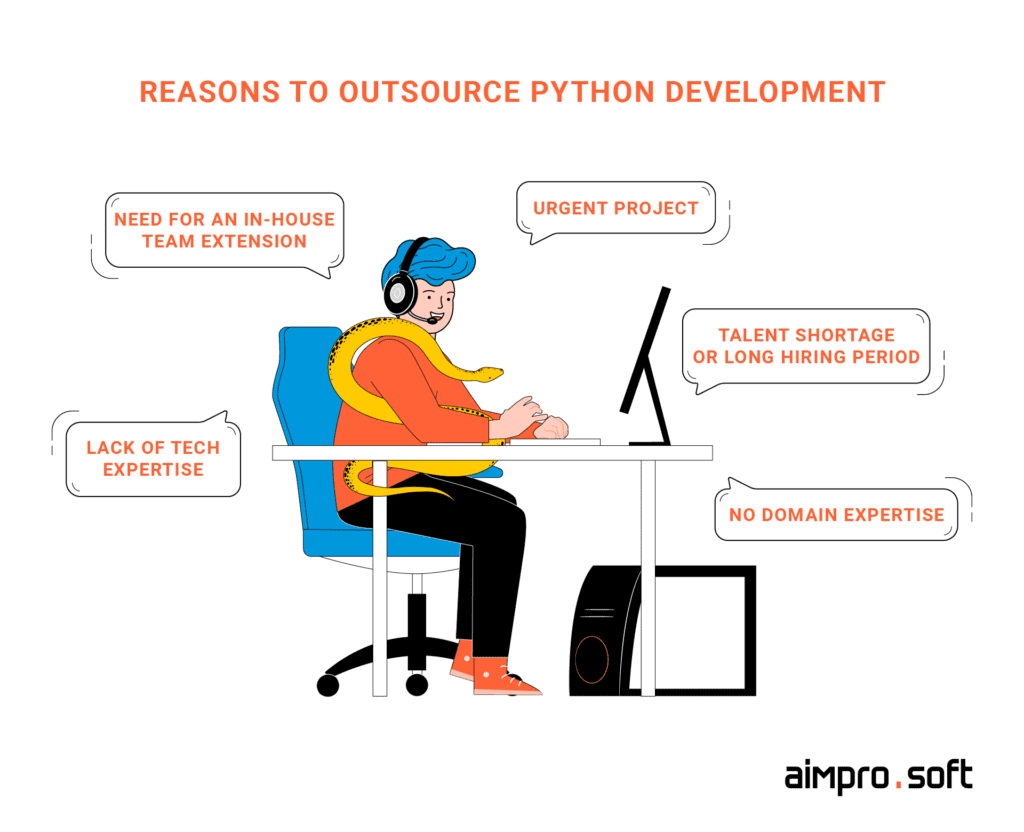
Reasons to outsource Python development of your project
From our practice, there are five main causes why you tackle looking for Python developers.
1. Need for an in-house team extension
You already have an in-house team and need to extend the team because of project growth
You can do it by onboarding an in-house developer, hiring a freelancer, or out staffer from a software development company. Staff augmentation is a proven outsourced strategy when you have determined which additional technical skills are required and address the market to make up for the lack.
2. Lack of tech expertise
You have a project and have to implement it on the technology beyond your tech department stack.
Often, it comes about rewriting an entire code base or a part of the existing project. In this case, you may be wavering between waiting while some of your developers learn Python to be able to implement it (it can drag on for weeks) or addressing an outsourcer and hiring an experienced specialist in several days.
3. Urgent project
You have to complete a solution with specific technology, having time constraints. Recruiting may take longer, but your need for an experienced specialist is urgent.
An outsourcing model allows you to quickly get a niche specialist to close a tech gap for your project without losing precious time.
4. Talent shortage or long hiring period
Obstacles with hiring locals are typical in cases of both startups and companies. It is a short talent supply in areas with high competition for talents (primarily in locations of tech giants’ offices, e.g., Silicon Valley, Dublin).
Outsourcing to talent hubs may turn out to be reasonable. Software outsourcing companies from Eastern Europe (Ukraine) usually have a long story and a proven track of successfully implemented projects. You definitely have a chance to find specialists that fit your needs.
5. Project from scratch
Assume you start a new project from scratch by entering a new industry. You have a good idea but no expert skills in tech implementation.
Startup owners, as usual, want to quickly enter their field and present an MVP to investors or proof of concept. All this with budget constraints under a heavy time pressing. Outsourcing to the agency with relevant expertise in the domain is the way out. Companies also can use the same strategy of Python outsourcing to deliver a product and accelerate time to market with a dedicated team.
Check our guide on how to hire dedicated developers from Ukraine.
Outsourcing vs. Outstaffing Python development
Outsourcing is the most widespread practice of delegating tasks to a third-party service provider of software development services when the vendor manages all the tasks related to the software development.
It has three options.
Nearshore outsourcing
You consider engaging an outsourcer from your area with pros:
- the same time zone;
- mindset;
- culture fit.
And cons:
- high rates;
- high benefits;
- high taxes;
- complex hiring process.
Offshore outsourcing
It may seem strange to you if you have never done it. But ask your partner, one from your network, someone who had a positive experience of outsourcing overseas to trusted Eastern European tech hubs with pros:
- affordable prices without compromising the quality;
- access to the vast pool of specialists with strong seniority;
- flexibility in delivering methodologies;
- experience in a remote working mode;
- proven expertise in Python-related domains;
- proficiency in English;
- fast onboarding from existing talent pool;
- variable payment models;
- high quality of services.
And cons (that sometimes can be turned out into pros):
- time zone difference;
- culture and social differences;
- communication barriers;
- security concerns.
Read also our guide on how to hire offshore Python developers.
Outstaffing
Outstaffing is a rent of employees to the staff of a software development outsourcer when the team members continue to work at the same workplace and perform their previous functions, but the role and responsibilities of the employer are officially transferred to a third-party outstaffing company.
This model attracts startups and large companies but needs more control from your side, whether a single coder or a dev team. Project management is also on your shoulders and requires a PM on your site. Moreover, you’ll need a tech lead to coordinate architecture and stack choice or have to be involved by yourself in the case of a small staff.
As a rule of thumb, some business owners have concerns about remotely hired developers working in different time zones concerning communication obstacles that may (or may not) occur. Some misunderstandings regarding your assignments, objectives, and requirements are the place to be.
Let’s have a talk and select the match for your requirements.
Well, let’s elaborate on the right strategy for Python developers outsourcing.
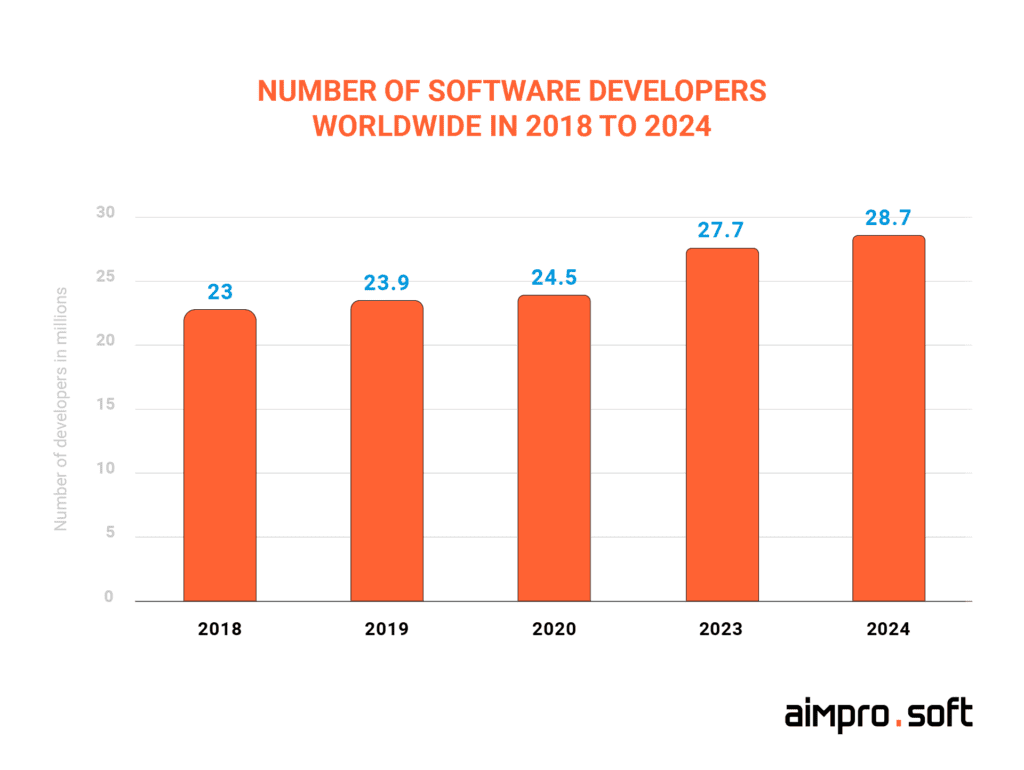
As estimated, the global programmer population will reach 28.7 million people by 2024.
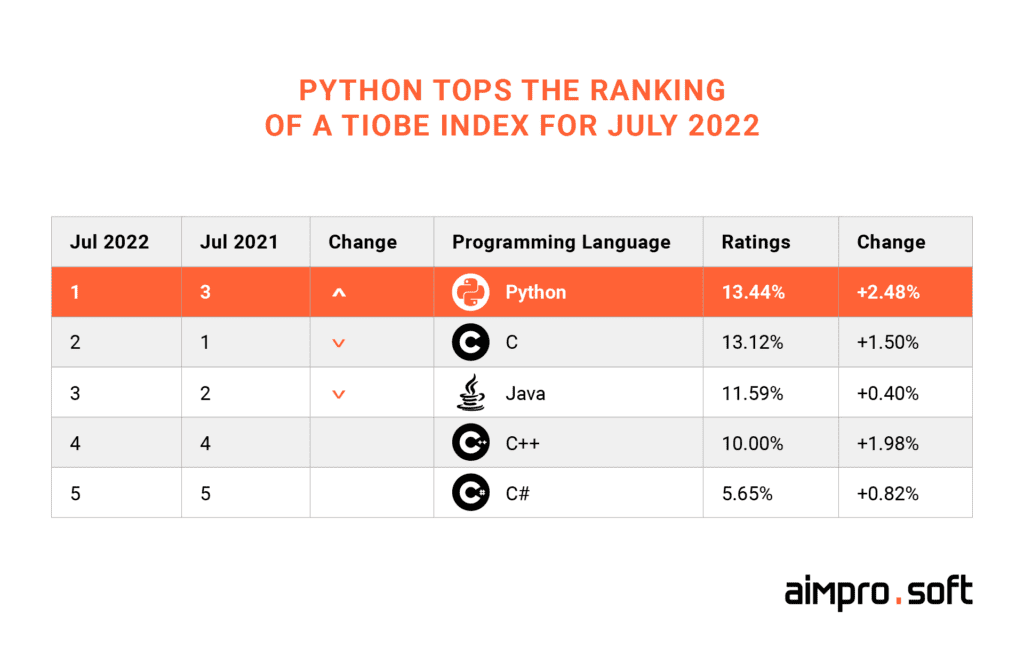
As of 2021, Python was the fourth most commonly used programming language among software developers around the world. In July 2022, Python leads the summer season of the TIOBI index. Thus, more and more developers master the technology.
Before you start searching for those developers, it would help you discover the destinations, freelance websites, B2B directories, and design communities .
Python outsourcing destinations
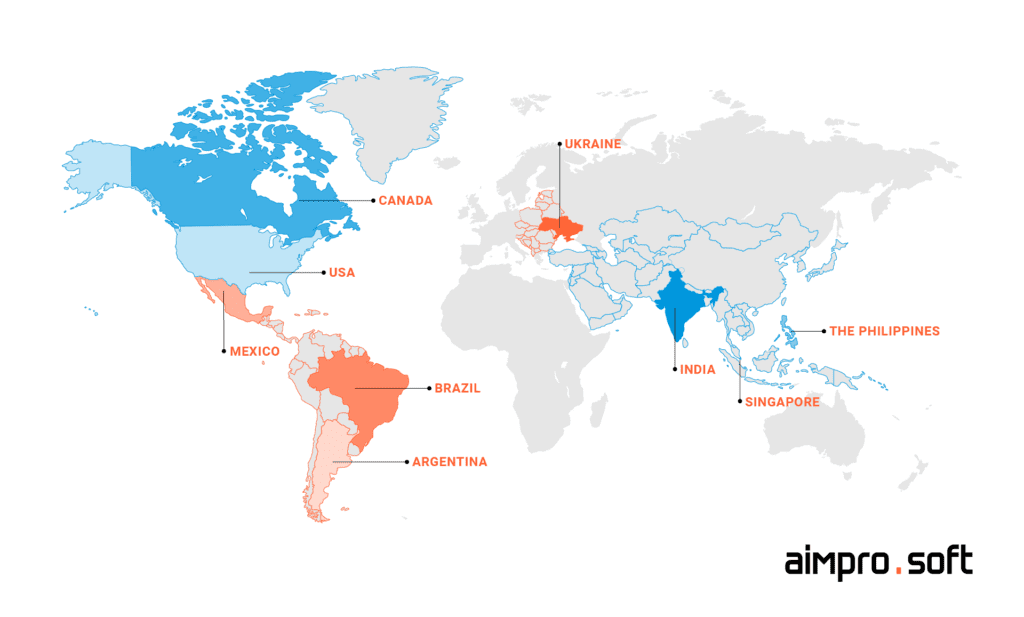
A North American region belongs to the nearshore areas of high-density tech specialists, which makes it kind of a red ocean with the highest competitiveness. The innovativeness of the USA creates a vast pool of tech specialists with similar a mindset and lifestyles but fall short of supply. But they’ve already booked. Rates are growing, and firms have to fight for talents literally.
Asia, primarily India, the Philippines, and Singapore, was historically one of the massive communities of developers known for their low prices. However, there were concerns about code quality, and the time difference (12 hours) is considered a weak spot. Indians are hard workers, but the difference in mindset may cause a lot of hidden misunderstandings.
Latin American countries are often chosen by US companies due to the geo proximity, comfortable overlapping working hours (as in a Europe-Ukraine partnership), and cultural and mindset similarities. English is spoken prominently in almost all Latin American countries. But comparatively with Eastern Europe, in Mexico, prices can be higher for the same seniority and stack.

We can help close your Python vacancy. At a reasonable price.
Business Service Leaders Association (ABSL) reported that 79% of the surveyed companies expect their turnover to increase in 2022. It is due to the tendency of growing software outsourcing to the Eastern Europe region. During wartime, only Ukraine’s IT sector generated $2 bln in export during the 1st quarter of 2022, which is 28% higher than in the same period in 2021.
Among over 285 000 software developers in Ukraine, Python is among the five most popular programming languages making up a large part of the IT community with 20 000+ developers. With over 50% of IT staff having STEM degrees, by hiring a Python development team, be sure those specialists will have Master’s Degree. The lifestyles and mindsets of Ukrainian developers correspond to European values, as proved by the upcoming flux of orders from Western European clients over the recent 25 years. This talent hub attracts by a customer-oriented approach, innovativeness, and affordable prices with qualitative delivered results that help save money. English proficiency is second nature for everybody in the IT sector.
9 Reasons why business leaders prefer outsourcing software development to Ukraine.
Online B2B directories with software vendors
Suppose you are convinced that Python software outsourcing to a software company suits you, then after choosing a destination. In that case, you can search for vendors on B2B directories, which will help you decide on an agency. They are online platforms containing company listings with clients’ feedback, rates, provided services, portfolios, locations, and contacts. The most popular are Clutch, G2, DesignRush, GoodFirms, TopDevelopers, TheManifest, TechReviewer, etc.
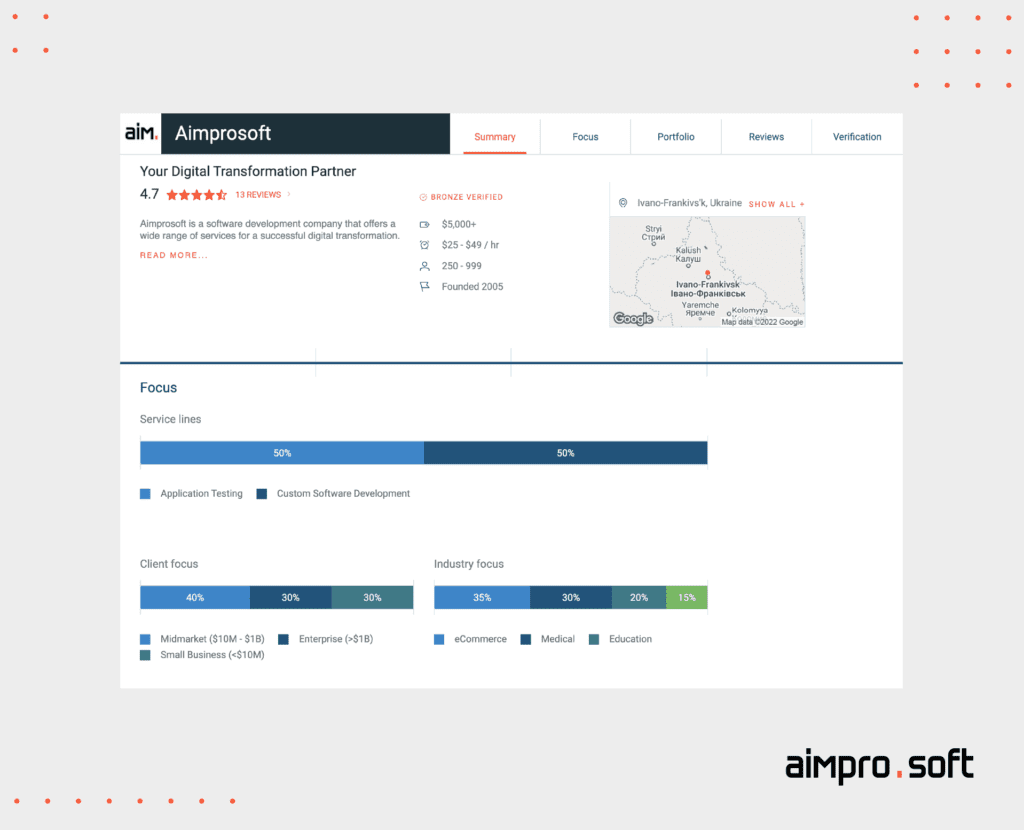
In 2022, Aimprosoft was recognized as one of the Top Custom Software Development Companies by DesignRush, leading B2B and B2C companies to increase their sales potential.
Design showcasing communities
It happens your search for developers doesn’t limit to techies. You need someone who can visualize your idea for end users to make a business earn. Often a Python software development company is staffed with web and mobile UI/UX designers providing design services along with development. Behance and Dribbble are the most popular among design teams to showcase their portfolio and expertise.
Tips to choose the right outsourcing partner
Globalization started with the Silk Road, perhaps. And software development outsourcing with a partnership between Kodac and IBM, when the latter was approached to set up a data center for a partner. Kodac could dive into the issue and waste time doing things beyond their competency. Instead, the company’s leader relied on specialists’ field expertise.
Check your shortlisted vendor on the nature of the expertise
Tech stack is important. It is the main reason many of those like you are looking for Python developers. However, one shouldn’t neglect customer service and overall approach to business. What are their principles and philosophy?
Try your vendor on approach to business
It’s’ like searching for your perfect match for a date: you go online and surf for each tiny detail about the person to verify them on fit. Business relationships also rely on reputation, even more than personal relations. Collected feedback and word-of-mouth can be handy there.
Verify the vendor’s reputation
Don’t chase for attractive low budgets in service agreements. Since your business depends on the quality you provide for your customers, a balance between budget and outcomes has to be kept.
Match your requirements with the vendor’s capabilities
The world of the digital economy placed data privacy in the first place. Usually, IT vendors comply with common IP rights and privacy policies following the nature of their business. But you are right to double-check security concerns to save your business from the unexpected.
Ensure your data are secured under the partnership
Finding a reliable software partner may seem complicated. But in the long run, your efforts will be worth it.
How much does it cost to outsource Python development?
Talking about Python developers outsourcing, it is fair to say that the price depends on the following factors:
- geographic location;
- seniority level;
- domain expertise.
Python salaries in outsourcing countries
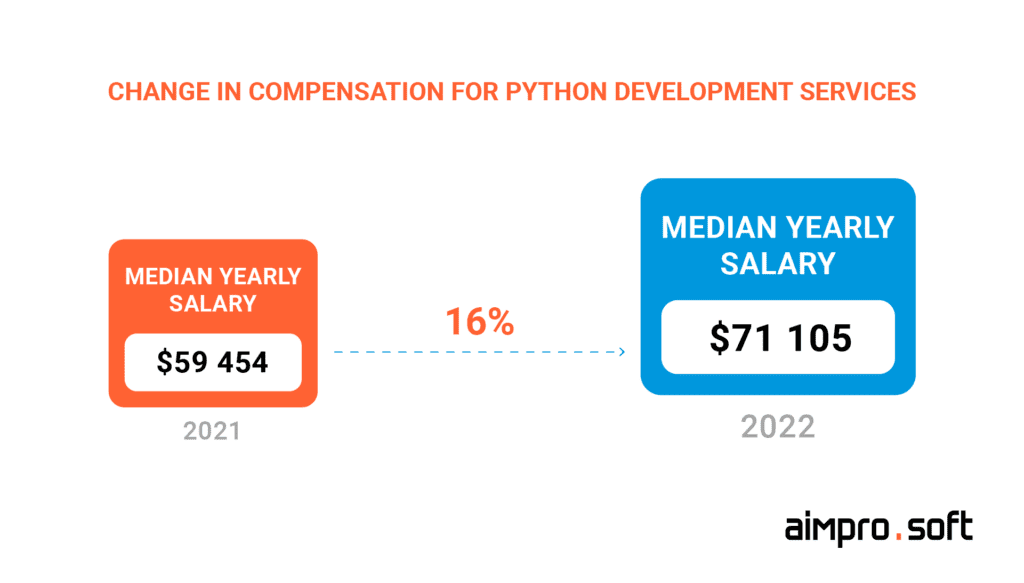
The demand for machine learning solutions, AI-based technologies, big data processing, and the rise of fintech startups for a number of advantages the programming language provides led to salary growth.
Change in compensation between 2021 and 2022. And although Python doesn’t have the highest compensation rate for development services, you can see a 16% increase between 2021 and 2022.
The USA is at the cutting edge of innovation, and of course, this explains why Python developers are more in demand in North America than in any other country in the world. Hence, the highest rates Python development services are clearly justified. According to Talent, the average Python developer salary in the USA is $121 000 per year, reaching the figure of $155 000 with a higher seniority level.
PayScale states that a Python developer in Sweden can expect to get $46 000 per year, with the highest rate up to $66 000. However, the distinguishing feature of a Nordic region is a short talent supply. Tech specialists prefer to gain experience and leave the country for better opportunities in North America.
It is hard to believe, but the United Kingdom is the home of 5% of all developers worldwide, 50% of which have been coding for less than ten years, as Stack Overflow revealed. The employers pay Python developers £65 000 annually as a median salary and can reach £110 000. But the region nevertheless suffers from a tech talent shortage. That’s why if you need to hire outsourced Python developers for the long term, consider regions with more intensive supply.
Germany takes one of the leading places among AI startups counting (53). Despite 900 000 software developers located there, a country with the largest economy in Europe permanently seeks new hires nearshore to meet the demand. On average, a Python developer count on a salary of €63 000 annually and €87 000 maximum based on Glassdoor .
Cost of outsourcing Python development to Ukraine
Salaries are clear, but behind them, there is spending on remuneration. Its amount varies from country to country and can include bonuses, commission payments, overtime pay, or other financial benefits. In the case of an outsourced team, a software development company bears the costs. Let’s see it at the example of IT outsourcing to Ukraine.
You can hire an outsourcing team of dedicated developers of high seniority for $45-50 per hour, which means approximately $90 000 yearly. This sum, as usual, includes all benefits for employees.
Key steps of Python development team outsourcing
It cannot be said that outsourcing Python development is fundamentally different from outsourcing tasks in Java or PHP. However, Python has a number of features that distinguish it from others. The set of steps for hiring the developers of this technology also depends on this. For example, working with big data and designing neural networks. Perhaps this is the most demanded in the era of digitalization.
The following knowledge can help you go the right way with outsourcing:
1. Define expectations and deliverables
It will streamline a discussion with the vendor when you can put on the floor a document with expectations and objectives you want to achieve after project completion. We at Aimprosoft use a Statement of Work as a base to go on the proper development path.
2. Agree on a tech stack
Apart from Python, a development process includes other tools, libraries, and frameworks. To achieve better results, you can impose it on the software vendor. Or if you have some special requirements, your tech lead can take it on themselves.
3. Decide on an outsourcing destination
As you’ve read above, the location of the tech talent pools significantly affects the money you’ll pay for your project. It is worth it to investigate the market to reach budget adherence thoroughly.
4. Select talents for your team
By choosing the vendor, try several candidates of the same seniority to hire the most matched one with appropriate soft skills, communication ability, and mindset fit.
5. Discuss control, quality, and deadlines
Before setting up a dev process, management, quality control, flow, iterations, and methodology have to be defined. It is a keystone to success.
How to set up an efficient Python development workflow process?
Depending on the initial inquiry, the first steps may vary.
Discussing your business goals, we start off with the application of Python. Let’s say your project relates to the IoT domain (smart home or smart energy). It would be reasonable to discuss collaboration with a hardware team and further integration. In the case of neural networks for healthcare projects, the question of HIPAA compliance will arise here. Successful big data processing depends heavily on the libraries that are for all occasions in Python.
Know more about the discovery phase of the software development life cycle.
Outsourcing your development to an external team comes with concept discussion, then follows a discovery stage and a scope estimation to define the staff’s stack.
An estimate is the basis of a proposal under a defined business model (dedicated team, staff augmentation, or full-cycle development). After signing a contract, software development is ready to be started.
Partnering with Aimprosoft, management, and delivery is our area of responsibility. Such services as UI/UX design, DevOps, QA, and User Acceptance Testing can contribute to successful project completion in one place. We also provide maintenance and after-launch support for our clients, which demonstrates the strengthening of business relationships.
Aimprosoft’s practice of outsourcing the Python development team
Hiring a full-fledged Python development team may seem complicated for newbies. Let’s see how Aimprosoft does it.
We negotiate
A thorough discussion of the client’s business objectives lies at the core of any project start. In the case of IoT projects, it is necessary to talk over a hardware part, and 3rd-party integration, ML, and AI projects for healthcare are in the area of heightened security of personal data.
We behave proactively
Often a tech stack or architecture style of the existing project can go against what we are addressed to do. If so, we speak out about the biases and consequences and provide a client with the best fitting solution at the place.
We can start with small
Hesitating is normal, especially for those who have never tried an outsourced Python team. Trying a Proof of concept (POC or PoC) to demonstrate the feasibility of the idea is normal both for startups and companies. Also, we practice staffing 1-2 developers from the start with a potential to scale.
We use resources wisely
Python projects tend to scale quickly. It is tempting for the tech leads to increase team members as well. We practice extending a team wisely on-demand.
Below, find three examples of projects in which companies use Python to prove the effectiveness of our style of work.
| Management platform for hotel and apartment complexes | |
|---|---|
| Challenge | Solution |
|
To enable fast and direct communication between property managers and hotel guests via a website and mobile app so that users can notify about issues as well as obtain updates about hotel news |
We suggested rewriting the poorly-coded Node.js server-side in Python because it was ideal for data processing compared to JS, with fewer libraries.
A designed and implemented event-driven microservices architecture brought additional value to the improved speed and cost of development. A client got a web and mobile presence with complex role-based access control and permission access in parallel delivery. |
| HomeLike: online booking service for long rentals | |
| Challenge | Solution |
|
To create integrations and data science tasks performance with a strong software architect |
Delivered integrations of third-party business real estate integration services with a backend.
We saw an extra value Python can bring: effectiveness evaluation models to assess the performance of integrated advertising services. |
| A complex IoT-powered smart home solution | |
| Challenge | Solution |
|
To build an integrated management system for IoT devices and smart meters |
A single manageable ecosystem of integrated IoT devices with a Python-based architecture and backend.
Machine Learning models for smart utility consumption and device control, and resource consumption analytics. An automated schedule for activating a smart appliance. |
Let’s have a video call to close all questions.
Conclusion
This is a big need in Python development in 2022 and will continue only. Leaders take the lead, and the rest have to follow, competing for the staff. Outsourcing tasks to proven tech providers such as Aimprosoft can help you win the competition and get your project done. Contact us now for a rough estimate and consultation with our tech specialists.
FAQ
When is Python development outsourcing more gainful than outstaffing and freelancers?
Suppose you want to set up and manage the development process by yourself when building software applications and be involved, then you should hire freelancers. If you have worked for a well-worked in-house dev team, you already know how to manage them. Thus outstaffers from a software development agency will be a familiar staff supplement for you on rental conditions.
What country is the best to outsource Python software development?
Where to outsource Python development services depends on your proximity to a talent hub, the technical and domain expertise you require, the speed of staffing specialists for your project, and so on. All these factors influence the cost and quality of deliverables. Also, you may check recognition lists of countries with the most favorable climate for outsourcing. For example, In 2017, the GSA UK Awards named Ukraine the Offshoring Destination of the Year.
How to improve external team efficiency?
If you are ready to outsource, Python developers have to become part of your in-house team, whether it consists of tech specialists or management. High-performance teams are based on maintaining clear communication, team member alignment, healthy accountability, and a keen interest in the project.
How to search for the right Python development company?
Pay attention to the track record in Python development, the complexity of projects, and their experience in your domain. Read client references on Clutch, GoodFirms, TheManifest, DesignRush, and others. Inquire about the company’s development methodology. Ask about their security practices and Quality Assurance. Consider the company’s ability to scale with your project’s needs and provide ongoing support.