
BACKEND DEVELOPMENT SERVICES
FOR SCALABLE
AI-ERA PRODUCTS
Nobody notices the backend until it breaks. Then everyone notices at once: queries that crawl, integrations that snap, an architecture that can't take the next 10x in traffic. That was true before AI, and it's more true now, because the thing standing between a working demo and a shipped AI feature is almost never the model. It's the retrieval layer, the orchestration, the token budget, and what happens when a provider rate-limits you at 4pm on Tuesday.
We're a backend development company that builds both halves. There's the classic work, meaning APIs, architecture, and migrations on Java/Spring and Node.js/NestJS, run in production by teams who do it every day. Then there's the newer layer sitting on top: LLM integration, retrieval infrastructure, agent orchestration, and the governance that keeps all of it predictable and affordable.
Everything we do is custom backend development, and we work as a specialist technology partner rather than a full-stack default. That might mean the backend half of a larger build, an AI capability added to a system you already run, or a standalone engagement to fix, scale, or migrate what you've got.
Backend development services we provide
AI and data services

AI integration and LLM orchestration
Getting a model to answer a question in a notebook takes an afternoon. Getting it to answer reliably, inside your product, at your volume, is backend work.
We build the service layer between your application and the model providers: prompt management and versioning, structured output parsing and validation, streaming, retries, timeouts, and graceful degradation when a provider has a bad day. Multi-provider by default, so a pricing change or an outage doesn't turn into a rewrite.

RAG and vector data infrastructure
Most "the AI is wrong" complaints turn out to be retrieval problems. We build the ingestion and retrieval side properly: parsing and chunking tuned to your content, embedding pipelines with versioning and re-indexing, hybrid search, reranking, and permission-aware retrieval so nobody sees a passage from a document they can't open. Which approach fits varies. Straight vector search suits flat documents, graph RAG earns its complexity when answers depend on relationships between entities, and agentic RAG handles questions one pass can't. We prototype against your evaluation set before committing, on pgvector, Pinecone, Qdrant, OpenSearch, or whatever your team already runs.

Agentic workflows and MCP tool APIs
An agent plans a sequence of steps, calls tools, reads the results, and decides what to do next. That loop is what makes agents useful and what makes them fail in ways a single prompt can't, so we build the controls around it: state and memory across steps, retries and fallbacks, step and budget ceilings, approval gates ahead of anything consequential, and an audit trail. On the tool side we build MCP servers, which describe what each input and output actually means so a model isn't inferring your API from a function name.

Evaluations, guardrails, and AI observability
You can't regression-test an AI feature by clicking around it. We build the eval harness: golden datasets, automated scoring, and CI gates that block a prompt or model change that degrades quality. Alongside that come runtime guardrails, including input sanitization, prompt-injection defenses, PII redaction before data reaches a provider, output validation, and content policy enforcement. Then the observability to see what's happening, with traces per request, latency and cost breakdowns, and quality drift tracked over time.

Data pipelines and AI-ready foundations
AI features expose whatever mess already exists underneath them. We build the ingestion, transformation, and sync pipelines that make your data usable: CDC from operational databases, event streaming, feature stores where they earn their keep, lineage and freshness monitoring, and the access controls that stop a model from becoming an accidental data-exfiltration path.

MLOps, LLMOps, and model serving
For teams running models themselves rather than calling an API, whether that's an open-source model taken off Hugging Face as-is, one you've fine-tuned on your own data, or a smaller distilled version that hits a latency target. We build the serving infrastructure with autoscaling and GPU cost control, model registries and rollout strategies, and A/B infrastructure to compare self-hosted against hosted on your real traffic. Self-hosting wins when data residency rules out a provider, and often on cost at volume.
Core backend services

API development services and integration
Secure, well-documented APIs that connect your systems and widen what your product can do. Still the single most requested piece of work we do, and now pulling double duty as the surface AI agents call. We build them to integrate cleanly rather than bolting them on afterward.

Backend architecture
Monolith, microservices, event-driven, hybrid: we pick based on your scale and team rather than applying a default pattern regardless of fit. Our architects assess constraints, map data flows, weigh trade-offs, and hand over blueprints covering service boundaries, deployment patterns, and governance. These days that blueprint also says where AI workloads live, what they're allowed to touch, and how they fail safely.


Cloud backend development
Architectures built on managed services, autoscaling, and distributed patterns, with the cost kept predictable. We work across AWS, Azure, and Google Cloud: serverless functions, managed databases, container orchestration, event-driven patterns, and GPU and inference capacity planning when AI workloads are in the picture. Monitoring, cost controls, and disaster recovery come with it.

Real-time data processing
Live updates, streaming analytics, instant notifications, and streamed model output, which turns out to have the same underlying requirements. The hard parts are ordering, backpressure, and what happens to a client that drops mid-stream and reconnects. We pick the transport to match: WebSocket or SSE at the edge, a log-based broker like Kafka or a queue like RabbitMQ behind it, and Redis where a shared cache or pub/sub layer earns its place.

Migration and modernization
We upgrade backends built on outdated technology while preserving the business logic that took years to get right. Components move incrementally with production live, old and new run in parallel, automated validation catches behavioral differences before your users do, and there's a rollback path at every step. The reason teams call us has shifted lately. More often it's that the current architecture can't take AI features without a rebuild underneath, rather than anything to do with the age of the code.

Authentication and identity systems
Fragmented identity creates security gaps, user friction, and engineering overhead all at once. We build centralized identity infrastructure: SSO, role-based access control, identity provider federation, and session management. That now extends to non-human identities too, so services and agents get credentials that are scoped and revocable and leave an audit trail, instead of a shared key sitting in an environment variable.

Backend web development services
Data synchronization, secure sessions, and API support built around what your frontend needs, rather than a generic backend retrofitted after the fact. We do the same work as a backend app development company for teams whose product is the app itself, so our mobile app backend services cover offline sync, push infrastructure, and the session handling a mobile client needs that a browser doesn't.

Backend development consulting, code audits, and AI readiness assessment
If you're not sure whether your architecture is the problem, we run a technical and security audit and tell you plainly what needs to change. If you're planning AI features, we run an AI readiness assessment: what your data layer can support, what it would cost at your volume, which use cases are worth building, and which ones are a demo that never survives production.
How we build: AI-assisted delivery
Our backend development best practices
Development approaches
Five principles hold across our work: SOLID, DRY, KISS, YAGNI, and evidence over preference. That last one means architecture decisions backed by load tests and measurements rather than habit.
Architectural patterns
Our engineers research and recommend the pattern that fits, whether that's monolithic, microservices, serverless, or event-driven, and they think through integration up front. That means third-party integration for a monolith, service interaction contracts for microservices, and boundaries around AI components so a slow or unavailable model provider degrades one feature instead of the whole product.
Infrastructure design and selection
We handpick cloud services that fit today's needs and anticipate growth: AWS, Azure, and GCP, plus inference and vector infrastructure where it's relevant. Cost modelling happens at design time rather than after the first surprising invoice. A steady fleet of application servers is easy to forecast. Per-token inference billing and GPU capacity that sits idle between bursts are not, and both need planning on their own terms.
CI/CD and quality gates
Automated testing, code quality checks, static analysis, and dependency and container scanning on every commit. For AI components the pipeline also runs evaluation suites, because a prompt change, a model version bump, or a retrieval config change is a deployment and gets gated like one.
Security and AI governance
The standard hardening is all there: authentication frameworks, encryption at rest and in transit, secrets management, vulnerability assessment, and compliance validation against HIPAA, PCI-DSS, SOC 2, and GDPR. БикЮ For AI systems it extends to OWASP LLM Top 10 coverage, prompt-injection and data-exfiltration defenses, PII redaction before third-party inference, data residency and provider selection under GDPR and the EU AI Act, and audit logging of model inputs, outputs, and agent actions.
How we build: AI-assisted delivery
Languages and frameworks
Java/Spring
Our deepest bench, and where most enterprise-grade work lands. Portable, secure, and it scales
Node.js/NestJS
Event-driven, and a good fit for data-intensive real-time applications and JavaScript-native full-stack teams
.NET / C#
Strong libraries and interoperability, for applications spanning web, mobile, and Windows
Go
Simple, efficient, concurrent by design. Good for high-performance services and large distributed systems
PHP / Ruby
Where an existing codebase or fast delivery calls for them. We have Laravel and Rails work in production today
AI and data layer
Model providers
OpenAI, Anthropic, Google, Azure OpenAI, AWS Bedrock, plus open-weights models self-hosted where residency or unit economics require it
Agent frameworks
LangGraph, LangChain, LlamaIndex, Semantic Kernel, and purpose-built code when a framework adds more indirection than value
Agent menory and state
mem0, Redis, Postgres, plus the retrieval stores below for long-term recall
Tool interop
MCP servers and clients, OpenAPI-described tools, provider function calling
Retrieval and search
pgvector, Pinecone, Qdrant, Weaviate, Elasticsearch, OpenSearch, plus a graph store like Neo4j where graph RAG fits, and cross-encoder rerankers
Workflow orchestration
Airflow, Flyte, Prefect, Temporal, Celery
Data and streaming
Kafka, RabbitMQ, dbt, Databricks, Redis
Serving and ops
Docker, Kubernetes, Terraform, vLLM, Ray, MLflow
Evaluation and observability
LangFuse, Ragas, OpenTelemetry-based tracing
Our backend development process
1. Requirements and technical discovery
We work with your stakeholders to understand business objectives, system constraints, and integration requirements, then translate them into architecture decisions.
2. Feasibility and use-case validation (AI engagements)
Before we commit to a build, we test whether the AI approach works on your data at your quality bar, and model the cost per request at projected volume. Some ideas don't survive this step, which is much cheaper to find out here than three months in.
3. Architecture design and technology selection
Systems designed around your data flows, performance requirements, and existing infrastructure, with technologies chosen for maintainability and cost.
4. Database and retrieval schema design
Normalized schemas, relationships, indexing strategies, and growth planning, extended to chunking, embedding, and index strategy where retrieval is involved.
5. API contract definition
Request and response formats, authentication, and versioning defined before development starts, including tool contracts where agents are the consumers.
6. Development environment and CI/CD setup
Dev, staging, and production environments with automated testing, quality checks, and deployment pipelines, so every commit gets validated.
7. Iterative development
Server-side logic, business rules, and integrations built test-first, peer-reviewed, and deployed incrementally.
8. Evaluation harness (AI engagements)
Golden datasets and automated scoring wired into CI, so quality becomes a number that either passes or blocks the release instead of an opinion formed during a demo.
9. Integration and testing
Backend services integrated with frontend, mobile, and external systems, with API testing under realistic conditions.
10. Performance testing and optimization
Load testing to find bottlenecks, query optimization, caching, and resource tuning, plus token and latency optimization where model calls sit on the critical path.
11. Security hardening and compliance validation
Authentication frameworks, encryption, patching, vulnerability assessment, and compliance validation, including AI-specific threat coverage.
12. Production deployment and monitoring
Blue-green or canary rollouts to keep downtime near zero, with real-time monitoring of performance, error rates, cost, and, for AI features, output quality and drift.
13. Ongoing optimization and maintenance
After launch we monitor, patch, tune resource usage, and refine the architecture against real usage. On AI systems this part never really stops: providers deprecate models, prices move, and your data changes underneath the retrieval layer.
Backend development solutions we build
Enterprise-grade backend systems
High-volume infrastructure that doesn't buckle under load. Motive Integrator's MIX platform processes 50M+ transactions a month with a zero-deployment-failure track record, and we run the SAP Commerce backends for Europe's largest pet supply and care retailer.
CRM & business system integration
Salesforce ecosystems running real commercial operations. For a leading European DIY and home improvement retailer we built partner onboarding and go-live tracking across markets, bidirectional Salesforce sync with a partner-management CRM via MuleSoft and Kafka.
SaaS product architecture
Multi-tenant and subscription-ready from the ground up. A Canadian business intelligence and supply chain analytics platform, built as a commercially viable location-intelligence SaaS product, plus our architecture work evaluating scalable subscription-based AI infrastructure.
E-commerce backend development
Storefronts that stay up. A zero-downtime Magento-to-Shopify Plus migration across US, Canadian, and Australian markets for a global manufacturer of protective cases and temperature-controlled packaging. Multi-brand B2B commerce on SAP Commerce Cloud for a European B2B wholesale and distribution group. Warehouse-integrated order logic for Zenfulfillment.
API design & integration
REST and GraphQL APIs built to connect systems cleanly, including new API layers and bulk data tools for the Genesys global genebank network, and a unified integration hub tying together Google Business Profile, Yext, Foursquare, and Vendasta for pr.business.
Admin & back-office tooling
Internal dashboards built for real operational use: user management, subscription controls, and reporting with role-based permissions, delivered for a professional services firm specializing in tax, audit, and accounting.
Payment infrastructure
Stripe, Braintree, Worldpay, Adyen, and PayPal, integrated and hardened. Real-time Stripe webhooks for Surfact's subscription billing, multi-gateway stability held through a live migration for a B2B wholesale and distribution group, and Braintree-powered transactions for a B2B digital marketing and PR platform.
Content platform engineering
We rebuilt a European public university's entire portal on Liferay, moving years of WordPress content across while adding custom audit logging, document workflows, and access control.
IoT platforms
From concept to firmware. We built a cloud-based IoT platform from scratch for Aroma360's smart aroma diffusers, covering architecture, MQTT broker, API, and mobile app, then took on embedded firmware development when the original hardware vendor couldn't deliver. For a leading UK clean-energy retailer we handled AWS IoT device provisioning, Zigbee smart-meter integration, BLE mobile pairing, and a Docker-based app store for a consumer energy-monitoring device.
Distributed systems
Backends that hold under load. Domain-driven microservices with async processing via Celery and RabbitMQ for a UK clean-energy retailer. For a global clinical trial management SaaS platform: multitenant sharded databases with Redis-based horizontal scaling, and serverless microservices for the lower-traffic workloads, built so one failing service doesn't take the rest down with it.
Blockchain platforms
An early-stage MVP turned into a full blockchain-powered compensation platform, with Web3.js, MetaMask, and WalletConnect integrations rewarding employees in crypto for hitting wellness goals. We also rebuilt the Spring Cloud microservices architecture and cut infrastructure cost 20% through DevOps cleanup.
Data and analytics infrastructure
The layer AI features depend on. Databricks-backed analytics with standardized KPIs across B2B dashboards for a European retail group, plus warehouse and streaming pipelines feeding operational reporting in production.
Featured backend development success stories across industries
AI document processing system
This collaboration started as a proof of concept that had stalled. An enterprise information-management startup wanted it in front of regulated customers, and the requirements list was demanding: thousands of documents processed in a single operation with no performance drop, prompt management flexible enough to work across different industries, extraction accuracy that held run to run, audit visibility for compliance, security tight enough for healthcare, finance, and legal, and enough resilience that one document failing wouldn't take the rest down with it.
We built a domain-driven microservices backend on Python/FastAPI and Celery, Java/Spring Boot, and Node.js, with RabbitMQ handling communication between services and the whole thing running on Docker and Terraform over AWS ECS, with Redis and OpenSearch underneath. We shipped a working PoC first, then grew it into a modular MVP with a prompt management and testing toolkit, an admin dashboard with full audit trails, and error recovery that holds onto a user's query when something fails instead of losing it.
Outcomes for the client:
- Document analysis dropped from hours to seconds
- 20,000 documents in one operation, which was the hard requirement the PoC couldn't meet
- Prompt engineering became a repeatable workflow with a testing toolkit behind it, rather than trial and error in a text field
- The security and compliance groundwork is what opened the door to healthcare, finance, and legal customers
- New clients onboard without anyone rebuilding the platform underneath them
Machine learning object measurement solution
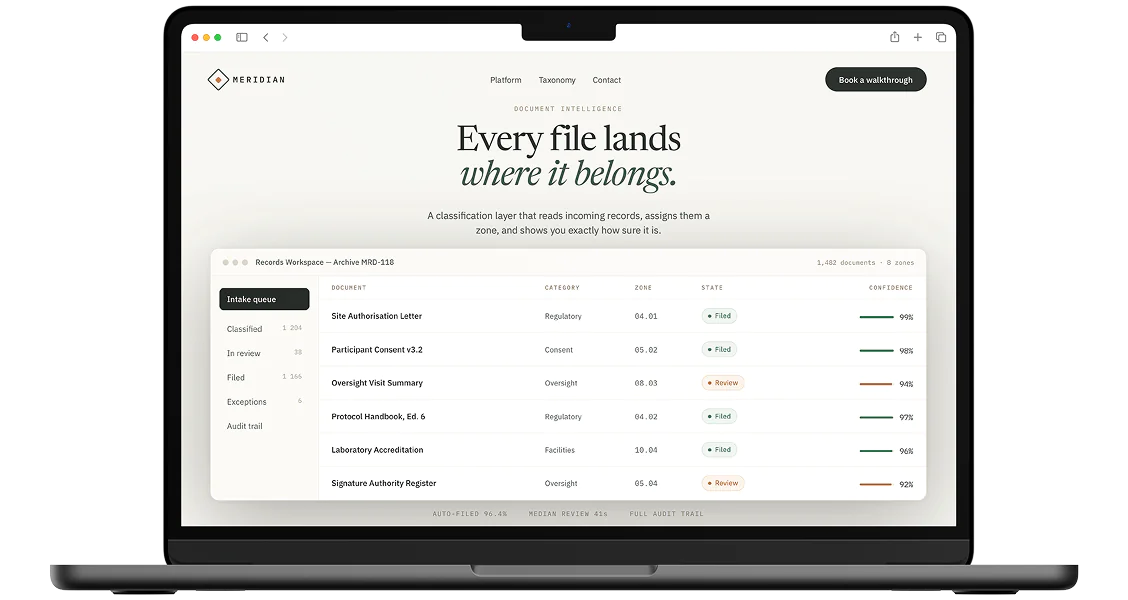
The app could already measure objects when the partner brought us in. It just couldn't measure them accurately enough to trust, which is a harder problem than not measuring them at all, because users had no way of knowing which numbers were wrong. The platform around it needed work too. The web app, the mobile app, and the admin panel each had their own usability problems, and nothing in the measurement flow was automated.
We started with the parts users touched most: image capture, 3D model generation, and the link between the mobile app and the web platform. In-app messaging and video calls were rebuilt so people could talk through a measurement while looking at it, sharing files, notes, and 3D models in the same session rather than emailing them afterward. Then we built the measurement module itself from scratch, using OpenCV and Python 3 to detect objects in an image and measure them without a person drawing the boundaries by hand. AWS S3 handles storage for the models and files. The rest of the stack is Angular, TypeScript, Node.js, Express.js, GraphQL, and MongoDB across AWS and GCP.
The result works for the fast-turnaround cases the partner cares about most, insurance assessments and construction estimates, where someone needs a defensible measurement from a photo taken on site. It holds up for smaller and personal jobs too, which matters more than it sounds: an app that only performs on professional-grade inputs gets uninstalled after the first casual use.

Motive Retail
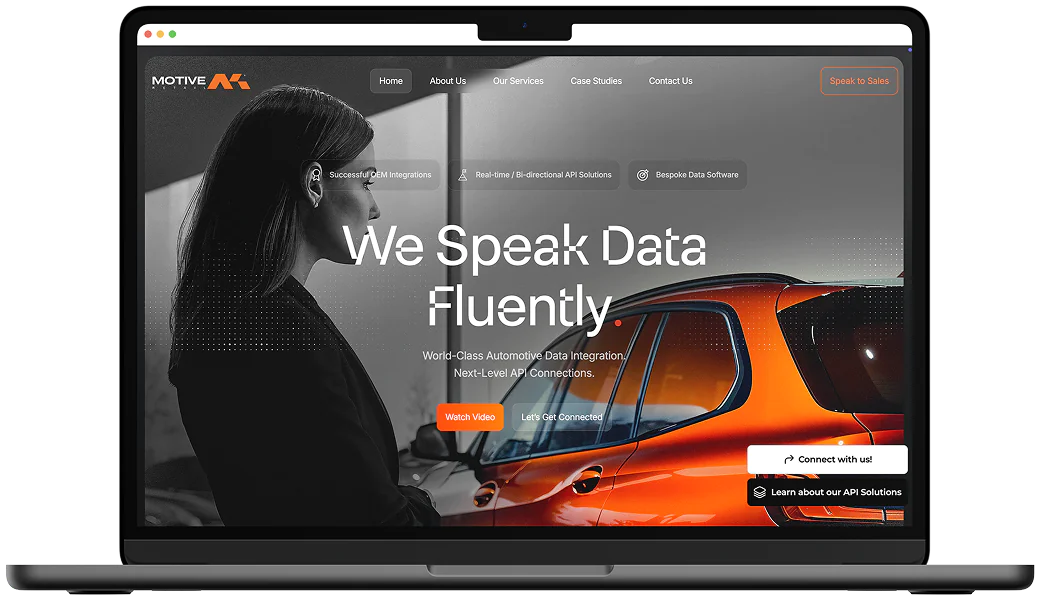
When Motive Retail came to us, they were running a Liferay certification portal alongside a desktop app for managing dealer and manufacturer integrations. Neither was holding up. Liferay was expensive to maintain, slow under real traffic, and built on an architecture nobody could point at and explain. The system also had to serve manufacturers, dealers, subscribers, and internal admins across tools that all depended on each other, while absorbing hundreds of thousands of API requests a day. There was no version of this we could patch our way out of.
So we rewrote it. The old certification system became Certify, with a Java backend and an Angular frontend, and their integration hub grew into MIX. We pulled the heavy pieces into their own services: Activate for subscription approvals, Console for live monitoring, and a separate Validation API so XML validation stopped competing with everything else for resources. Asynchronous processing through AWS SQS, plus multithreading and caching, handled the volume. The stack moved off Liferay and plain JavaScript onto Java, TypeScript, and Angular.
What that got them:
- MIX now handles 50M+ transactions a month
- A 0% deployment failure rate across years of active releases, which is the number our team is quietly proudest of
- Thousands of API certification requests processed weekly through Certify
Genesys, built for the Global Crop Diversity Trust
Genesys is the Crop Trust's global platform for plant genetic resources, and it was originally a PHP application. That was fine until it wasn't. Millions of genebank records worldwide put pressure on it that the original build wasn't designed for, and the frontend and backend were passing far more data back and forth than either of them needed, which showed up directly in response times. Then the scope grew to include a second platform, GGCE, and keeping both consistent became its own ongoing problem.
Our team rewrote the backend from PHP to Java 11 with Spring (Core, MVC, Data, Security), Hibernate, and Elasticsearch, then moved the frontend to React. We also took over development of GGCE, where we added role-based access control and digitized the workflow tools genebanks actually use day to day. Bulk data submissions were another sore point, so we built a Java API layer and an uploader to standardize them. Right now we're leading the migration to API v2, with AI-assisted search.
Today the platform hosts 4.3M+ seed samples, with data coming from more than 450 genebanks across 100+ countries and 165 partner institutions relying on it. We've been working on it for over 12 years, and the Crop Trust's Product Owner has gone on record about how reliable it's been.

Surfact
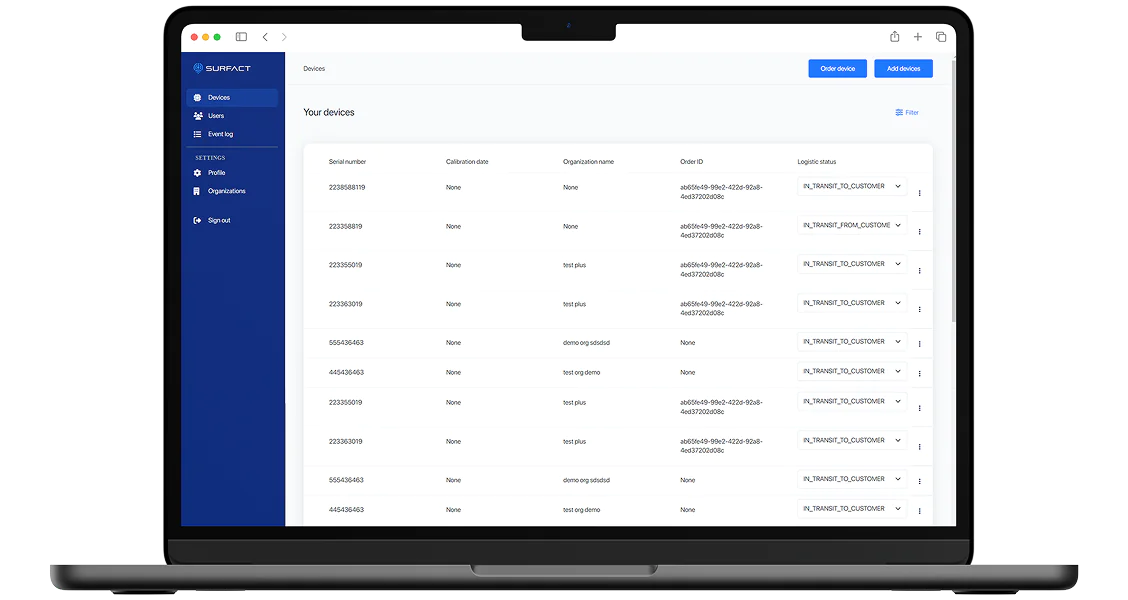
Surfact needed a web portal from scratch to manage IoT device orders, subscriptions, and payments for their waste-reduction platform in the food and pharmaceutical industries. Three third-party services had to work together (Stripe, Sendgrid, Ubidots), security and performance couldn't slip, and the delivery date was fixed. The wrinkle was Stripe: out of the box it only supported card payments, and Surfact needed invoice-based billing too, so we built an alternative flow for it.
We built the platform on Node.js with a Nest.js and TypeORM backend, PostgreSQL underneath, deployed on Microsoft Azure. The architecture is a monolith, chosen deliberately: at this size it's easier to maintain and leaves room to grow. Stripe webhooks handle subscription and device-status updates as they happen. We ran the project in Scrum with two-week sprints and CI/CD pipelines behind it, and hit the deadline.
Surfact's CEO has since talked publicly about our technical expertise and consistent delivery, and the platform is set up for whatever they build next in IoT and logistics.
Client testimonials
Clear process and transparent communication, involvement of the team, and proposed solutions for any case became pillars for seamless collaboration. If you need to rely on a software vendor with a proactive and responsive approach to providing robust solutions, we recommend Aimprosoft.”

How we can collaborate on backend services
We shape every engagement around your workflow, priorities, and delivery operations.
Agile POD squads
An SLA-backed squad built around one specific backend workstream. We agree contractual KPIs (lead time, defect rate, throughput) before Sprint 1, then report against them from day one.
Dedicated teams
Your own backend engineering team, embedded long-term and reporting into your architecture and roadmap decisions. We staff it and retain it, with 90%+ continuity guaranteed, and your side directs the work like it's in-house without the hiring overhead.
Staff augmentation
Individual engineers who slot into your existing team and tools on your timeline. No pod structure, no separate PM layer. Vetted backend and AI engineers working inside your standups, your backlog, and your process, added or removed as your capacity shifts.
AI feature sprint
A fixed-scope engagement that takes one AI use case from validated idea to production: feasibility check, build, eval harness, cost model, and handover. Useful when you need a working answer before you commit to a roadmap.
Ready to build a backend your AI features can stand on?
Book a free discovery call and talk through your architecture, stack, and scope, including what you're planning to build with AI and what it would actually take to run it in production.
If you're building the full product, see our custom web development services and frontend development services. Need help scoping requirements first? Start with our business analysis services. For deployment and scaling support once the backend is built, our cloud managed services cover that step. For model-level work beyond the backend layer, see our AI development services.
FAQ about backend development services
We’ve received your message and will get back to you shortly.