SAP Hybris vs. Shopify vs. Salesforce: What to Choose for Your e-Commerce Project?
Published: – Updated:

Key takeaways
- Check out a comprehensive comparative table that explores the differences among 3 top eCommerce solutions: Shopify, SAP Hybris, and Salesforce.
- Learn more about the main aspects to consider when choosing an eCommerce platform for your project.
- Explore an in-depth overview of each eCommerce giant, namely Salesforce vs. SAP Hybris vs. Shopify, and figure out which one meets your business needs most.
- Edges and drawbacks: what to expect from adopting one of the three popular solutions.
Here is the truth: many in the e-Commerce industry pursue a number of objectives, choosing a new platform for online retailing. It may be customer acquisition through online channels, replacing outdated, poorly featured software, integrating an omnichannel or multichannel strategy, or launching a new business focused on online operations management.
There is a myriad of eCommerce software on the market for small and mid-sized businesses. However, owners of enterprise-level businesses are limited (for better or for worse) to a dozen worthwhile platforms. Despite the size of the eCommerce business, all of them are at a crossroads, facing a dilemma about what path to choose and what best practices to follow. All of them wonder whether to invest in proven large systems or try the concept with a low-cost solution, doubting whether they have enough resources of time, money, and workforce to reach strategic goals.
Customers involved in e-commerce quite often waver between three major platforms of the modern online merchandising industry: Hybris, Salesforce, and Shopify. Each of them is progressive, high-quality, self-sufficient, and profitable. Let’s elaborate more extensively on these three and see how to choose the one that will suit you most.
Table of comparison: Hybris, Shopify, and Salesforce systems
| Feature | Hybris | Shopify | Salesforce |
|---|---|---|---|
| Country of origin | Germany | Canada | USA |
| Business focus | |||
| B2B focus | 10 | 3 (claimed to have) | 3 (claimed to have) |
| B2C focus | yes | yes | yes |
| Client type | large enterprises, medium business | B2C retailers of any level | Third-party integrations (availability, ease) |
| Customers | 21DIAMONDS, Volkswagen, Henkel, Ericsson | MMA Warehouse, Hawkers, 2 Chainz | Adidas, Design Within Reach, YETI |
| Technical-tactical performance | |||
| Programming language | Java | Ruby on Rails | Java |
| Mobile version | yes | yes | yes |
| Mobile app | yes | yes | yes |
| SaaS | yes/no | only | only |
| Web Services /API | yes | yes | yes |
| Ease of deployment | 7 | 9 | 9 |
| Easy settings and customization | 9 | 9 | 7 |
| Technology readiness | 9 | 9 | 9 |
| Frontend speed | Can influence | Hardly can influence | Hardly can influence |
| Backend speed | Can influence | Hardly can influence | Hardly can influence |
| OS Supported | Windows, Linux, Android, iPhone/iPad, Mac, Web-based | Windows, Linux, Android, iPhone/iPad, Mac, Web-based | Windows, Linux, Android, iPhone/iPad, Mac, Web-based |
| Start for developers | 7 | 9 | 3 |
| Start for users | 8 | 8 | 5 |
| Performance | Can influence | Hardly can influence | Hardly can influence |
| Scalability | Can influence | Hardly can influence | Hardly can influence |
| Sustainable growth | 9 | 9 | 8 |
| Features | |||
| Rich out-of-the-box functionality | 8 (9 with market addons) | 5 (9 with market addons) | 7 |
| OMS (order management system) | 8 | 8 | 7 |
| Extensions and addons | yes | yes | yes |
| Sales-driven engine | 8 | 5 (7 with plugins) | 8 |
| Customer segmentation | 8 | 1* (exl. addons) | 9 |
| SEO friendly | 8 | 8 | 8 |
| Flexibility and extendability | 9 | 7 | 6 |
| Free themes | no | yes | yes |
| Library of extensions | yes | yes | yes |
| Easy to start for content managers | 7 | 8 | 5 |
| Third-party compatibility | yes | yes | yes |
| Technical support | Depends on a vendor | Good | Good |
| Import/export of category data | OOTB | OOTB | OOTB |
| CMS for content pages | 9 | 8 | 5 |
| Customizable | 9 | 7 | 7 |
| Effective cache | Exists | Not available | Exists |
| Friendly user interface | 8 | 9 | 5 |
| Changes without dev | 7 | 7 | 6 |
| Third-party integrations (availability, easiness) | 7 | 8 | 7 |
| Image Management | 7 | 8 | 5 |
| Multisite management on a single instance | 7 | 7 | 9 |
| Omnichannel commerce | 10 | 1 | 6 |
| Languages | English, China, Germany, India, Japan, Spain, France, Russia | English | English, French, Spanish, Brazilian Portuguese |
| Support | |||
| Community support | 7 | 9 | 3 |
| Version updates | Manually | Auto | Auto |
| Skilled resources | 7 | 9 | 5 |
| Pricing | |||
| Price scheme | Quote-based | Monthly payment | Quate-based |
| Free community version | no | no | no |
| Enterprise edition subscription | yes | yes | yes |
| Integrations | |||
| Default integrations | Third-party integrations (availability, ease) | MailChimp, QuickBooks, Fulfillrite, itDuzzit | No available info |
| Integration with payment systems | 7 | 9 | 8 |
| Integration with tax systems | 9 | 8 | 8 |
| Integration with shipping systems | 9 | 8 | 8 |
What platform to choose for your e-Commerce project?
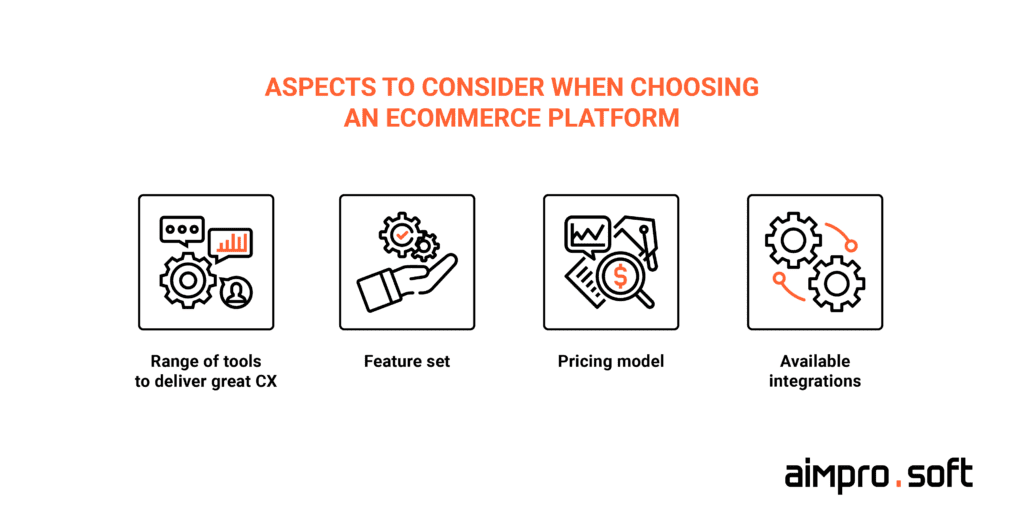
Let’s say your business objectives are related to continued steady growth through opening new units for a definite period and improving customer service quality, or you have already come up in the world of retailing on a local scale and are thrilled to start international market expansion. Before selecting a particular eCommerce platform, businesses, whatever their goals, should run the solutions under consideration through the checkpoints listed below to avoid making the wrong choice.
Focus on customers
If your overreaching goal is to improve a customer experience (CX) and make sure buyers can complete all transactions seamlessly, you should rivet your attention on the tools relating to the advanced search of goods, client service (online support via live chat, socials, call center, emails), customer segmentation, sales channels integration, loyal programs and other functionality that aims to set up an overwhelming control over the CX.
Thus, if you are examining Salesforce Commerce Cloud vs. SAP Hybris vs. Shopify, SAP Hybris (currently known as SAP Commerce Cloud) is well-suited for omnichannel needs for both B2C and B2B clients, while Salesforce Commerce Cloud and, particularly, Shopify are far from ideal omnichannel vendors.
Agree on features
Before embarking on searching for the perfect e-Commerce solution, we recommend that you create a spreadsheet listing all desired features aligned with the business objectives, and define which are affordable and can help you conduct all commerce operations efficiently, and which may result in overhead. It may happen that you do not need the B2B-focused features of Hybris, so there is no sense in buying the subscription. For instance, in a comparison between Shopify and SAP Hybris, Shopify’s simplicity, a basic set of features for a quick start, and a responsive community will stand out.
To provide a comprehensive feature set for e-Commerce stores across the B2C and B2B segments, we would be better served by dedicating a single post to this. Now let’s go over some basic features that are essential for any online store:
- СMS
- Cart increases purchase intent
- Painless checkout process
- User-friendly UI conducive to purchasing
- Promotion and discount program tools
- Analytical and reporting tools
- Popular payment, tax, and shipping integrations
- Scalability for unhampered growth
- Online marketing integrations
- SEO-friendly backend and layout
- Blogging option
Consider pricing
Faltering between pricing schemes, be watchful when budgeting for your e-Commerce platform. Some traps can be related to subscriptions, payment gateway fees, or licenses. Expecting a pure pricing scheme, you can lose sight of peripheral costs. Let’s examine this aspect in terms of comparing SAP Hybris vs. Salesforce Commerce Cloud vs. Shopify.
For example, the enterprise Salesforce solution uses a quote-based calculation that also includes a sales income percentage. Salesforce, formerly Demandware, offers services for customers with a $20 million yearly turnover. A subscription for enterprise-level e-Commerce resources starts from 1% of turnover.
In turn, the SAP Hybris pricing model involves the annual license fee. The payment amount is influenced by many factors, such as the number of users, revenue, out-of-the-box features, and discounts if you already use SAP suite solutions (SAP ERP, CRM, etc.). You can significantly reduce development costs by outsourcing to vendors.
When comparing pricing between SAP Commerce Cloud and Shopify, Shopify’s pricing packages are aimed at B2C retailers at any level, starting at $29 per month, and include a 2-week free trial with the basics to get a new business started. The red-hot is a mid-tier plan at $79 for retailers with sustained business growth. A monthly fee of $299 is available for ambitious entrepreneurs who want to scale up with an advanced package.
Enterprise-grade solutions are available for those ready for scalable, exponential growth with Shopify Plus. Prices are not publicly available. You will have to inquire about your plan by filling out the web form. Shopify also charges payment gateway fees. Moreover, almost every Shopify integration also has a monthly fee.
Examine available integrations
E-commerce platforms are selected for the abundance of available features, but at the same time, many advanced options remain in short supply out of the box. We offer to look at this parameter while considering Salesforce Commerce Cloud vs. Hybris vs. Shopify.
The most demanded Hybris acceleration add-ons, for example, are available in the SAP Hybris Products Extensions market, sorted by four core SAP products. Those being overlooked still can be connected by any experienced SAP Hybris developer. Default Hybris integrations include the full range of SAP solutions: Data Hub for data integration, ECC (ERP), CSV, and ImpEx.
When comparing SAP Commerce Cloud vs. Salesforce Commerce Cloud, Salesforce makes up for its native feature shortfall with an extensive marketplace of integrations. For example, if you seek tax providers to connect to your Demandware-based store, user-friendly navigation will help you to filter by technology and find what you want. Tag tips show you an application area to help you choose. Also, Salesforce displays a list of consulting vendors tagged by region.
Shopify can boast a wide range of default integrations and the availability of extensions via APIs. The platform has in its basket MailChimp, KISSmetrics, QuickBooks, and other tools for selling, running marketing campaigns, analyzing, and managing finance and accounting, all focused on making it as simple as possible. The App Store (a digital marketplace for apps and extensions) significantly enhances the capabilities of the Shopify-based e-Commerce store through integrations organized by category, price, popularity, and collection.
Overview of top e-commerce platforms
Hybris
Hybris fits well with large development organizations and is ideal for a quick start on an enterprise e-Commerce project. You may appreciate a number of solutions by default, such as a responsive storefront, CMS, order management, reporting, and the B2B/B2C Accelerator. SAP Hybris can cover the most popular customer journeys, releasing you from doing customizations to a bare minimum.
Out-of-the-box (OOTB) features (promotions, gifts, payment, tax, shipping solutions) make the development time more efficient. In a pair of SAP Hybris vs. Salesforce, the latter cedes the upper hand in brilliant omnichannel capabilities to the absolute winner.
If you’re looking for solutions to streamline your enterprise activities, you may want to check out our article on content management systems, another robust enterprise-level software option.
If we dive deeper into the pool of solutions that can be empowered with Hybris, we can say that, based on our expertise with this technology, it suits middle- and large-sized retail businesses perfectly, except for small companies. However, let’s look more precisely at those products that can be a perfect match with Hybris:
- Marketplaces. If you decide to build your marketplace not from scratch but instead opt for a SaaS eCommerce platform, Hybris is the right solution to consider. Hybris is designed to run both B2B and B2C online marketplaces, providing even commerce infrastructure services as part of core commerce functionality, responsible for simple integration with third-party services. This e-Commerce software places great importance on search and navigation to drive higher conversion rates and larger order volumes. A payment module, which is considered the heart of the Hybris platform, can coordinate the flow of transactions among a large number of vendors, consumers, and banks. In turn, a Rule Engine module is used for bundle rules, order management, warehouse and sourcing rules, etc. It allows managing business objects under rules. For example, sellers can create and manage dynamic, personalized promotions in the marketplace portal and monitor their results across the customer journey with the Promotion engine. These, and many other capabilities of Hybris, can be used to create robust, user-focused marketplaces. If you are interested in building a prosperous marketplace solution but lack the guidance to get started on your software development journey, our in-depth guide will be of great help.
- B2B eCommerce platforms. When you’re comparing Shopify vs. Hybris, Hybris is the solution to opt for if your goal is to create a feature-rich and reliable B2B platform. It is no coincidence that Hybris is considered one of the leading B2B eCommerce platforms. Due to OOTB accelerators and the availability of hundreds of Hybris extensions in the SAP Marketplace, B2B e-Commerce implementation can move quickly. This solution provides seamless integration with 3rd-party systems and offers a wide range of currencies and languages for global coverage.B2B companies choose Hybris for its efficient order management, ability to configure custom catalogs and pricing, variety of enhanced content management features, numerous integrations with industry-specific software, versatile tools for customer financial management, built-in SEO optimization tools, and many other features that can streamline all sorts of B2B business operations. You may be interested in checking out our article to learn more about the cost of B2B website development on the SAP Hybris platform.
- Scalable eCommerce projects. Hybris is rather flexible and adaptable, and it can be easily adjusted to meet the demands of projects with big ambitions, which may have certain limitations at the moment but want to scale without restrictions in the future. The platform’s architecture is designed to handle high customer traffic and significant order volumes, and it is scalable when you need new components quickly and flexible to meet market needs. It provides companies with available components and business logic that can be easily customized for specific business processes. For instance, we scaled a Hybris website for one European chain of drug stores when the client changed its focus, deciding to expand its market presence and occupy the niche on the international market as well. Our developers easily implemented country branding (localization for multinational trade) because Hybris allows duplicating the business logic of the parent site without having to develop core functionality from scratch. It helped save our client both time and money, since implementing a country-specific store can take 120+ hours, depending on the required changes.
Are you considering Hybris as a technology to empower your eCommerce project?
Contact our specialists, and they will conduct a proper analysis of your requirements and provide consultation.
Edges
- Quick setup of an enterprise-level e-Commerce platform. Only one working day, and you have an environment for online trading. All that’s left is to connect the extra tools.
- A wide variety of OOTB features for B2B2C retailing. The Hybris e-Commerce platform was initially designed as a B2B platform, but it also succeeded for B2C.
- Scalability for unlimited growth. With Hybris, you should stock up on servers and be ready
Drawbacks
- Personalized support is hard to get from SAP Hybris. You should find a reliable software vendor, and the challenge will be solved.
- You may be confused with a lack of resources, but it is only at first glance. Try to discover Eastern Europe, and you will find an oasis of dedicated developers.
- Proper documentation and community support are available only for a proprietary product. We know that users of the Hybris e-Commerce platform lack supporting documentation. That’s why we try to share missing explanatory guides via posts on the Aimprosoft blog.
The adoption of Hybris technology requires technical resources, either in-house or outsourced to a dedicated development team. The cost of skilled Hybris developers is not low or reasonable. To ensure the right project kick-off, it makes sense to have a proven implementation partner. In the realm of SAP Hybris Commerce, businesses consider Salesforce and Shopify as alternatives. Let’s proceed with Salesforce.
Salesforce
While Gartner predicted growth in digital commerce platforms up to $8.5 billion by 2020, Salesforce decided that acquiring Demandware was the way to go. What are the features of a newborn Salesforce Commerce Cloud that users are fond of? Undoubtedly, the list will place a strong focus on sales representatives, regardless of what Tom Ebling says about its customer focus. The platform is pretty good at building business rules for custom marketing and promo campaigns.
Excellent platform performance, paired with omnichannel B2C capabilities, intensifies the Salesforce Commerce Cloud. CRM customer data is available to users alongside B2C commerce to provide a complete interaction history for every customer. Retailers use the platform for prospecting and analytics, and it highlights how information is organized. Sales reps have healthy visibility into their sales pipeline.
Salesforce Commerce Cloud is not good for growing mid-tier companies that are frugal in spending. And the multisite management option, available from a single backend with quick setup for a new website, will encourage business owners to do more. Their AppExchange marketplace reduces the need for development by providing customized solutions tailored to everyone’s tastes. In the Salesforce vs. Hybris comparison, they share the top rung on the ladder concerning availability and ease of integration with third parties.

Edges
- Treatment of leads. It has an outstanding sales-driven engine to track the lifecycle of leads and provides opportunities to automate campaigns.
- Predictivity, reporting, and analytics with Einstein. It has robust AI and machine learning capabilities that leverage consumer behavior to provide granular data.
- Sales income percentage. Demandware was designed initially to serve big players and free them from technical issues.
Drawbacks
- B2B opportunities are a strong point for Salesforce, while SAP Hybris is a natural option.
- Poor community support. In other words, outsourced Demandware developers have to draw on their experience in the main.
- Cost. It is really overpriced for small and mid-tier businesses.
Shopify

When Shopify was created, none of the founders even imagined the platform would one day process up to 4 million inquiries and 10,000 purchases per second. Shopify isn’t at the core of our portfolio, but we have been delivering Shopify development services for small to medium businesses upon request. Based on our experience, customizations and connections are common, while the development of new plugins is ordered very rarely.
The platform is mainstream among mid-level stores. It scores high in product catalogs, CSV import, consolidating all data in one place, and simple content management, where no extra tools are required. In a round-up of Hybris vs. Shopify, Hybris is unquestionably stronger in order management. But at the same time, simplicity is everything. Because of its SaaS model, Shopify is easy for non-tech users and doesn’t require ongoing maintenance.
Shopify is a serious contender with drop shipping, dozens of payment gateways, automatic tax calculation, and carrier shipping rates. Add to all that a classy, consumer-oriented frontend, and you will have a perfect online sales machine, with a faster payback and higher profitability.
Edges
- Plugins. The app market is teeming with add-ons created by enthusiasts to extend Shopify’s core functionality.
- Ease of use. Besides, Shopify is technology-ready, very user-friendly, and intuitive to work with.
- Low-cost business launch. For those who are unpretentious in options, it is a good start with a basic set of features for a reasonable price.
Drawbacks
- Shopify is ill-designed for stores with a wide variety of goods.
- Poor out-of-the-box categories. If you want to diversify your store with advanced filters and categorize products, adding a plugin is the only possible option.
- Businesses are limited by Shopify’s checkout customization and dynamic pricing. Special requirements can be met only with an advanced plan or add-ons.

Hybris vs. Salesforce vs. Shopify: what to choose for your e-Commerce project?
As you can get from this brief overview, every single system has its pros and cons. Whatever platform you are considering for your e-Commerce project, SAP Hybris, Shopify, or Salesforce, you should evaluate what you have at the moment and your ambitions for the future. If you need a simple, modest, yet attractive online store, consider Shopify.
If you want to shift from your outdated platform to a B2B-adapted one, Hybris offers a suite of solutions for scalable merchandising. And finally, if you are a stubborn achiever who has gone beyond all possible borders in your niche, opt for Salesforce; its Demandware e-Commerce system is exactly what you’re looking for.
If you want to have a live talk with experts and figure out how to create a Hybris-based solution, consult on the relevance of SAP Hybris technology for your current project, or maybe you need to solve a particular problem (e.g., create a REST API in SAP Hybris Commerce to marry SAP Commerce with any application), no problem. We are open. The same applies regarding the consultations on Shopify and Salesforce-powered solution development.
Frequently Asked Questions
What is the price for the e-commerce platform?
Seems you’re looking for a one-size-fits-all answer. However, the price depends on your ambition first. Hosting, design, system setup and configuration, custom development, after-launch support and maintenance, staff training, etc., all influence the price. An e-commerce site will also require continuous investments in functional improvements, regardless of the software type you choose (traditional, SaaS, or custom).
What is the difference between on-premise and cloud-based e-commerce systems?
An on-premise e-commerce solution is provided for you on a license basis. You install it on your server and maintain it with your in-house development team or outsource it. With a cloud solution, you pay for the software license and maintain it the same way, but all data is stored in the third-party server of the cloud services provider.
Which platform is better for e-commerce enterprises?
Enterprise is highly load-dependent. They handle a massive traffic flux. The key requirements for the platform are excellent technical, installation, and troubleshooting support. Consider a credible software brand with a wide range of built-in features.
Why are enterprises moving to the cloud?
Moving to the cloud attracts enterprises for many reasons. Companies get stability during traffic overloads, faster online sales processing, maintenance savings, security-compliant hosting for online payments, flexibility, faster time-to-market, server failover, and emergency secondary data centers.
What is the best platform for an e-commerce business?
It depends on your business type. It is an affordable and straightforward SaaS solution for beginners. As businesses scale towards online presence, whether in a B2C or B2B model, companies often choose one of the leading software vendors. Hybris vs. Salesforce vs. Shopify comparison is given in this article.