Legacy Application Modernization Cost: What Budget to Set and Where It Goes
Published: – Updated:


Ask three vendors about legacy application modernization cost, and you may get three answers that differ tenfold. One guide we’ve seen online prices a small app at $5,000, while another puts mid-sized systems at $150,000 and up. They differ because they’re pricing different work.
The problem with published fixed numbers is that vendors sometimes exclude extras, like discovery, data migration rehearsals, or the months when old and new systems run side by side. All those are variables and may change dramatically. In an Oxford study of 1,471 IT projects, one in six ran about 200% over budget.
Waiting has a price too. McKinsey estimates that companies pay an extra 10 to 20 percent on every new project just to work around existing technical debt. Because of those reasons, our guide doesn’t give you fixed numbers. Instead, it helps you understand how the price is composed, so you know what you’re paying for.
Why does legacy modernization have no price list?
Application modernization cost figures range from a few thousand dollars to around $10 million. Such an enormous spread has three causes. First, vendors call very different work “software modernization,” from moving a system to new servers to extensive, enterprise-scale legacy system rebuilds. Second, they include different line items. And third, they often quote one price for what later appears to be a complex multi-year program. That’s why when you see a legacy modernization software cost published, you usually can’t see what it covers.
We know how wide the range can get from our own experience. Modernizing a single module for one client takes a few months. Another client’s platform migration, in turn, keeps a large team busy for several years, and the number climbs well beyond “$150,000 for complex projects.”
That’s why an honest cost guide can’t hand you a number. It can show you how to arrive at one based on the approach you choose. Our plain-English guide to application modernization explains how the approaches differ.
How to estimate your legacy application modernization cost in four steps
Step 1. Estimate the work in hours, module by module
Break the system into modules or business functions and estimate the engineering hours for each. Hours make vendor estimates easier to compare and show where the work is concentrated. The biggest factors affecting the estimate are:
- Size. Count modules, screens, and business rules, and check which parts of the code are still in use. Unused features may not need modernization.
- Integrations. Each connected system needs testing, and some may need a temporary adapter while the old and new systems run together.
- Data. Duplicates and inconsistent formats add cleansing work and more migration rehearsals.
- Documentation. When business rules exist only in code, the team must rediscover them before making changes. Many cost guides underestimate this work.
- Compliance. Standards such as HIPAA, PCI DSS, and SOC 2 add validation, audit trails, and security reviews to releases.
- Uptime. The less downtime the business can tolerate, the more you’ll need to spend on parallel running and rollback plans.
Step 2. Multiply by a blended hourly rate
Multiply the estimated hours by the vendor’s blended hourly rate. For example, at $50 an hour, 2,000 hours would cost $100,000. Rates vary by region and seniority, so compare hours first and rates second. A lower hourly rate can still cost more if it takes twice as many hours.
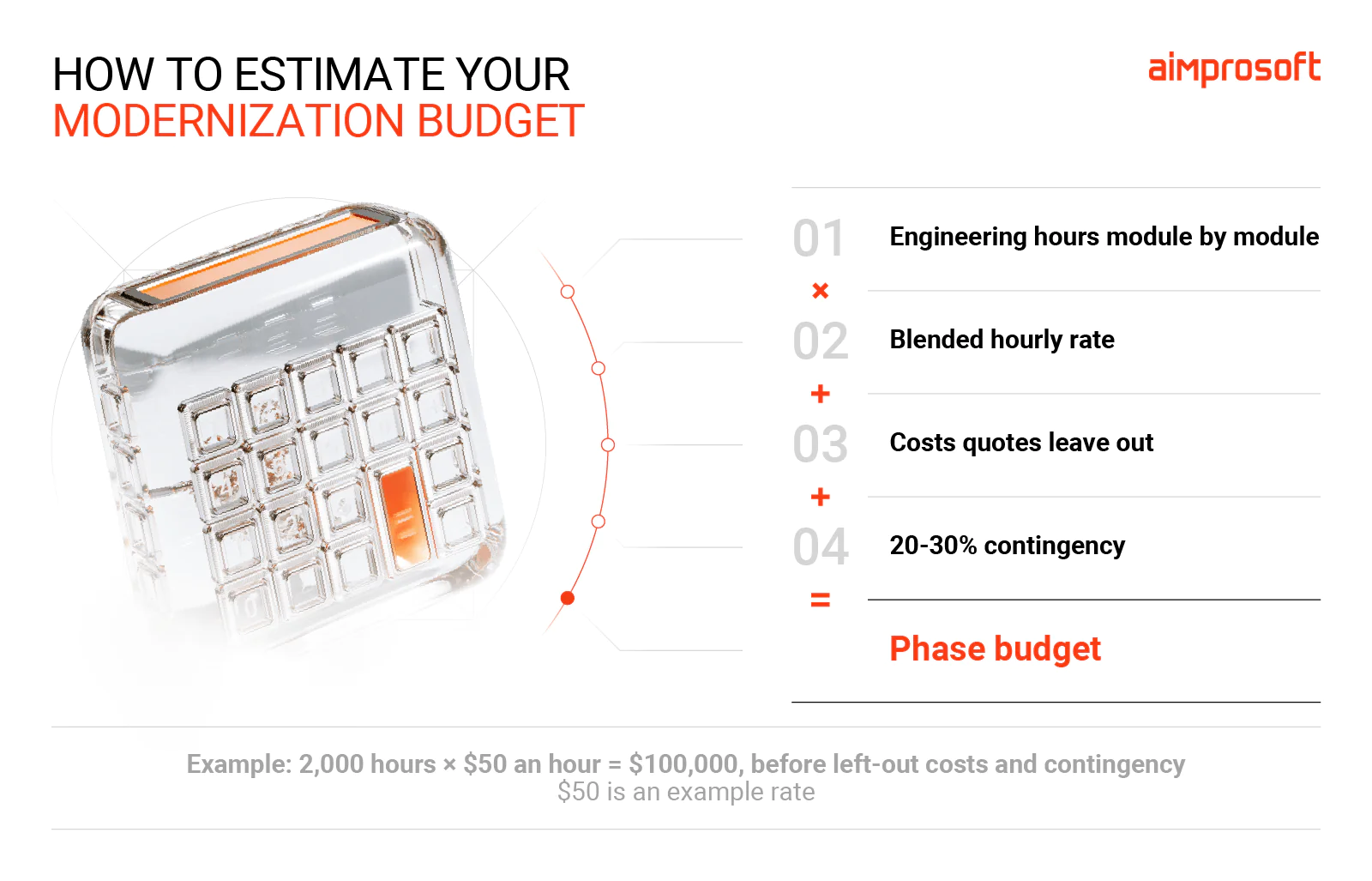
Step 3. Add the costs quotes leave out
Check every quote for the following costs. If a line is missing, ask who is expected to pay for it and when.
- Discovery: code analysis, dependency mapping, and interviews with the people who use the system.
- Behavioral testing: tests that document what the old system does today, so no business rule is lost during the transition.
- Migration rehearsals: dry runs using production-sized data before the actual migration.
- Parallel running: keeping the old and new systems live at the same time, including overlapping licenses and infrastructure.
- Decommissioning: shutting down the legacy system and archiving any data you need to retain.
- Your team’s time: product owners, subject-matter experts, and business testers.
Step 4. Add contingency
The same Oxford study we’ve mentioned before found that projects ran, on average, 27% over budget. Moreover, one in six projects ended up roughly 200% over budget. Almost 70% ran over schedule.
That is why a 20–30% contingency per phase is a sensible starting point. More importantly, we recommend re-estimating each phase based on lessons learned from the previous one. If costs run higher than expected, you can adjust the next phase instead of letting one overrun derail the entire project.
Why fund legacy app modernization in phases?
Boards rarely approve a multi-year modernization budget, and they shouldn’t. Start with one phase: discovery plus the module with the clearest payoff, with its own budget and success metrics. Fund the next phase based on the results.
Your legacy modernization strategy also affects how costs and risks build up. A Big Bang replacement concentrates spending and risk around a single cutover. According to ITIC’s 2024 survey, more than 90% of mid-size and large enterprises reported that an hour of downtime costs them over $300,000. A failed cutover can therefore wipe out the savings of a lower-cost approach. Business continuity needs its own budget.
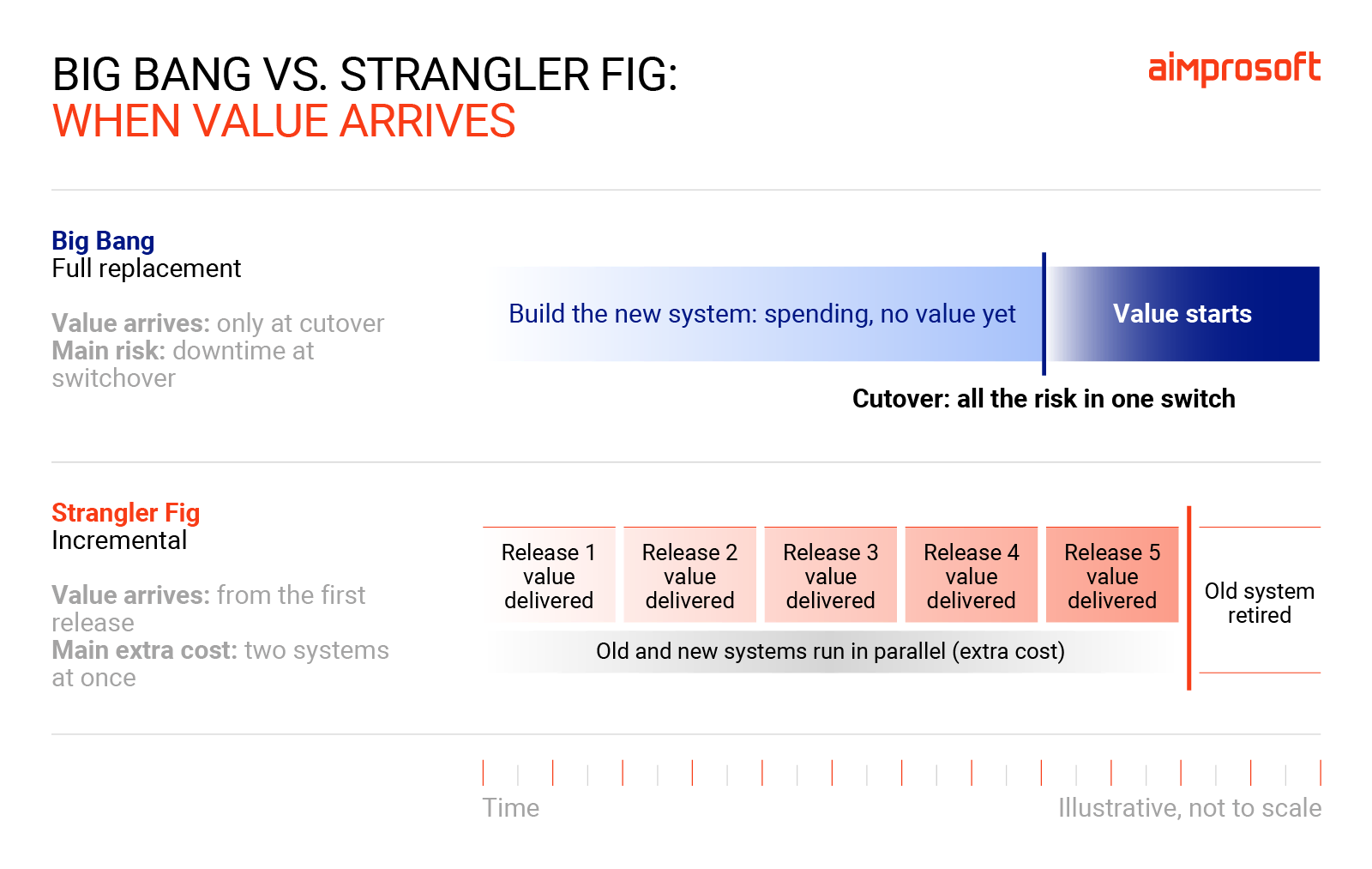
The Strangler Fig approach costs more during the transition because the old and new systems run in parallel. In return, each release is smaller and easier to reverse, while the business starts getting value from the first migrated module. Costs vary by strategy; our Strangler Fig vs. Big Bang comparison explains approaches and systems they fit.
What phased modernization looks like in our projects
Aimprosoft has modernized the Genesys platform for the Global Crop Diversity Trust over more than a decade, moving it from PHP to Java and from JSP to React while keeping it live. Motive Retail moved from Liferay to Spring Boot microservices over 17+ years, with its integration hub now handling more than 50 million transactions a month. In both cases, users could keep working while the technology changed underneath, and the modernization could be funded and measured in smaller steps.
We also have an example of what happens when a migration goes off track. An e-commerce company came to us after a previous vendor’s migration stalled halfway. We audited and refactored the codebase, completed the missing core features, and delivered a production-ready MVP within 12 months. The initial lower-cost approach ultimately led to a second project to recover the work.
See how our legacy application modernization services keep each budget step small and measurable.
Does AI make legacy modernization cheaper?
It’s starting to. Gartner’s 2026 CIO report expects generative AI to reduce application modernization costs by 30% by 2028. It also expects AI-augmented tools to be used in 90% of modernization projects by 2029, up from under 20% in 2026.
AI is most useful for reading and repetitive work: explaining undocumented code, drafting documentation, generating tests that capture current behavior, and speeding up routine code conversion. It is less useful for decisions about architecture, business rules, and risk. As one of our modernization experts puts it: “AI gets a vote, but not a veto.” People still make the final decisions. Aimprosoft’s AI SDLC framework shows how we incorporate AI into delivery.
The relationship between modernization and AI also works in reverse: an outdated platform can make it harder to launch new AI features. If AI is on your roadmap, an AI readiness assessment can identify which parts of the existing system could hold them back.
What does it cost to wait?
When you postpone modernizing legacy systems, you won’t see the consequences as a budget line. But the cost hides in support hours, slow releases, and projects you can’t start, from new integrations to digital transformation plans and implementation of AI features. Here are the main consequences of delayed modernization:
- Maintenance leaves less room for the roadmap. The U.S. federal government planned to spend about $83 billion — 79% of its fiscal 2025 IT budget — on operating and maintaining existing systems. In other words, nearly four out of every five dollars were earmarked to keep existing systems running rather than build new ones.
- Technical debt slows down new projects. CIOs told McKinsey that they spend 10 to 20 percent of their new-product budgets on resolving it.
- Waiting makes modernization harder. McKinsey also found that companies with the worst tech debt were 40% more likely to have incomplete or canceled modernizations.
- Knowledge leaves the company. Often only one or two people understand a critical module, and when they leave, so does all the knowledge.
To put this in front of a board, compare the annual benefit with the cost:
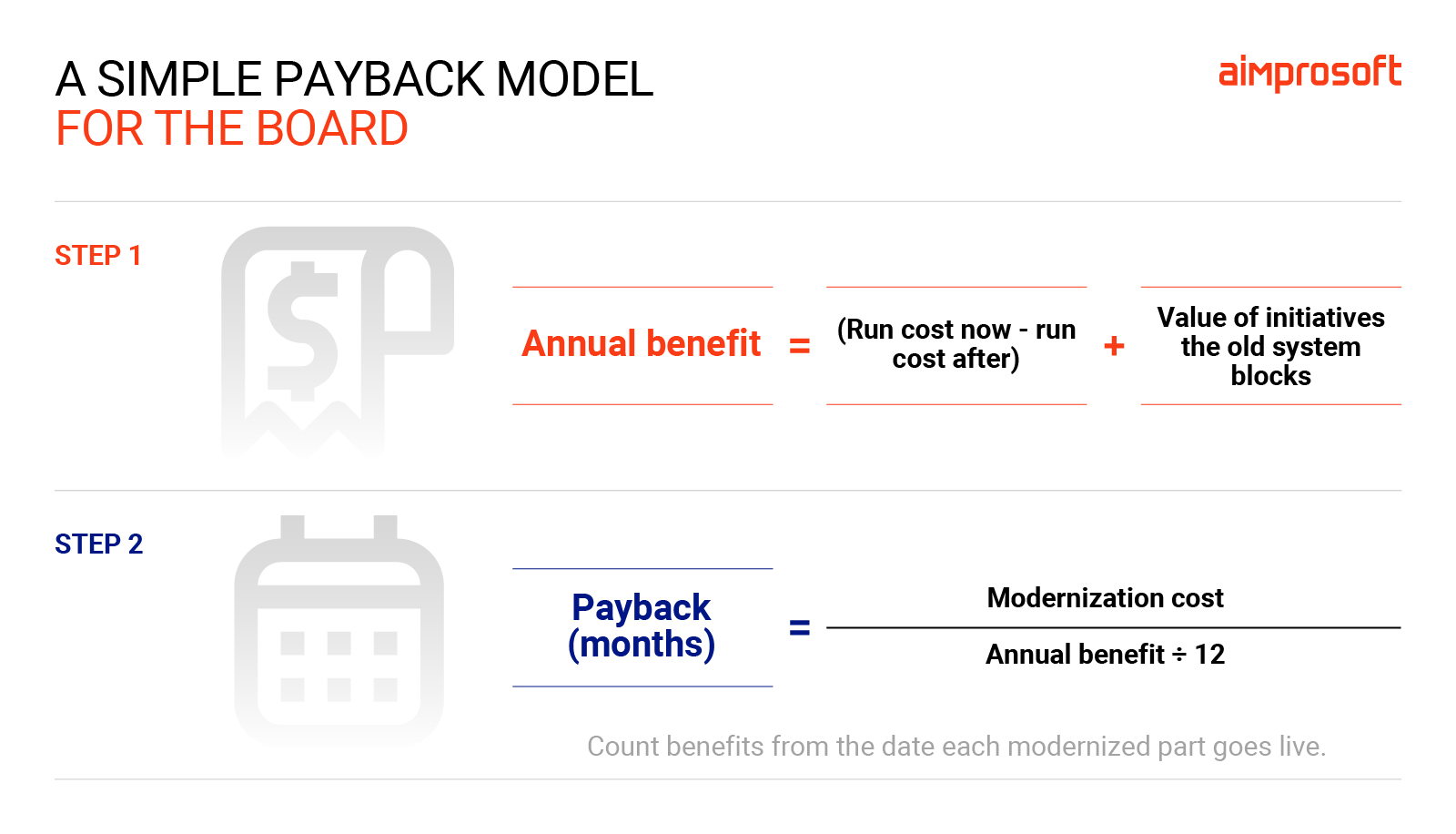
An illustrative example: A system costs $600,000 a year to run. After modernization, that drops to $350,000, and an initiative worth $150,000 a year finally becomes possible. That’s a $400,000 annual benefit. On a $900,000 program, payback takes about 27 months, and five-year ROI is about 122%.
Phased delivery usually shortens the payback because the first modules start paying off before the program ends.
What to look for in a quote for legacy software modernization services?
When analyzing quotes, focus on what they include, what they leave out, and how the cost can change as the work progresses. A fair quote breaks the price down by phase and shows the hours behind each number. Our guide to choosing a legacy software modernization company covers the broader vendor checklist. For cost, watch for these red flags:
- A fixed total for the entire program before the code is assessed. Any gap between the estimate and the actual work can come back as change requests.
- A lump sum with no breakdown of hours. You can’t compare it with other quotes or assess whether the estimate is reasonable.
- No separate line for parallel running or migration rehearsals. These costs need to be accounted for. Otherwise, you may end up paying for them later.
- No contingency, or contingency hidden in the rates. You can’t manage a risk you can’t see.
- A large AI discount with no assessment behind it. AI savings depend on the codebase and should be based on an assessment, not an assumption.
- No retirement date for the legacy system. Without one, you risk paying to run two systems indefinitely.
The goal is not to predict the final modernization cost down to the last dollar. It is to make the assumptions visible, identify the main risks, and account for costs that may otherwise surface later. A phased estimate gives you a clearer number now and a better way to manage costs later.
Get a phased estimate based on your existing code, dependencies, and undocumented business rules.
FAQ
How much does legacy application modernization typically cost?
There’s no fixed range, because legacy application modernization cost follows engineering hours. At an example rate of $50 an hour, 2,000 hours come to $100,000, and multi-year platform migrations cost several times more. A discovery phase gives you a reliable estimate for your system.
What’s included in a legacy modernization project cost?
A full quote for legacy application modernization services covers discovery, architecture, building and refactoring, testing, data migration, the parallel run, decommissioning, and knowledge transfer. Firms offering application modernization consulting services often price discovery separately. Your own team’s time and overlapping licenses might sit outside the vendor quote.
How long does legacy software modernization take?
A single module usually takes a few months, and several connected systems take several months to a year. A core platform often becomes a multi-year program. Phase-by-phase pricing for legacy software modernization services makes these timelines easier to fund.
Can we modernize in phases to spread out cost?
Yes, an incremental legacy modernization strategy, such as the Strangler Fig pattern, replaces the system one part at a time, and each phase gets its own budget. Our comparison of legacy application modernization strategies explains how it works.
What is the ROI of legacy application modernization?
Add the drop in run costs to the value of initiatives the old system blocks, then compare that with the modernization cost. Reducing technical debt also frees engineering time for new work, which is often the biggest gain in legacy app modernization.
How do we build a business case for modernization investment?
Show what keeping the system costs, then ask for phase one only, with success metrics and a contingency. Boards usually respond better to business continuity and digital transformation than to technical arguments.
Does the modernization strategy we choose affect total cost?
Yes. Rehosting costs the least but keeps the system’s old problems. A Big Bang rewrite concentrates cost and risk at one cutover. Incremental legacy system modernization strategies add parallel-running costs in exchange for smaller, reversible releases.