
VIBE CODE CLEANUP: TURN YOUR AI-BUILT APP INTO PRODUCTION-READY SOFTWARE
You built something real with Lovable, Replit, Bolt, v0, Cursor, or Claude. Now it has to survive real users, real payments, and a real security review. Our team audits the code, fixes what's risky, keeps what already works, and ships it on infrastructure you can trust.
Your AI-built app works in the demo. Production is a different story.
Security gaps
API keys sitting in client-side code, open database tables, unauthenticated webhooks. Storage buckets any logged-in user can read. Scheduled jobs anyone can trigger. A changed ID in the URL that opens someone else’s document.
Performance that stops at the first real spike
Queries that are fine at 50 rows crawl at 50,000. No indexing, no pagination, no caching.
Happy-path-only logic
The code assumes every API call succeeds. Real users hit timeouts, null values, and 500 errors the app has no answer for.
Code nobody can maintain
Different prompts produced conflicting patterns and duplicated logic. Change one screen, and three others break.
No tests
Your users find the bugs. Every release is ship-and-hope.
Platform lock-in
Hosting, data, and pricing are tied to one builder, and leaving takes a plan you don't have yet.
What is vibe code cleanup?
Vibe code cleanup is the process of auditing, securing, and refactoring an app built with AI coding tools so it can run safely in production. A vibe code cleanup specialist reviews the AI-generated code, fixes security and architecture flaws, adds tests and deployment pipelines, and keeps the business logic that already works. In most cases you keep the app you have. What changes is everything holding it up.
Our vibe coding cleanup services

AI code audit
Not sure what's broken, or where to start? The audit gives you a picture of your app's health before you commit to any fixes. We pair manual review by senior engineers with our own AI toolkit. AI finds patterns across a codebase fast, and our engineers decide which of those patterns matter for your business.
We look at:
- Security holes and anything exposed to the open internet
- Performance bottlenecks, and the traffic level where your current setup stops coping
- Logic that looks right and breaks on the second try: empty states, failed API calls, half-finished payments
- Dependencies and platform lock-in
The audit tells you exactly what your app needs. You get a severity-rated report (critical, high, medium, low) that explains what each risk means in business terms, and a separate estimate for the fixes in hours, so you can decide what to do and when. The audit is where the work starts, not where it ends: an app reaches production only after the fixes, the tests, and the first release are done.

Security hardening for AI-generated code
Security is the gap most founders underestimate, and it's the first thing an enterprise buyer asks about. Our team closes it before it costs you a breach or a deal.
That usually starts with getting API keys out of client-side code and into proper secrets management, then rebuilding authentication, authorization, and session handling so every endpoint checks who's calling it. We turn on and verify database access rules, including Supabase row-level security, which AI builders often leave wide open. We validate input, work through the OWASP Top 10, verify webhooks, and protect payment flows against replays and duplicate charges. If GDPR, HIPAA, or SOC 2 are going to come up in a sales conversation, we add the audit logging those conversations need.
One pattern worth naming: the engineering risk usually shows up as a stalled deal long before it shows up as a breach.

Refactoring and paying down technical debt
Your app works. It just isn't steady enough to build on yet.
We restructure AI-generated code without throwing away what's good. Duplicated logic gets merged, business rules get separated from the UI, and patterns get standardized across screens that different prompts built in different styles. Then we document what the code does and why, so the next developer to open it doesn't have to reverse-engineer your product. Your team ends up owning a codebase it can actually change.

DevOps, hosting, and migration off the builder
We set up CI/CD with separate staging and production environments, so nothing reaches your users without a review first. When you've outgrown the platform, we export your code to GitHub and move it to AWS, GCP, Azure, Vercel, or Railway. After that, the code, the data, and the hosting are yours.

Testing and QA
Tests aren’t an add-on here. We don’t sign off a production release without tests on the flows that cost you money when they break: sign-up, login, payments. We add unit, integration, and end-to-end tests for those flows and anything else your revenue depends on, such as checkout. Load tests happen before your traffic arrives, not after it.

Performance and scalability
We optimize queries and indexing, add caching and pagination, move heavy work into background jobs, and size infrastructure for what you actually use. The target is an app that handles 10,000 users as calmly as it handled 10.

Monitoring and ongoing support
Logging, alerting, and uptime monitoring catch problems before your users report them. Once you’re live, support runs on a fixed monthly capacity, with requests through a shared backlog and a weekly sync, so you always know what’s being worked on. When the product needs to grow, the same engineers can carry on as a dedicated team.

Not sure which of these your app needs?
That's what the audit answers. You get a severity-rated report and a separate estimate for the fixes, so you can decide what to do and when. The audit itself is fixed-price, agreed before anyone starts.
No commitment, and no pitch deck. Bring the app and your deadline.
From vibe-coded prototype to production: our process
Keep, refactor, or rebuild? How we decide
The fear we hear most often is that we'll tell you to start over. Usually we won't. We make the call per component, based on what the audit finds and how you plan to work after launch.
Keep and harden
The logic works and you want to keep building in your AI tool. We fix risks in place and put guardrails around them.
Refactor
The app works but is fragile or hard to extend. We restructure the code while keeping your features and data.
Migrate
You've outgrown the platform's hosting, pricing, or limits. We move the app onto a cloud stack you own.
Rebuild a component
One part is too tangled or insecure to save. Usually payments, auth, or the data layer. We rebuild that part only.
One of our clients built a document signing platform in Lovable and planned to keep maintaining it there himself. A full migration would have handed him code he couldn't manage on his own, so we kept the app in Lovable, fixed the critical issues through its interface, and added staging and production environments with a GitHub-based CI/CD flow.
We can only tell you which column your app falls into after the audit. A 30-minute call is enough to tell you where that audit should start.
We take apps from any AI builder to production

Lovable
Good for MVPs. The apps we see ship with weak Supabase access rules and keys sitting in the frontend. We harden the security, set up real environments, and handle the export to GitHub and self-hosting when you're ready to move.
Replit
Fast for prototyping. Too often, Replit apps that reach us are still on prototype-grade hosting and configuration, which is where they stall under sustained traffic. We move you to cloud hosting with proper environment configuration, CI/CD, and room to grow.

Cursor, Claude Code, and Windsurf
Developer-driven AI coding produces bigger codebases with patterns that shift from prompt to prompt. We standardize them and add the tests and architecture that keep them maintainable, with a close look at what these tools leak most often: secrets in the repo and unsafe dependencies.

v0 by Vercel
v0 builds good UI. What's usually missing is everything behind it: server-side logic, auth, API integrations, a real data layer. We build the Next.js application around the frontend you already have.

Base44
Base44 is a partial case: the frontend exports, but the backend and database don't, so moving off means rebuilding the backend and migrating your data. We scope that explicitly before you commit.

Bolt.new
Bolt gets a full-stack app running quickly. We give it a backend structure that holds up, plus tests, GitHub export, and a deployment process.
Built on something not listed here? We've probably seen it.
AI pilot to production: getting AI features and PoCs live
It isn't only vibe-coded apps that stall before launch. Plenty of AI projects get stuck between a working pilot and a real rollout, in what the industry calls pilot purgatory.
The demo runs on clean sample data. Production brings messy inputs, model output you can't fully predict, token costs that climb with usage, and compliance questions nobody asked during the pilot. Taking an AI PoC to production means adding the parts the pilot skipped:
- Test sets and quality metrics, so you find out that output quality dropped before your users tell you
- Guardrails: input and output filtering, fallbacks, and human review wherever the stakes justify it
- Secure data pipelines, access control, and a private LLM where the data can't leave your environment
- Prompt and model versioning, tracing, and alerts
We run the same audit-to-launch process for AI projects moving from pilot to production, with our AI development and AI integration teams behind it. If you're not sure the organization is ready for any of this yet, start with an AI readiness assessment.
Bring your security and compliance people to the call. They usually have the questions that decide this.
Production-readiness checklist for vibe-coded apps
Run through this before you launch. If you can't tick most of it, you're not ready.
- No secrets or API keys in client-side code or the repository
- Authentication and role-based access tested on every endpoint, including the ones nothing links to
- Database access rules such as row-level security enabled and verified
- All user input validated and sanitized
- Webhooks and payment flows verified, idempotent, and protected from replays
- Errors, timeouts, and empty states handled in the UI
- Automated tests covering sign-up, login, payments, and anything else that costs you money when it breaks
- Separate staging and production environments with a CI/CD pipeline
- Backups, plus a restore you've run
- Logging, monitoring, and alerts
- Rate limiting in place, and a load test at the traffic you expect
- Documentation good enough for a new developer to take over
Engagement options
Option
Best for
What you get
Production-readiness audit (the first step)
Knowing where you stand before you spend more
Severity-rated report and a separate fix estimate, item by item. Fixed scope and price. Leads into cleanup or MVP to production.
Cleanup and hardening
Apps that work but aren't safe or steady enough
Security fixes, refactoring, tests on critical flows, and CI/CD in sprints
MVP to production
Founders ready to launch or raise
Full takeover: audit, fixes, tests, migration, launch, handoff
Ongoing support
Live apps that need steady upkeep
Fixed monthly capacity, a shared backlog, and a weekly sync
Dedicated team
Products that need to keep growing
Senior engineers who carry on developing after cleanup
Every option that ends in a production release includes tests on sign-up, login, and payments.
Who this is for
Most of the people who come to us fall into one of four groups:
- Founders who shipped an MVP on a vibe coding platform and are now facing real users, an investor's technical diligence, or a first enterprise contract
- Non-technical product owners who need engineers to take the wheel without starting the product over
- Product and dev teams that inherited AI-assisted code and find it harder to change every month
- Enterprise innovation teams with internal AI pilots that must clear security and compliance before anyone can roll them out.
If a developer, an investor, or your own gut has told you it's not really production-ready, that's the signal.
Why teams bring this work to our company
The instinct is to fix AI-generated problems with more prompting. It usually adds to them. AI writes code that looks correct, but it won't tell you why an architecture falls over at 10 times the traffic, or which parts of it are worth keeping. That judgment is the job.
- Secure data pipelines, access control, and a private LLM where the data can't leave your environment
- Your code gets reviewed by AI-savvy senior backend, frontend, DevOps, and QA engineers.
- We're an OpenAI and Anthropic partner, so the models your app depends on aren't a black box to us.
- Cyber Essentials certified, with compliance work behind us in fintech, healthcare, and legal tech.
- As an AWS Select Tier Services Partner, our migrations land on infrastructure that's configured properly the first time.
- If you want to stay in your AI builder, we harden it there. If you want out, we move you cleanly.
Case study: securing an AI-built document signing platform
Client: Scandinavian legal tech founder
Built with: Lovable, Supabase, Stripe, Google Gemini, n8n
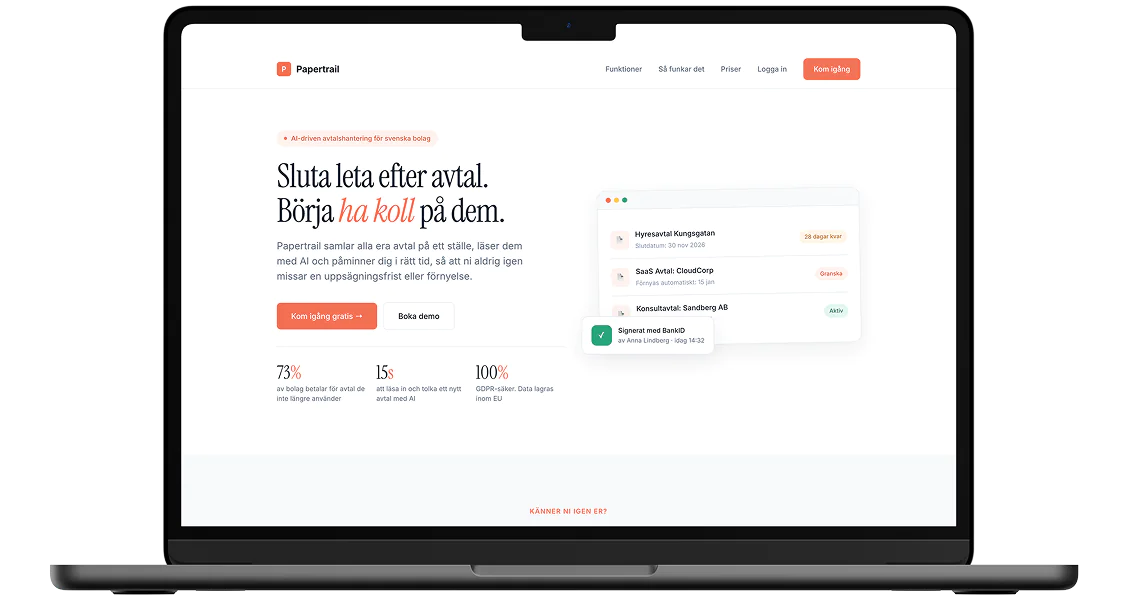
A founder built a multi-party signing platform in Lovable, with user roles, billing, and document analysis, without writing code. He came to us for an audit before launch. We found exposed API keys, unauthenticated webhooks, and a flaw in the Stripe integration that could have allowed duplicate or fraudulent payments.
We fixed the critical issues inside Lovable, added separate staging and production environments, and set up a GitHub-based CI/CD pipeline with Stripe webhook hardening and replay protection.
Results:
- Critical risks closed across auth, data access, and payments, with the platform cleared for launch
- A staging and production pipeline that lowers the risk of every release after this one
- A full vulnerability report with business impact and a remediation path for each item
Ready to take your AI-built app to production?
Tell us what you built and where it hurts. Book a 30-minute call. We’ll take a first look at your app and tell you where the audit should start.
No commitment, and no vague timelines. You talk to engineers who do this work every week.
FAQ about vibe code cleanup
We’ve received your message and will get back to you shortly.