Private LLM with RAG: How to Run Enterprise AI Without Sending Data Out
Published: – Updated:


AI gives better answers when given the right context. But such context often means emails, documents, lines of code, or Excel files. All of them contain information you can’t simply redact; otherwise, you’ll get a wrong or average reply. And sharing sensitive data with third-party AI comes with its own risks.
Of course, in some cases, a corporate/enterprise tier is all it takes to resolve the issue. But what if you can’t share data with an external provider? Due to regulations or client agreements.
Instead of sending company data to public APIs, businesses can run the model in a private environment where they control how and where their data is processed. In other words, a private LLM.
Still, being private doesn’t automatically give the model access to your company’s knowledge. That is why Retrieval-Augmented Generation (RAG) is needed. It acts as a bridge, allowing instantly access your internal documentation and base its replies on it.
How does private LLM deployment with RAG look? Why do enterprises need it? And what does it take to build? We’ll answer them all in today’s article.
What is a private LLM, and why do enterprises use one?
A private LLM is a large language model hosted on the company’s infrastructure. It’s important to understand that it doesn’t mean the business developed a model. A company can also host open-weight options such as Llama, Mistral, or Qwen, and it would still meet the definition. Because the key to privacy comes down to data control.
With a private setup, data never leaves the environment your organization controls. This means that businesses can deploy a self-hosted LLM in several ways depending on their needs.
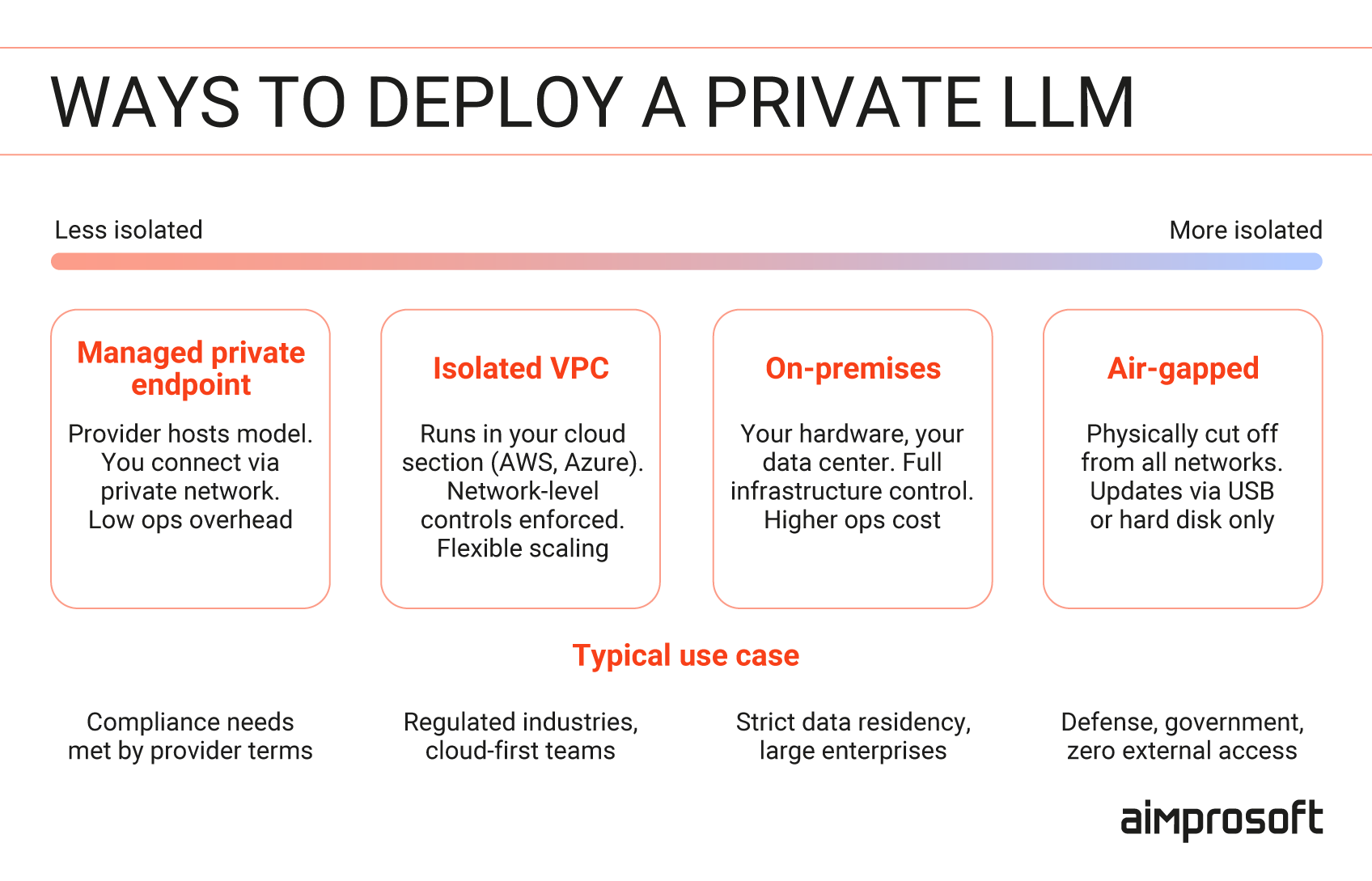
- On-premises. The organization owns and manages the physical servers on which the model runs.
- Private cloud or isolated virtual private cloud (VPC). The model runs in an isolated section of a public cloud service, such as AWS or Azure. Despite hosting on public cloud, you can access it with network-level controls.
- Managed private endpoint. A cloud provider hosts and manages the model, but your organization connects to it via a private network instead of the internet.
- Air-gapped deployment. The model runs in an environment physically disconnected from external networks (e.g., the internet). To provide an update or upload information, the company must use a USB drive or a hard disk.
Reasons behind why enterprises choose private hosting differ, but key ones include:
- Regulatory and compliance requirements. Private deployment can make it easier to meet certain security, data governance, auditability, and data residency requirements in regulated environments, such as finance or healthcare. Including some systems subject to the EU AI Act.
- Data residency. Some companies and jurisdictions may require data to remain within a particular country or region. While public AI providers can offer regional hosting, running the model in a controlled environment gives companies more say over where sensitive data is stored and processed.
- Contractual obligations. Not all clients wish to share their data with third-party services. With private deployment, companies can use AI without sending that data outside their own environment.
- Restricted-network requirements. Defense contractors and other security-sensitive businesses often operate in environments with no access to the public internet. A private LLM lets them run AI workloads within those constraints.
If you want to learn more about the benefits of private LLM deployment and how it differs from public ones, read our article
Why add RAG to a private LLM?
A large language model uses its training data to provide answers. It can answer some basic questions, like what you do, based on publicly available information. But it can’t tell you about the last contract you signed, the number of sales you made, or any updates to HR policy, unless it’s part of the training data.
To turn an enterprise LLM into a true knowledge assistant that uses proprietary data for answers, you need RAG.
RAG, or Retrieval-Augmented Generation, is a layer that sits on top of a language model. From a user’s perspective, everything may look like just any other context window. Yet every time they ask a question, RAG searches the knowledge base for relevant content and then provides the model with the necessary context to generate a response. As a result, the user gets an answer grounded in the company’s documents rather than training data.
Enterprises can use RAG to build internal knowledge assistants, search tools, customer support systems, and specialized solutions for legal, HR, IT, sales, and other document-heavy workflows.
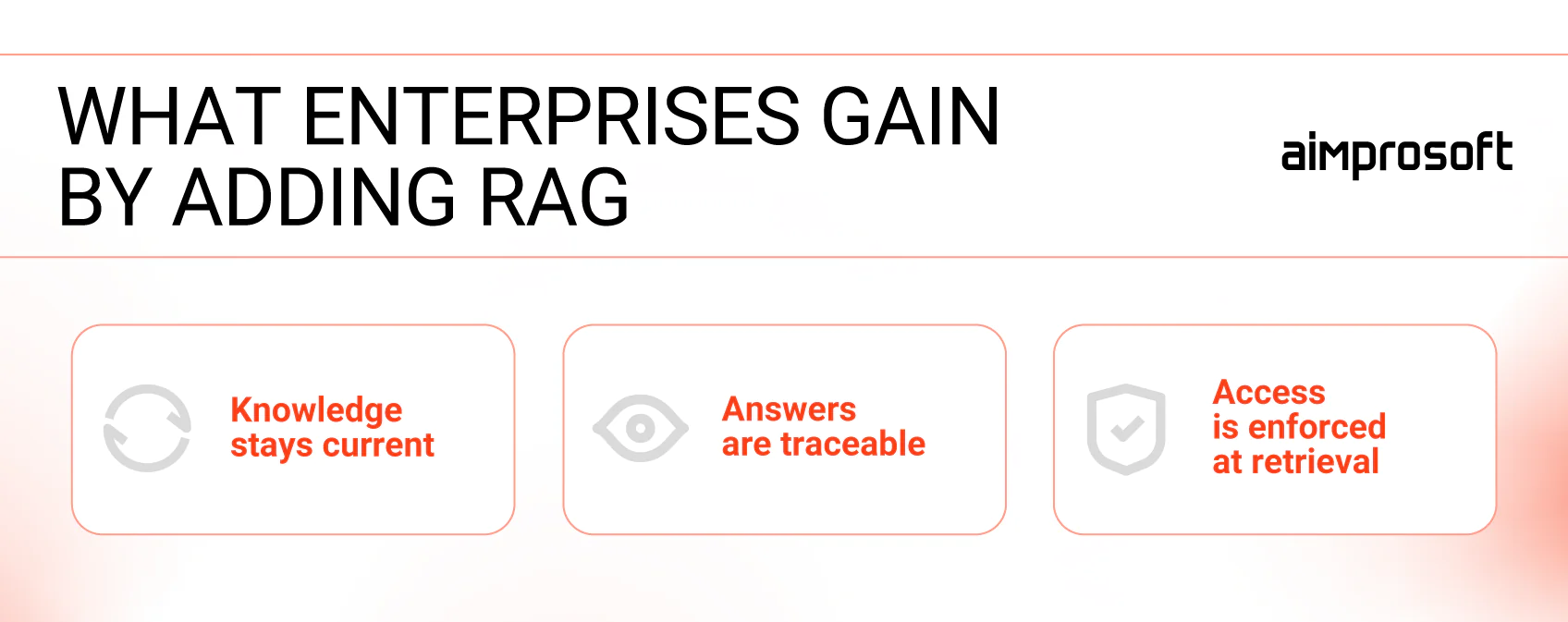
Enterprise knowledge isn’t static. Policies change, new contracts are getting signed, and that information needs to be up to date for proper decision-making. If you bake that knowledge into your private LLM through fine-tuning, you need to start a training cycle every time you update that data. This process can take time and resources you can spend elsewhere.
With RAG, all it takes is to update the source document and re-index it, and the system will provide current information for the query.
Because every response draws from specific documents, it becomes easier to trace and audit. For example, if your legal team asks about a contract clause, they see which documents the system used to answer along with the response. In regulated environments, this traceability is essential, and RAG supports it by design.
Access control is another important benefit of enterprise RAG. When building the system, your team or an external software company implements permission-aware retrieval. It uses users’ identities and existing source-system permissions to ensure the layer doesn’t return everything it finds. These precautions keep documents or chunks in check before they are passed to the model, so employees see only what they’re allowed to see.
It means that if only the HR team has access to the contractor contact database located on SharePoint, only they will see it in the response, even if someone else tries the same query.
How RAG works in a private LLM setup
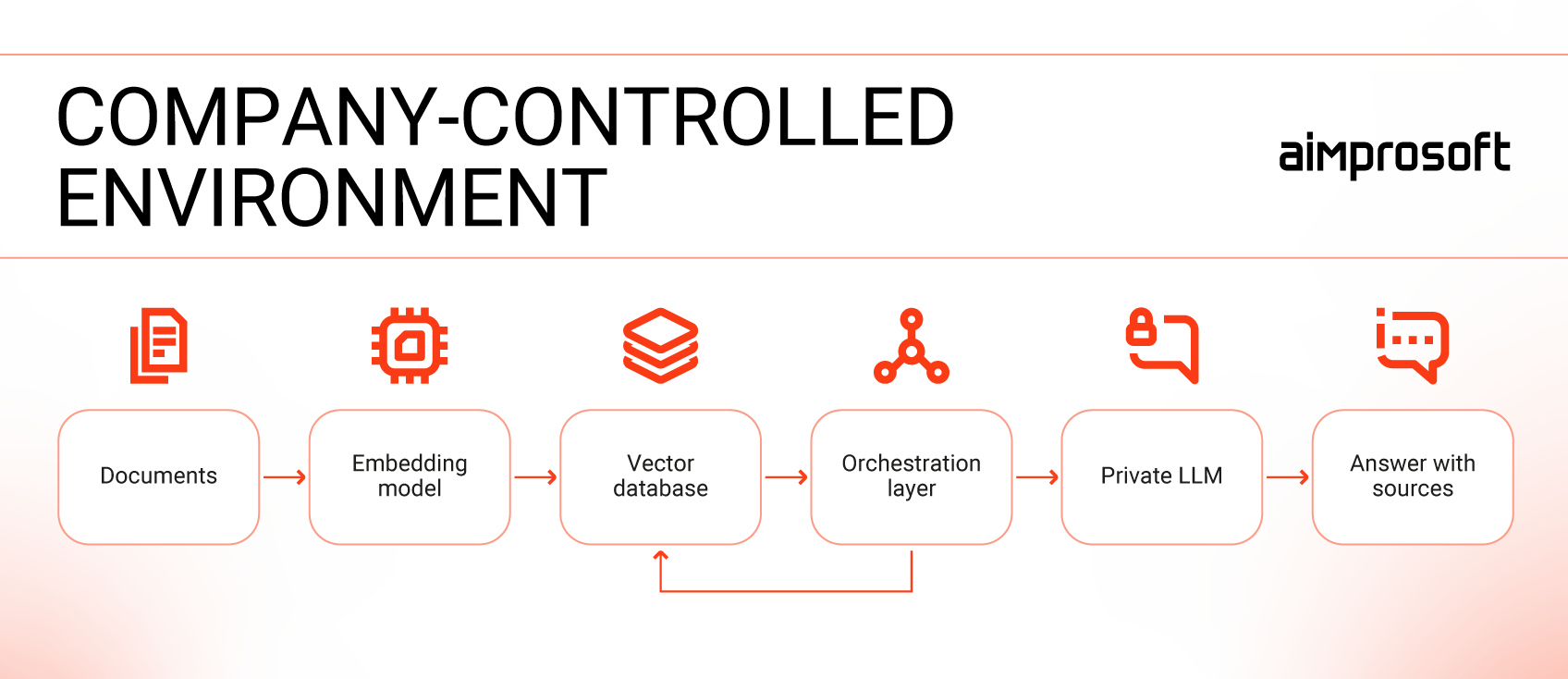
RAG in a private setting doesn’t really differ from any other retrieval pipeline. The system finds relevant content and passes it to the model for context so it can generate a response. The only difference is that now the embedding, vector database, orchestration layer, and self-hosted LLM all run within the company’s controlled environment instead of relying on external services.
What does it take to deploy a private LLM with RAG
The steps needed to deploy an enterprise LLM with RAG depend heavily on the foundation that already exists. Meaning that if you already have a self-hosted AI, adding a retrieval layer takes less work than when you have to build both components from scratch.
In this section, we’ll focus specifically on the second type of scenario: An enterprise starting with neither component.
1. Define the use case and constraints
The starting point of any development is purpose, not a programming language. So start with what your system will do, who will use it, and what data it requires to work properly. An AI assistant for sales will require different access control and response time than a copilot for the IT department.
Once the use case is clear, review client agreements and internal security policies. These requirements will tell you where data can be processed, if external services are allowed, and how isolated the system must be.
This step sets a baseline for your next infrastructure decisions.
2. Choose and deploy the private LLM
Following step 1 constraints, choose where the model will be hosted. If regulations, contractual requirements, or your threat model prohibit connectivity to external networks, an air-gapped deployment may be necessary. If there aren’t such hard rules, the decision comes down to your budget and whether your team can maintain the environment.
Enterprises often opt for open-weight models such as Llama, Mistral, or Qwen, and then test different sizes to assess their performance on their hardware and expected tasks. Larger models usually give better answers and are well-suited for complex tasks but are costly. Smaller models are cheaper and faster to run, but they struggle with tasks that involve multiple reasoning steps.
Once selected, you deploy the model using a serving framework such as Ollama or vLLM. The framework runs the model and provides a private API through which you can send requests and receive responses.
3. Build the RAG knowledge layer
Modern RAG systems commonly use an embedding model and vector-capable search engine, often combined with keyword/full-text search in a hybrid retrieval architecture. Embedding converts text into numerical representations, and the vector database stores and searches them when the user types a query. Among self-hosted databases, enterprises usually pick Qdrant, Milvus, and pgvector.
Next, you connect retrieval with your approved data sources, such as SharePoint, Confluence, Google Drive, or Slack. Documents are extracted, cleaned, split into chunks, converted into embeddings, and added to the database. Each chunk should include its source, last update, and access permissions to support accurate and secure retrieval.
Finally, configure the connectors to detect changes in the source content and automatically update the index. This keeps the knowledge base current without requiring manual updates.
4. Wire in security and access control
Start by connecting the retrieval layer to your identity provider. It’s the system your organization already uses to manage who has access to what, like Azure AD, Okta, or Keycloak. This way, the RAG system will inherit existing permissions without retraining.
Even within a private environment, encrypt data at rest and in transit between components. Internal threats are still real, and encryption can limit the damage if one component is breached. For the same reason, keep the LLM, vector database, and orchestration layer in separate network zones, so a breach in one cannot spread freely to the rest.
Lastly, enable audit logs that record who submitted each query, when it was submitted, and which documents were retrieved.
5. Evaluate and prepare for launch
Before going live, make sure to test these three things separately. First, that retrieval returns chunks that are in the query. Second, that the model produces grounded answers on these chunks. Third, users can’t access content beyond their permissions, even if they modify their prompt.
Define basic quality metrics — answer accuracy, retrieval precision, latency — and decide how they will be monitored before launching, not after the first incident.
6. Plan for ongoing maintenance
Indexes need refreshing as documents change. Models need updates and occasional replacements as better open-weight alternatives emerge. Retrieval parameters (chunk size, similarity thresholds, and the number of results passed to the model) need to be adjusted based on real usage patterns. More importantly, you need people who can own this ongoing.
If you’re looking for a team to provide custom RAG development, you can always reach out to us.
Need RAG on your own infrastructure?
When private LLM + RAG makes sense, and when it doesn’t
Hosting the model within the company’s own environment is the right architecture for a specific list of situations. But it’s not the default for every enterprise AI project. To help you decide which approach fits your needs, we’ve prepared a comparison table.
| Private LLM + RAG makes sense when | A third-party AI service may be enough |
|---|---|
| The system will handle data covered by HIPAA, GDPR, or similar frameworks that may restrict the use of certain third-party services. | The provider’s data-handling terms cover your compliance needs. |
| The system must enforce document-level permissions, so users can only retrieve content they already have access to. | Your access control requirements are straightforward and can be handled at the application layer. |
| The workload requires predictable latency, restricted-network operation, or offline capability. | The system can run in an approved cloud environment with standard network access and SLAs. |
| Usage is high or stable enough to justify dedicated capacity and infrastructure investment. | Usage is low, irregular, or still at pilot stage. |
| Your team can maintain the models and supporting infrastructure. | Faster implementation matters more than infrastructure control. |
Wrapping up
When built correctly, a private LLM powered by RAG gives you a system that answers from your actual documents and keeps every query inside your controlled infrastructure. But it makes sense only if your constraints require that level of security, otherwise, they add complexity to your budget and team.
Therefore, start with your needs, not technology. And if you need additional help or more examples of private LLM development, you can contact us anytime.