CASE STUDY
UBIDEX
Engineering an AI-powered QA framework for AdTech
Learn how Aimprosoft helped UBIDEX speed up regression testing and code review by designing an automation framework and AI agent architecture, cutting QA automation time by 40%.
Foreword
UBIDEX is an AdTech platform that helps brands increase user value by offering automated ad buying and retargeting based on audience analytics. To keep up with frequent releases and deliver new features to clients on schedule, the company looked for ways to accelerate software development and testing.
After consulting on ways to apply AI across their engineering workflows, we identified test automation as the highest-value opportunity. Together with a client team, we selected Claude Code as a key enabler for more efficient, scalable QA. Our team created a framework for automating UI and API testing that the UBIDEX engineering team could amplify and reuse for new test scenarios.
Services provided
AI consulting, AI implementation, QA & software testing, product engineering
Team
Delivery manager, 2 AI/QA specialists, UI developer, software developer
Duration
August 2026 - ongoing
Industry
AdTech/ Software
Story
As a forward-thinking AdTech company, UBIDEX built its retargeting platform to help clients get more value from existing users. They offer various ad and retargeting tools in one platform to engage users with relevant offers and re-engage inactive users.
Delivering on that requires a modern, highly responsive platform that adapts at the speed of the market. So new features, frequent releases, and constant refinements were critical requirements for UBIDEX to stay ahead of client expectations.
At a certain point, the company realized they couldn’t sustain the pace they had set for their product evolution. Development and quality assurance, done entirely by hand, which worked fine before, were no longer sustainable. The company needed a way to scale testing and development not by hiring more people but by improving the current processes.
That’s the problem UBIDEX brought to Aimprosoft. From there, we mapped out where AI could realistically solve the bottleneck and deliver the most value. We began by automating test workflows, which we then turned into a reusable framework constructed with Claude Code. Currently, we’re expanding coverage to include regression testing.
Requirements & Challenges
UBIDEX needed to increase test coverage and release quality, and all that shouldn’t affect the speed of development or require hiring new QA specialists. The automated approach also had to be reusable and maintainable, as opposed to a rigid page-object-based suite that would require rewrites with every design tweak.
Key requirements and challenges included:
- Building automation from scratch. The client team relied entirely on manual testing and had no existing automated test coverage. So the framework had to provide a ready-to-expand foundation for UI and API testing, which wouldn’t take long to set up.
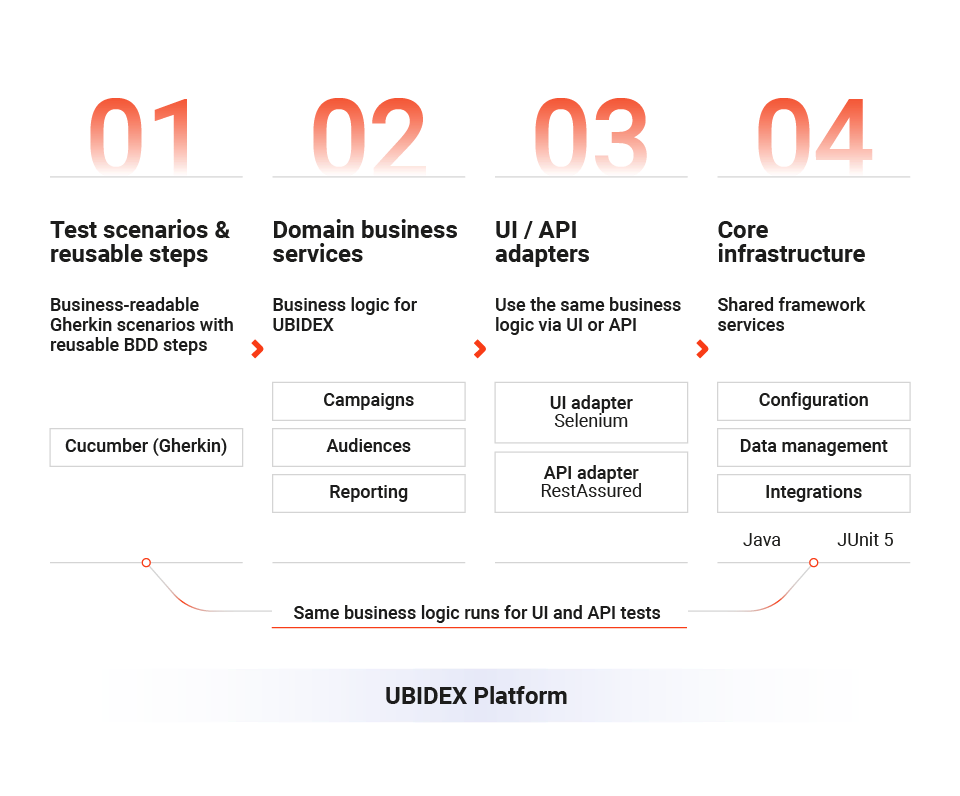
- Making tests reusable. Test scenarios had to be built like building blocks—reusable, aggregable behavior-driven development (BDD) steps—to let the team add new coverage using the same logic.
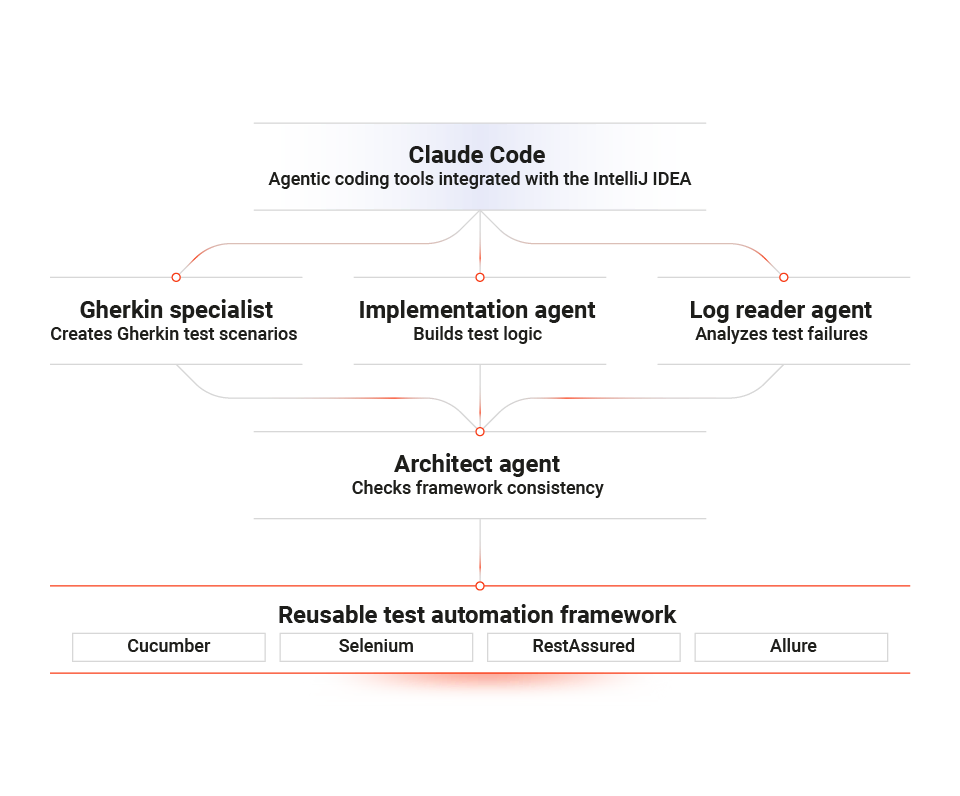
- Integrating AI into the engineering workflow.Claude Code had to fit the team’s existing development environment and advance framework development with the help of specialized AI frameworks.
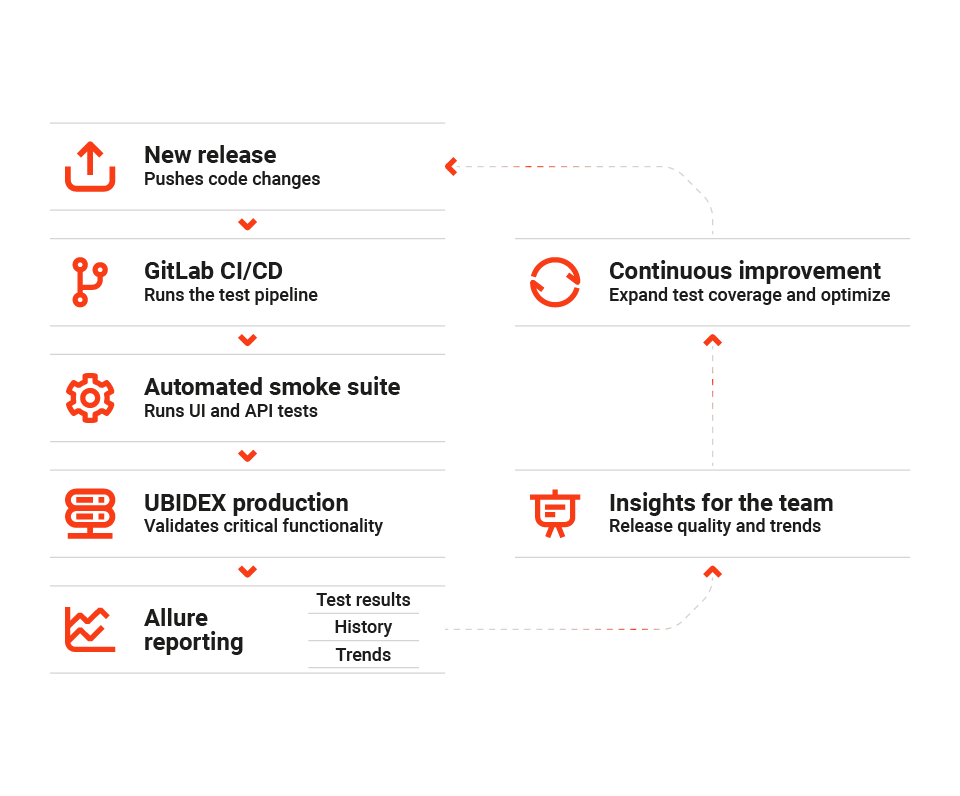
- Automating release verification. Replacing manual smoke checks with an automated suite running through the existing CI/CD workflow, with room to expand into regression coverage.
Solution
1. Domain-oriented test automation framework
Solution
2. Multi-agent AI workflow
Solution
3. Automated smoke testing and reporting
Solution
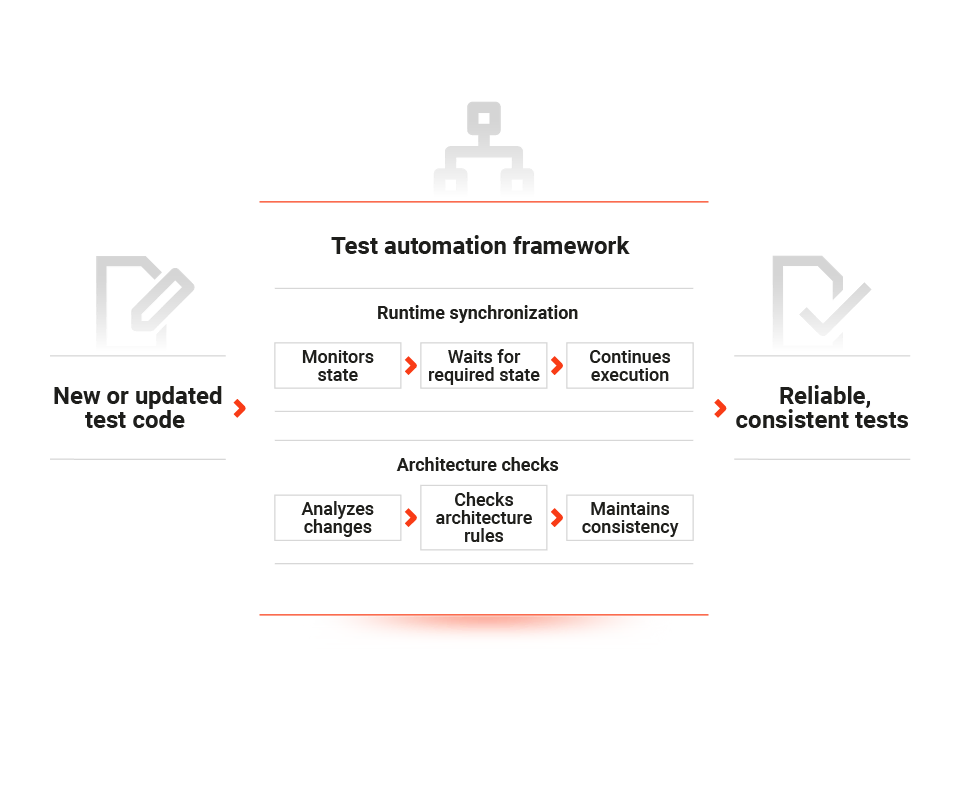
4. Built-in synchronization and architecture checks
Stack
- - Backend
- - Testing frameworks
- - DevOps
- - AI tools
Project outcomes
Thanks to joint effort and targeted AI implementation, the UBIDEX team managed to switch from fully manual QA to an AI-assisted automation workflow in just a few weeks. Right after the first version of the framework went live, the team noticed significant time savings across every stage of the QA process, among other results.
-
3x faster test automation setupThe team estimated that setting up the initial framework and base test coverage would take about three weeks. With domain-oriented architecture and AI-assisted development, the work was completed in roughly one week.
-
40% faster test developmentWriting a new automated test now takes less than or nearly 2.5 hours instead of 4. With around 20 tests created per two-week sprint, this currently saves about 30 hours per sprint.
-
33% faster technical support investigationsWith Claude in Chrome assisting root-cause analysis, investigating a support issue now takes about 20 minutes instead of 30 minutes. That’s a massive time saver on a task the team completes dozens of times a sprint.
-
25% faster product task preparationShorten task preparation and refinement from around 40 minutes to 30, which results in nearly 4 hours saved per sprint, provided the team completes an average of 25 such tasks per sprint.
-
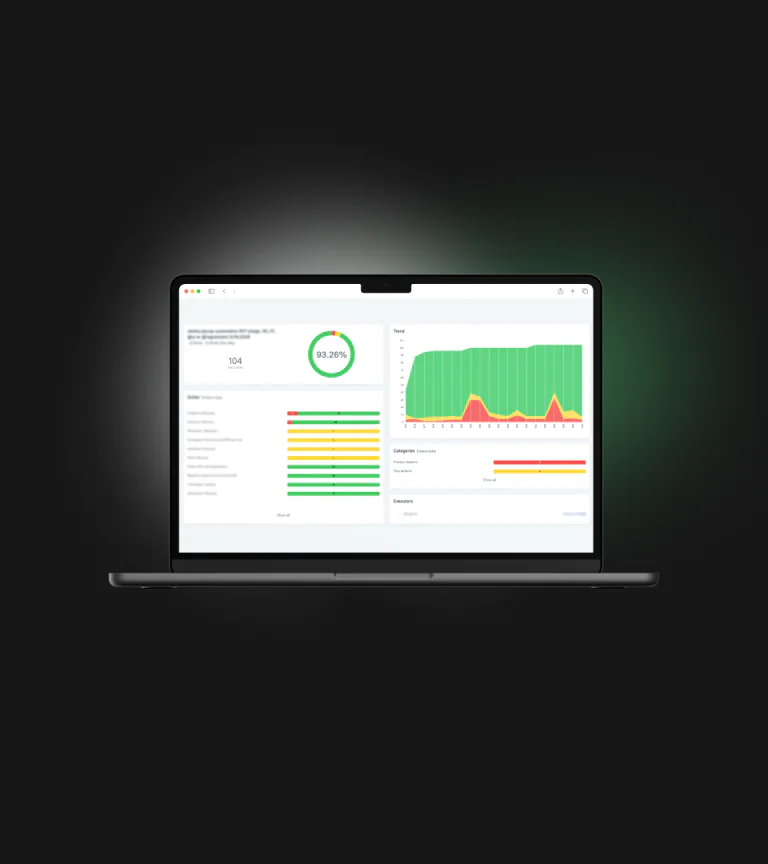
Automated smoke testing in productionThe framework now runs smoke tests against the live UBIDEX platform through GitLab, with Allure reporting providing all the necessary detail to catch issues early. Work to build out full regression coverage is in progress.
-
Growing AI adoption across teamsStarting with three Claude Team seats for QA, technical support, and product teams, the company is now scaling to five.
We’ve received your message and will get back to you shortly.