This website uses cookies to improve your browsing experience and help us with our marketing and analytics efforts. By continuing to use this website, you are giving your consent for us to set cookies.

Find out more Accept

Custom Scientific Data Platform Development

Accelerate scientific discovery with real-time access to federated datasets. We offer custom database development for scientific data platforms that centralize records from dozens of contributing institutions and make them easy to find, compare, and export.

The challenge of managing distributed scientific data

The more institutions share their findings, the faster scientific discovery advances. But every contributor stores and structures its data differently. And you can’t realistically expect a partner institution to overhaul its internal systems just to fit your standard. That structural mismatch, not the data itself, is the real barrier to scalable data platform development and effective research.

Valuable data stays hidden

Finding the right record becomes hard when datasets use different formats or lack proper metadata

Manual data preparation slows research

Every new dataset needs hours of validation and mapping before it's usable

Data quality becomes harder to maintain

Duplicate records and disconnected updates reduce reliability of the data over time

Contributor onboarding gets complicated

Adding new institutions requires custom integration work or manual onboarding

AI capabilities stay out of reach

Advanced search and automated insights need standardized data to work at all

The most effective approach is to build research data management software that standardizes data while letting contributors continue working in the systems they already know.

Why custom data platforms fit research networks best

Why not just buy a data platform off the shelf? Because research networks don’t operate like standard enterprise databases. A system built specifically for your research network does four things no standard tool can.

Capabilities we can build for your scientific data management software

Every capability here should serve your organization’s broader goals. When you opt for custom web application development, you gain full control over your architecture and the ability to design every feature to match your network’s unique operations.

Your custom scientific data platform

Purpose-built. Interoperable. Ready for what's next.

Standardized ingestion API
Metadata search & discovery
Interactive map & filters
Public & restricted API access
AI-powered search
Centralized registry
1. Collect & standardize

Make it easy for every contributor to submit high-quality data, no matter their format or system.

  • Format-agnostic ingestion APIs
  • Validation tooling and quality checks
  • Bulk data upload software
  • Contributor onboarding and mapping
2. Discover & explore

Powerful search and visualization tools help researchers find relevant data by metadata, location, and climate in seconds.

  • Metadata registry
  • Advanced filters
  • Interactive map-based search interface
  • AI-powered smart search
Scientific data platform capability diagram Central node "Your custom scientific data platform" surrounded by six capabilities: standardized data ingestion API, metadata search and discovery, interactive map and filters, public and restricted API access, AI-powered search, centralized registry. Your custom scientific data platform Purpose-built. Interoperable. Standardized ingestion API Metadata search& discovery Interactive map& filters Public & restrictedAPI access AI-powered search Centralized registry
3. Connect & integrate

Public and restricted API tiers let your network share data openly with the field while keeping sensitive records controlled.

  • Public API access
  • Restricted API access, with authentication and permissions
  • Integrations with external systems and workflows
  • Export and data exchange tools
4. Innovate & scale

Smart search extracts relevant records even when researchers don't know the exact terms to look for, turning a registry into a system that actively helps people find what matters.

  • AI-powered filtering and recommendations
  • Semantic search and natural language query support
  • Extensible architecture for future capabilities

AI-augmented discovery for scientific data management

AI delivers real value only when built on well-structured data. That’s why we help you refine research workflows and make them more efficient with AI-powered search development. By integrating AI on top of your scientific registry platform, your organization can lead the field while others are still catching up on data infrastructure.

Semantic search

Find relevant records even when researchers don't know the exact keywords or taxonomy

Data enrichment & quality

Automatically classify, tag, and enrich datasets using scientific ontologies and external reference sources

Knowledge discovery

Reveal relationships between datasets, species, geographic regions, publications, or contributors that would be difficult to identify manually

AI research assistant

Allow researchers to ask questions in natural language and receive summarized answers with links to supporting datasets

Predictive analytics

Apply machine learning models to identify trends, evaluate biodiversity risks, or assist with conservation planning

From fragmented research data to a global scientific infrastructure

The Crop Trust partnered with Aimprosoft to modernize their plant genetic resources platform. Aiming to safeguard crop diversity for global food security, they needed a connected system for sharing and discovering plant genetic resource data across genebanks and contributors in 100+ countries.

Business impact

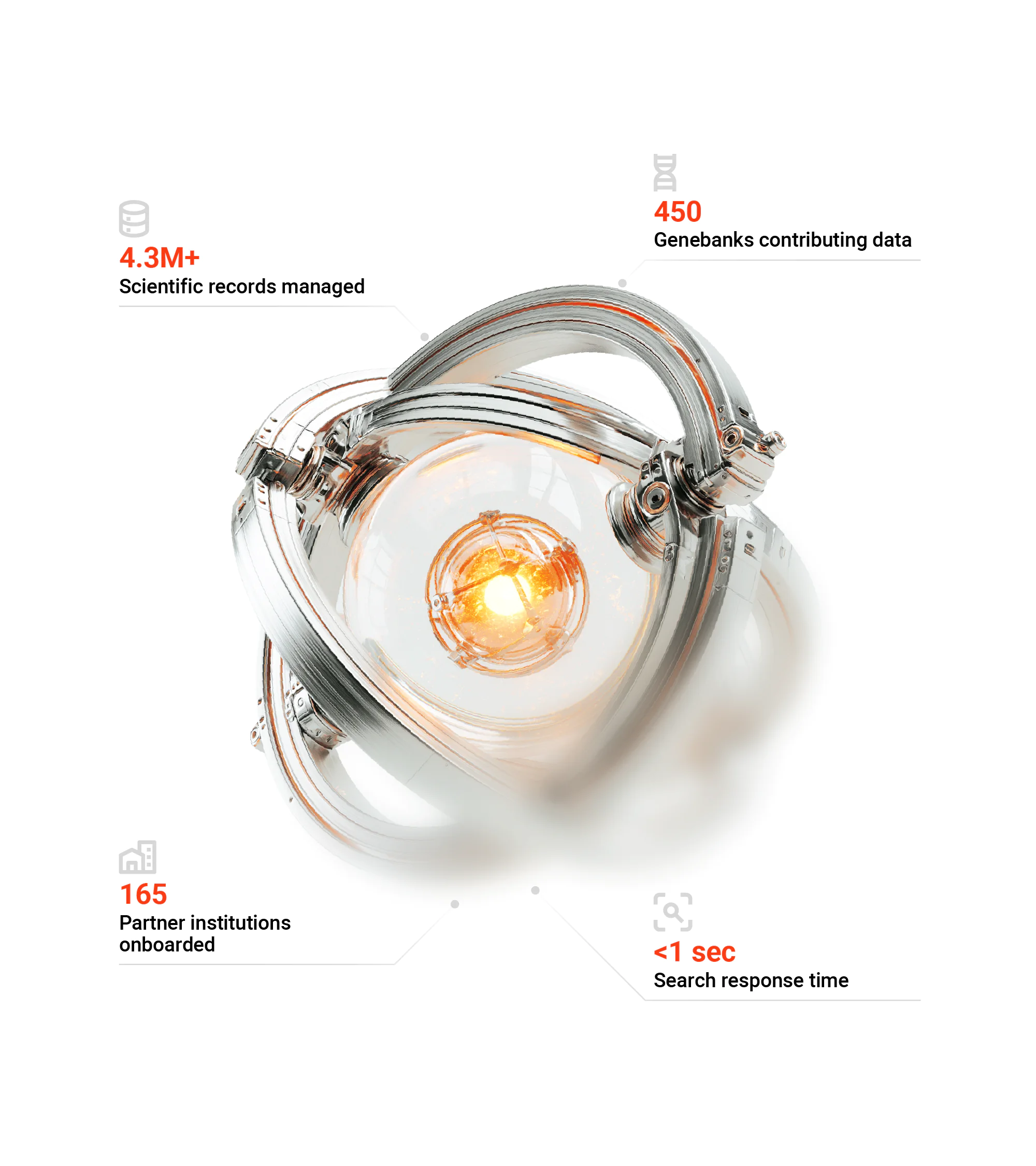
Scientific records managed
0 M+
Genebanks connected
0 +
Search response time
< 0 sec
Partner institutions onboarded
0

Challenge

A standard searchable database became insufficient to manage millions of accession records from genebanks worldwide. The registry had to standardize data from diverse sources, simplify research workflows, and scale with a growing global research network.

Our solution

Through custom database development, we addressed the operational challenges the Crop Trust's global network encountered daily.

Inconsistent contributor formats

A standardized, format-agnostic ingestion API with a custom Java-based uploader that converts any format into MCPD, the field’s standard

Manual, paper-based genebank workflows

Grin Global Community Edition (GGCE), an open-source software and database system, modernized into a digital system with configurable, automated workflows

Slow discovery across millions of records

A centralized registry with metadata search and interactive map-based, climate-overlay exploration

Legacy architecture that couldn't scale

Rebuilt on Java/Spring with Elasticsearch and Hazelcast for fast querying, and a modern React frontend for dynamic data exploration

Built on

Backend

Search & Data

Frontend

Infrastructure

Build on a proven approach to scientific data management

Research domains we develop data platforms for

Organizations from different fields face similar standardization and data-sharing obstacles. Backed by direct experience building for research networks, we know which capabilities can be reused and which need to be purpose-built for your organization and your domain.

Agriculture & сrop sciences

Support breeding programs, germplasm collections, and biodiversity data management with solutions that make genetic resources easier to share and preserve across global research networks.

Life Sciences & biobanks

Develop biobank software and secure life science data platforms to manage biospecimens, research metadata, and sample lifecycles more effectively while improving traceability and collaboration.

Biodiversity & conservation

Enable researchers to explore biodiversity through centralized search and mapping tools, built on open data platforms that bring together all field data from every contributing partner.

Museums & scientific collections

Improve catalog management and public archive accessibility by creating a federated registry of collection databases with geographic and metadata search that makes every cataloged item discoverable.

Pharma & R&D

Organize sample libraries, activity data, and experimental results with custom research database software that simplifies searching and sharing discovery-stage research across distributed labs.

Our process for scientific data platform development

Discovery & domain modeling

Understand and map your research workflows, scientific assets, stakeholders, and existing systems.
Deliverable:

Platform roadmap · domain model · implementation plan

01 STEP
02 STEP

Data architecture & standardization

Design schemas, metadata models, taxonomies, and governance rules aligned to your domain's standards.
Deliverable:

A standardized, future-proof data architecture

Solution engineering

Build the backend, APIs, permissions, integrations, and core workflows that power your data platform development initiative.
Deliverable:

A connected platform with production-ready backend services

03 STEP
04 STEP

Search & user experience

Develop user-friendly interfaces with advanced search, filtering, visualization, and domain-specific discovery capabilities.
Deliverable:

Fast, reliable access to data

Migration & launch

Migrate legacy datasets, validate them against real records, test business-critical workflows and launch with minimal disruption.
Deliverable:

A live, production-ready data platform

05 STEP
06 STEP

Continuous enhancement

Expand the system with new integrations and AI-powered capabilities.
Deliverable:

Easy-to-adapt and upgrade platform

01 STEP
Discovery & domain modeling
Understand and map your research workflows, scientific assets, stakeholders, and existing systems. Deliverable:

Platform roadmap · domain model · implementation plan

02 STEP
Data architecture & standardization
Design schemas, metadata models, taxonomies, and governance rules aligned to your domain's standards. Deliverable:

A standardized, future-proof data architecture

03 STEP
Solution engineering
Build the backend, APIs, permissions, integrations, and core workflows that power your data platform development initiative.
Deliverable:

A connected platform with production-ready backend services

04 STEP
Search & user experience
Develop user-friendly interfaces with advanced search, filtering, visualization, and domain-specific discovery capabilities. Deliverable:

Fast, reliable access to data

05 STEP
Migration & launch
Migrate legacy datasets, validate them against real records, test business-critical workflows and launch with minimal disruption. Deliverable:

A live, production-ready data platform

06 STEP
Continuous enhancement
Expand the system with new integrations and AI-powered capabilities. Deliverable:

Easy-to-adapt and upgrade platform

Why Aimprosoft as your data platform development partner

Most software teams know how to build databases. We've spent more than a decade evolving a scientific registry into one of the largest federated research platforms.

Proven at global research scale

12+ years building and maintaining the Genesys open data platform for the Crop Trust

Research infrastructure expertise

Platforms built for long-lived, multi-contributor scientific ecosystems

Engineering ownership

We validate architectural decisions early and stay accountable for measurable outcomes

AI-ready architecture

Built to support semantic search, intelligent discovery, and future AI capabilities

FAQ

A federated scientific data platform lets independent institutions contribute to and search shared data without needing point-to-point integrations between every system. It uses standardized data models and ingestion workflows to normalize incoming records and then makes them centrally searchable through a single interface and APIs.
Yes, geospatial data platform development is one of our service offerings. We build interactive map-based interfaces that allow researchers to explore records by location, with climate-layer filters alongside standard metadata search. Depending on your use case, we can support everything from simple geographic visualization to advanced geospatial search and analysis.
If your current research database makes information difficult to find, we can enhance it with AI-powered search functionality. This may include Elasticsearch-based indexing, semantic search, natural language queries, and relevance tuning based on your data and research workflows.
A subscriber’s request is automatically routed to the responsible approver – a dealer, data owner, or compliance officer – before any access is granted. Every request, decision, and status change is recorded, so API governance holds at every step. That gives you complete API subscription management, with built-in API audit trail software.
We design role-based and tiered access, so public researchers browse open records while restricted data stays limited to authenticated institutions. Public and private tiers can coexist within the same registry. Permissions can be managed at the user, organization, dataset, or record level, based on your requirements.
A core registry with standardized ingestion and search typically takes 4–6 months. Adding map-based search, tiered access, and AI capabilities extends that to 8–12 months. Larger, multi-institution platforms can take 12+ months. Every project scope is different, so we can give you an accurate timeline after reviewing your requirements.
We migrate legacy scientific databases to modern platforms, carefully protecting existing records, metadata, and integrations. As part of our data platform development services, we validate data quality and map legacy structures to a new data model to minimize disruption during transition.
Costs scale with scope: a basic scientific registry platform typically starts around $150K+, with AI features, map-based search, or multi-institution integrations increasing that range. We’ll size the estimate to your actual requirements after an initial discovery call.

In one conversation, we'll help you determine the right platform architecture, identify implementation risks, and estimate the effort required to build a custom data platform