
YOUR DEDICATED SOFTWARE DEVELOPMENT TEAM, FROM CORE PLATFORM TO AI FEATURES
We put together a team of senior engineers, AI and ML specialists, data engineers, QA engineers, business analysts, and a project manager, and they work as part of your company. You deal with one accountable partner instead of a patchwork of freelancers and agencies, and that partner can own both your core platform and the AI features your users now expect.
Maybe you're scaling a product line, adding an AI assistant to your app, or trying to close a skill gap before the next release. Our dedicated development team services get you there without months of hiring and onboarding, and our engineers bring AI-assisted tooling that speeds up delivery from the first sprint.
Ready to accelerate your delivery?
When should you hire a dedicated development team?
Hiring can't keep up
A senior engineer can take six months to hire. Someone who has actually run LLMs, data pipelines, or MLOps in production takes longer. Meanwhile the backlog grows, your current team absorbs the extra work, and code quality slips.
Your engineers don't know the domain, or how AI behaves in production
That gap shows up as rework: features that technically work but miss what users need, plus technical debt your senior people end up cleaning.
AI pilots stall after the demo
The proof of concept impressed everyone. Now the team needs to turn that promising demo into a production-ready feature, with clean data, guardrails, evaluation, monitoring, and predictable costs. And that’s where many get stuck.
Too many vendors, nobody owns delivery
One developer from here, a QA contractor from there, an AI consultant on the side. Without one process and one owner, priorities drift and handoffs eat the week.
Priorities move faster than your team
New features, customer requests, modernization plans, and AI initiatives all compete for the same engineers. Something has to give, and it's usually tech debt.
Your tech leaders are managing handoffs
They should be working on product direction and AI strategy. Every extra contractor is one more person to manage.
Sound familiar? Tell us where you're stuck and we'll suggest a team setup that fits
Dedicated development team services, from classic engineering to AI
AI features need the right data, careful UX, new kinds of testing, and monitoring after launch. So our dedicated development team services cover all of it, and every specialist on the team works to the same product goals, milestones, and quality bar.
With staff augmentation, you manage each engineer yourself. Adedicated software development team manages its own work as an extension of your organization.
AI strategy and discovery
Not sure where AI will pay off? Our AI audit looks at your use cases, data readiness, and build-vs-buy options, then maps a route from pilot to production with ROI tracked from day one.
Business analysis
Our BAs keep stakeholders and engineers agreed on priorities and scope. On AI projects they also write the success metrics and acceptance criteria, so "it works" means the same thing to everyone.
Product and AI UX design
User flows, wireframes, and interfaces, including conversational UIs, AI copilots, and human-in-the-loop flows people are willing to rely on.
Custom software engineering
Senior developers across 50+ technologies and 26+ domains who take ownership of code quality, architecture, and delivery speed. Want to outsource a web development team, a mobile app development team, or a full-stack development team? We'll put together the right mix.
AI and ML engineering
We build AI into new and existing products: LLM integrations, RAG knowledge assistants, AI agents and workflow automation, recommendation engines, NLP, computer vision, and predictive analytics. Commercial, open-source, or fine-tuned models, whichever fits your use case.
Data engineering
Plenty of AI features that break in production break on data. Our data engineers build the pipelines, clean and structure your data, set up vector databases, and keep what goes into your models reliable and compliant.
Legacy modernization
Before anything gets touched, AI-assisted code analysis maps and documents the old codebase, so no business logic gets lost. We then move aging systems to a modern architecture step by step, while the product stays live.
DevOps, MLOps, and AI security
CI/CD automation, model deployment and monitoring, inference cost control, guardrails, access controls, and compliance checks.
QA and AI evaluation
Quality assurance runs through every sprint. On top of classic testing, we check AI output for accuracy, hallucinations, bias, and regressions, so a feature that behaves on release day still behaves six months later.
AI-assisted engineering: how your team can ship faster
Your team builds AI features, and if your governance allows it, it also uses AI in its own day-to-day work. In practice that looks like this:
- AI coding assistants handle boilerplate, refactoring, and first-pass code review, which leaves senior engineers more time for architecture and the tricky logic
- Test cases and test data get generated faster, so coverage grows without a separate push
- Specs, API docs, and onboarding materials stay current
- Before a legacy migration, AI tools help map and document the old codebase, which cuts the risk of surprises halfway through
Every tool follows your security, IP, and compliance rules, and a person reviews everything that goes to production.
AI speeds us up. Senior engineers stay responsible for the result.
Dedicated development team structure: who's on your team
We don't pull people from a fixed resource pool. Your team is built around your product, stack, and goals, and it changes when they do.
Core product team
AI and data extension (add as needed)
Tech lead / solution architect
AI solution architect
Frontend, backend, or full-stack developers
ML / LLM engineers
Mobile developers
Data engineers and data scientists
QA engineers (manual and automation)
MLOps engineer
Business analyst
AI QA / evaluation specialist
Project or delivery manager
Prompt and AI UX specialist
UI/UX designer, DevOps engineer
Example setups
- Already have a product and want AI in it? Keep a team on your current stack and add an ML/LLM engineer and a data engineer for AI search, a copilot, or automation
- An AI-first product usually needs an AI architect, ML and backend engineers, data engineers, and QA who can evaluate model output, from discovery through MVP to scale
- For modernization, full-stack developers and DevOps use AI-assisted code analysis to move a legacy system onto an architecture that's ready for AI later
Not sure what your team should look like?
Results of our dedicated software engineering teams
Every vendor says its engineers are talented. The more useful question is what those engineers did for a product over years, so here are five partnerships that are still running.
PlatformX Communications (part of TalkTalk)
Telecom · UK · since 2010, ongoing
The challenge
PXC runs a wholesale telecom platform for 1,000+ partners, and it sat on a monolithic Liferay portal that was hard to scale or automate. It had to keep shipping features and stay up for a growing partner base while moving to modern tech. After TalkTalk bought the company in 2022, it also had to meet new security standards.
What we did
- Moved the portal off the Liferay monolith in stages: an Angular single-page app first, then Spring Boot services with Keycloak authentication, then Liferay removed completely
- Built 1Access, the core of the portal, where partners get Ethernet, internet, and cloud services in one place. We also added 1Cloud, security tools, an admin panel, a customizable dashboard, and Elasticsearch search across the platform.
- Set up a real-time, two-way Salesforce integration
- Introduced DevOps practices and CI/CD pipelines
The results:
- 1,000+ partners, 14,000 users, and 500,000 completed orders
- 98% nationwide coverage and a 60% share of the UK wholesale broadband market
- A fully microservices-based platform with better scalability, security, and stability
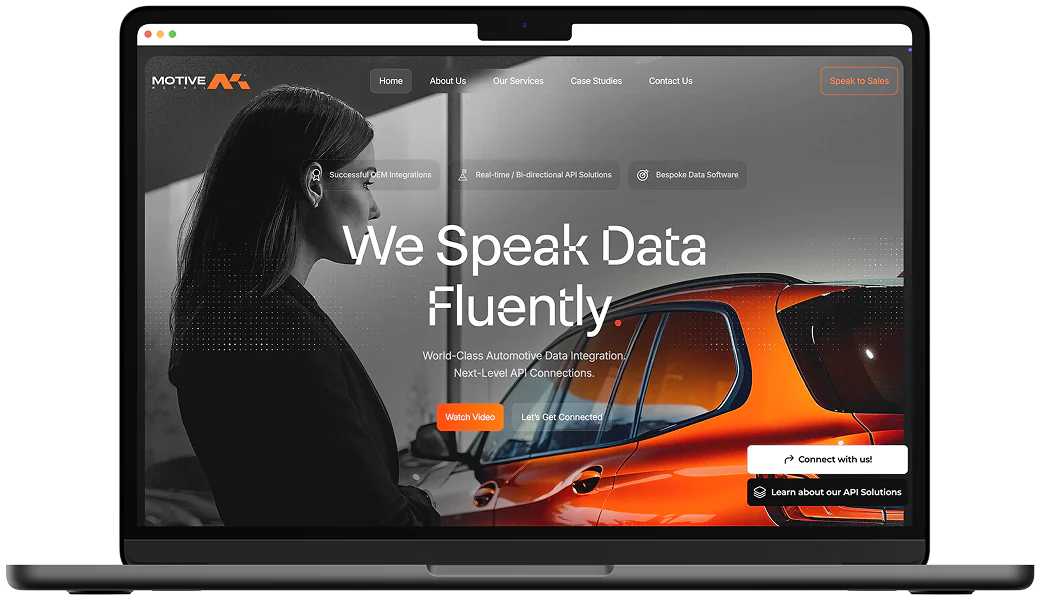
Motive Retail
Automotive retail / API integration · USA · since 2008, ongoing
The challenge
Motive Retail's two core systems, an API integration platform and a desktop certification app, needed to work at a much larger scale. An earlier move to a Liferay portal had brought performance bottlenecks and heavy maintenance. The ecosystem serves manufacturers, dealers, subscribers, and admins, takes hundreds of thousands of requests a day, and can't pause production to add features.
What we did
- Rewrote the certification system from scratch in Java and Angular as Certify, with multi-phase certification workflows, dashboards, announcements, and automated notifications
- Turned Motive Integrator into MIX and split out Activate (API subscriptions with dealer approval), Console (real-time API analytics), and an admin panel
- Moved heavy XML validation out of Certify into its own Validation API
- Added async processing on AWS SQS, caching, multithreading, and an automated billing tool
The results:
- 50M+ transactions a month through MIX, plus hundreds of thousands of API requests a day through Activate
- Thousands of certification requests handled each week in Certify
- Billing data that took two weeks of manual work now takes one click
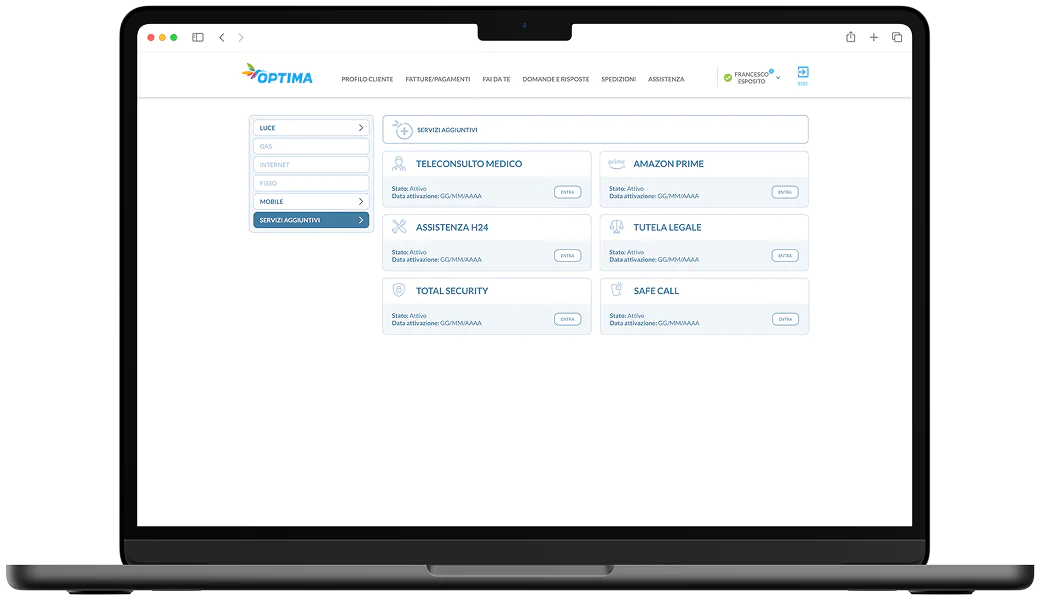
Optima Italia
Multi-utility (energy, telecom, insurance) · Italy · since 2011, ongoing
The challenge
Optima wanted one customer platform for electricity, gas, mobile, internet, and insurance, plus a field app that lets agents close complex, multi-step contracts. The two had to sync in real time and keep sensitive data safe, while the legacy PHP portal and Java-based Android app were getting harder to maintain.
What we did
- Rebuilt the customer portal from PHP to Angular and Java. It now has one dashboard for every service for B2B and B2C users, consumption charts, PayPal/Nexi/UniCredit payments with auto-pay, and mobile plan management.
- Built and kept evolving the agents' Android app, with a two-phase contract and e-signature flow, ML Kit document scanning, secure offline sync, and a consumption calculator
- Put the portal and the app on a shared backend, security, and data layer
The results:
- 200,000+ customers use what we built
- Mobile app performance up 30% after the refactor
- A contract an agent creates shows up for the customer immediately, and payments and services stay in sync across both channels
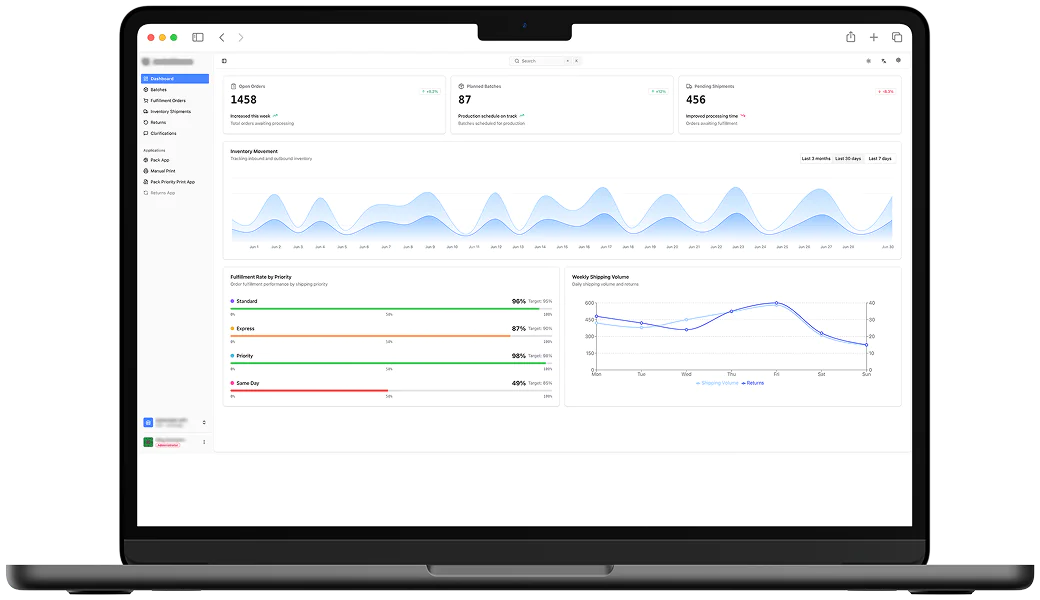
Zenfulfillment
E-commerce fulfillment · Germany · since January 2024, ongoing
The challenge
Three in-house engineers were looking after nearly 40 repositories. Deployments were manual, monitoring was thin, and key warehouse processes leaned on third-party tools. The company needed DevOps skills and more development capacity to keep growing.
What we did
- Replaced manual deployments with infrastructure as code (Terraform, GKE), Grafana monitoring, and autoscaling, and merged five AWS accounts into one production system
- Restarted the paused in-house WMS with barcode scanning, batch handling, and label printing, replacing Google Scripts and spreadsheets
- Maintained the Shopify, WooCommerce, and XML integrations, and rewrote the Shopify one from REST to GraphQL
- Added client-specific logic for packaging, pricing, and carriers, a customer analytics dashboard, and admin panel improvements. UI freezes are fixed with virtualization.
The results:
- Infrastructure costs down 50%
- 60–70% fewer daily support tickets
- 14 warehouse packing stations on the new WMS
- 14 warehouse20,000+ shipments a month packing stations on the new WMS
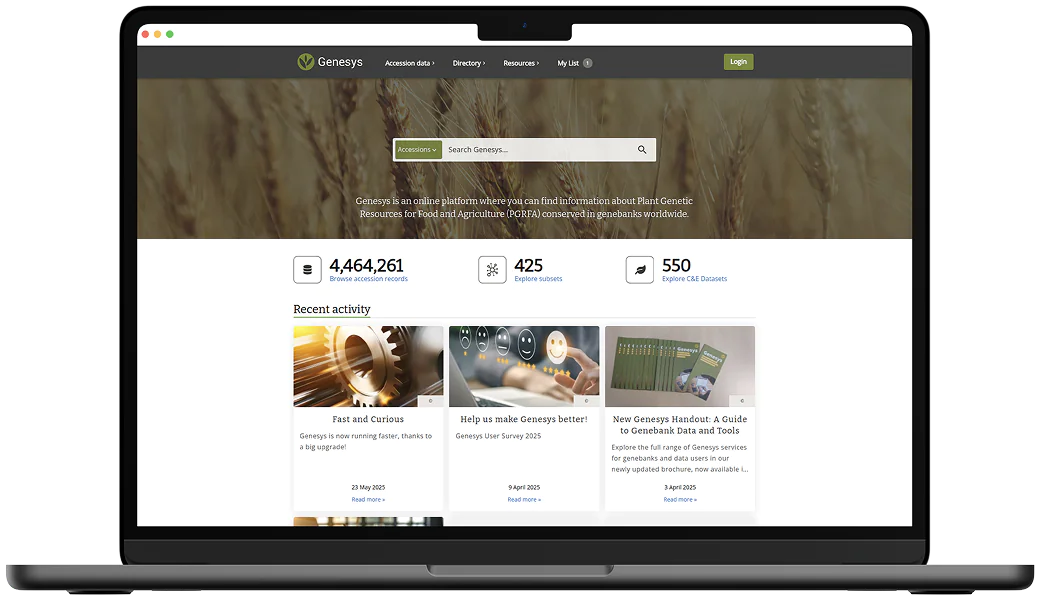
Genesys & GGCE (The Crop Trust)
Agriculture / crop diversity conservation · Germany · since 2013, ongoing
The challenge
Genesys, the global database of plant genetic resources, ran on PHP that couldn't keep up with growing genebank data, and it sent redundant data that slowed the UI down. In 2020 the team also took over GGCE, an open-source genebank management system. That meant running two related platforms, keeping their data consistent, and updating the stack without disrupting users around the world.
What we did
- Rebuilt Genesys on a Java backend with a REST architecture (relaunched in 2015) and moved the frontend from JSP to React (2019)
- Reworked how data moves between frontend and backend, so only the data a screen needs gets sent
- Added custom workflows, barcode tracking, and role-based access control to GGCE
- Added client-specific lDelivered bulk upload and validation tools, the Genesys API with a Java uploader that converts data to the MCPD format, and map-based filtering with climate layers gic for packaging, pricing, and carriers, a customer analytics dashboard, and admin panel improvements. UI freezes are fixed with virtualization.
The results:
- 4.3 million seed samples hosted
- 450 contributing genebanks and 165 partner institutions, with data from 100+ countries
- The world's largest open-access repository of plant genetic resources, and one that new institutions find much easier to join
Benefits of hiring a dedicated development team with Aimprosoft
One of our dedicated teams has worked with the same client since 2008. Another stayed on through two acquisitions and a rebrand. Companies keep these teams because the results keep coming: faster releases, lower running costs, and platforms that grow without breaking. Here's what a dedicated team can do for you, with numbers from real Aimprosoft projects.

01 · Partnerships that outlast roadmaps
Five of our client partnerships have passed the 12-year mark. The longer a team stays, the better it knows your product, your users, and your business, and you benefit from that knowledge in every sprint.
-
Product knowledge that compounds
When priorities shift, a long-standing team doesn't need to be onboarded all over again. We've worked with Motive Retail since 2008, helping them turn two early tools into an API ecosystem for US automotive retail. Their MIX platform now handles 50M+ transactions a month with a 0% deployment failure rate. -
Continuity through acquisitions and rebrands
We started building PlatformX Communications' partner portal in 2010, back when the company was a startup called Upshot. Our team stayed on when Virtual1 acquired it in 2015, and again when TalkTalk did in 2022. Today the platform serves 1,000+ partners, has processed 500,000 orders, and holds 60% of the UK wholesale broadband market. -
Responsibility that grows with trust
Optima Italia first brought us in in 2011 for a single Liferay theme. Six delivered products later, our team shapes the architecture of the portal and field-agent app that serves 200,000+ customers.

02 · A team that grows and shrinks with your plans
Start with the one role you need most. Add people once the work proves itself, and scale down without losing what the team has learned.
-
Start small, expand on results
When our DevOps engineer joined Zenfulfillment, their three in-house engineers were juggling nearly 40 repositories. Two of our full-stack developers came on later. Together, the team cut infrastructure costs by 50%, got incident response under an hour, and reduced daily support tickets by 60–70%. -
Scale down without starting over
When Homelike moved most development in-house, we kept a few of our experts on the project. So when they scaled back up, our specialists slotted straight into their payments, search, infrastructure, and booking teams. By the end of our 7-year partnership, the platform grew to 120,000+ apartments in 500+ cities and processed requests 5x faster. -
New skills as your product evolves
Qardio came to us in 2012 with one mobile app. As it turned into a health ecosystem with doctor portals and device integrations, the team grew with it, adding backend, frontend, iOS, Android, QA, DevOps, and architecture roles. The platform gained 3 million active users and a 97% positive rating.

03 · Every role you need, in one team
You don't just get developers. You get analysts, designers, QA, DevOps, and delivery managers who already know how to work together.
-
A complete product team from day one
Kashkick came to us with an MVP built on outdated technology. Together with the client, our dedicated team rewrote the MVP into a production-grade platform that handles 3–4x higher concurrent user load during marketing campaigns. -
Expertise that's hard to hire
For a leading energy supplier, our engineers work inside the company's R&D lab on web, mobile, IoT, and B2B SaaS. In six years, that mix of skills has shipped 28 products across six countries, from smart-meter devices to ESG reporting tools. -
Seniority you can count on
We tell you each engineer's experience level upfront, and you'll find it matches reality. In the words of Homelike's Head of Engineering: "Aimprosoft gave us a list of engineers based on price, with a description of their experience levels. Those levels have been exactly as depicted."

04 · A fast start, even on someone else's code
Our teams are used to jumping into live products mid-flight, including ones another vendor built.
-
Onboarding in days, not weeks
Optimus Education asked us to support five live Drupal platforms for school training and accreditation. We'd planned several weeks for onboarding. It took a few days, and maintenance started right away. -
Smooth takeovers from previous vendors
Avora's first vendor left behind slow progress and a fragmented codebase. We took over full-cycle development in 2016, made reports and dashboards 5x faster, and cut data preparation from days to minutes. -
Results under a hard deadline
A Canadian business-intelligence company had two months to get its geo-analytics platform ready for sales demos. After a two-week discovery, our team tripled platform performance and delivered 171% of the planned sprint scope. They made the deadline.

05 · Lower total cost, not just a lower rate
The biggest savings come from what the team changes: leaner infrastructure, less manual work, and no failed hiring rounds.
-
Cheaper to run
Kashkick's platform used to run on one big monolithic server. We moved it to smaller, optimized servers and cut memory usage roughly threefold, so hosting got cheaper even as more users came in. -
Less manual work for your people
At Motive Retail, preparing billing data for API subscriptions used to take up to two weeks of manual effort. The automated billing tool our team built does it in minutes. -
No hiring gamble
One client had spent a long time trying, and failing, to hire QA and frontend engineers. We placed a QA engineer first, then added a full-stack and a React engineer as their needs grew. Production defects went down, and releases got more predictable. -
Predictable monthly budgets
PayForED has no in-house developers. Our team runs their platform on a fixed monthly budget, and one of the first upgrades cut page load times from 20 seconds to 2–3.

06 · Engineers who act like owners
Our teams don't wait around for tickets. They spot problems, suggest fixes, and own the outcome.
-
Ideas, not just execution
Many of Motive Retail's most useful features started as suggestions from our team, including the organization hierarchy tree for admins and the automated billing tools. Their Sr. Director of Engineering put it like this: "Your team has been a true partner to Motive Retail, helping us bring products to life and investing in our success as if it were your own." -
A voice in technical decisions
At Optima Italia, our team recommends refactoring, proposed the move from Java to Kotlin, and owns system stability. Along the way, we've cut technical debt and improved mobile app performance by 30%. -
Accountability for delivery
Here's how Kashkick's CEO sees it: "We like the way you have taken on the responsibility for the timely delivery of projects, documentation, data systematization and structure. Thanks to Aimprosoft, our team has become more productive, proficient and effective."

07 · Modernization without stopping the business
You can rebuild a legacy platform while your customers keep using it. We do it step by step, with no big-bang cutovers.
-
From monolith to microservices, live
From 2020 to 2024, we replaced PlatformX Communications' Liferay monolith with an Angular front end, Spring Boot microservices, and Keycloak authentication. The portal kept serving its 1,000+ partners the whole time. -
Cloud migration with zero disruption
For a global B2B distributor with 10,000+ employees, we moved 7–8 heavily customized storefronts from on-premise SAP Commerce to SAP Commerce Cloud. Orders, payments, and ERP integrations kept running, and go-live landed on schedule. -
Rebuilds that last for years
We rewrote the Crop Trust's Genesys platform from PHP to Java in 2015, then moved it to React in 2019. Researchers in 100+ countries now use it to access 4.3 million seed samples from 450+ genebanks.

08 · Delivery you can see and predict
You always know who owns what, what's at risk, and what ships next. We measure quality instead of promising it.

-
Full visibility from day one
Before writing a line of code for the Canadian BI company, our team set up a shared workspace with RACI roles, a risk log, KPIs, and the roadmap. Their CEO noted that "KPI preparation and maintenance for project governance were also handled very well." -
AI-assisted delivery
We use AI to speed up estimation, test case writing, and code review. On the BI platform, it helped the team reach 90%+ regression test coverage and a 228% bug resolution rate. -
Faster release cycles
For Orbis's CampusConnect, an experiential-learning platform for Canadian colleges, our four-engineer team moved releases from monthly to weekly. Colleges and students now get new features sooner. -
Quality in numbers
Motive Retail runs at a 0% deployment failure rate. Homelike has 85% test coverage, and Qardio keeps 80% unit test coverage on a platform that tracks billions of health data points.
We combine deep technical expertise with long-term product experience. That's what helps us deliver consistently, and that's why our clients keep coming back with new projects and ideas.
Business sectors we serve with dedicated teams
Your team shows up already knowing the rules, risks, and AI opportunities in your industry, so it doesn't spend the first weeks on basics.
Fraud detection, risk scoring, and support assistants
Clinical documentation and patient-facing assistants, on compliant data pipelines
Personalization and AI search; demand forecasting
Document processing, predictive ETAs, and route optimization
Load forecasting and predictive maintenance
Computer vision quality control, IoT data platforms
How we build your team
Understand your product, delivery, and AI goals
Build the right team
Plug into your engineering team
Deliver and keep improving
Scale as the product grows
Got an AI idea but no team to build it?
Technologies we use
From proven web and mobile stacks to current AI tooling, your team works with the stack that fits your product, which isn't always the one we'd reach for by default.
- Frontend development
- Backend development
- Databases
- Mobile app development
- DevOps & Cloud computing
- QA & Software testing
- UI/UX Design
- AI implementation services
What clients say about their dedicated teams at Aimprosoft
Is a dedicated software development team the right model for you?
We believe an engagement model should fit your product's maturity and goals, not the other way around. Whether you're building a long-term product, need help with one bottleneck, or want AI experts for a set period, we'll match the model to your needs.
Staff augmentation
Add specific people to your existing team, like an ML engineer, a data engineer, or a senior backend developer. You keep full control of architecture and priorities, and we supply the experts. It works best when your process is already set up and you're short on capacity or niche AI skills.
Agile POD teams
Small, self-managed units with clear KPIs that own one area, such as an AI feature, a data platform, or a module. They work alongside your existing Scrum teams.
Ready to hire dedicated software developers who know AI?
Tell us about your product and where AI fits in. We'll come back with a suggested team setup, a timeline, and next steps, with no strings attached.
FAQ about dedicated teams for software development
We’ve received your message and will get back to you shortly.