AI Governance Framework: Managing AI Risk at Scale
Published: – Updated:


What if the biggest AI governance problem isn’t a lack of governance?
Most companies have several versions of it. Legal professionals manage acceptable-use policies. The security team reviews vendor tools for data privacy and exposure. Compliance tracks alignment with regulatory obligations, while the IT department maintains approved tool lists. At bottom, each one owns a different slice of the risk AI poses. The missing piece of the puzzle is a common framework for making decisions when those responsibilities intersect.
That’s why AI transformation is a problem of governance, a reality many organizations mistake for a technology challenge. The ultimate goal is to determine whether your governance can keep pace with AI adoption without cutting corners on compliance or oversight.
By the end, you’ll be able to evaluate your current governance model and find the missing elements to get where you need to be.
What an AI governance framework is
An AI governance framework is a set of rules and review processes that let companies use AI systems securely and responsibly with respect for human rights. Its purpose is to align AI adoption with business objectives. At the same time, it establishes guardrails needed to manage risks effectively, ensure compliance, and drive accountability among teams.
Before discussing enterprise AI governance frameworks in detail, it’s worth clarifying four concepts that often get used interchangeably but serve different purposes.
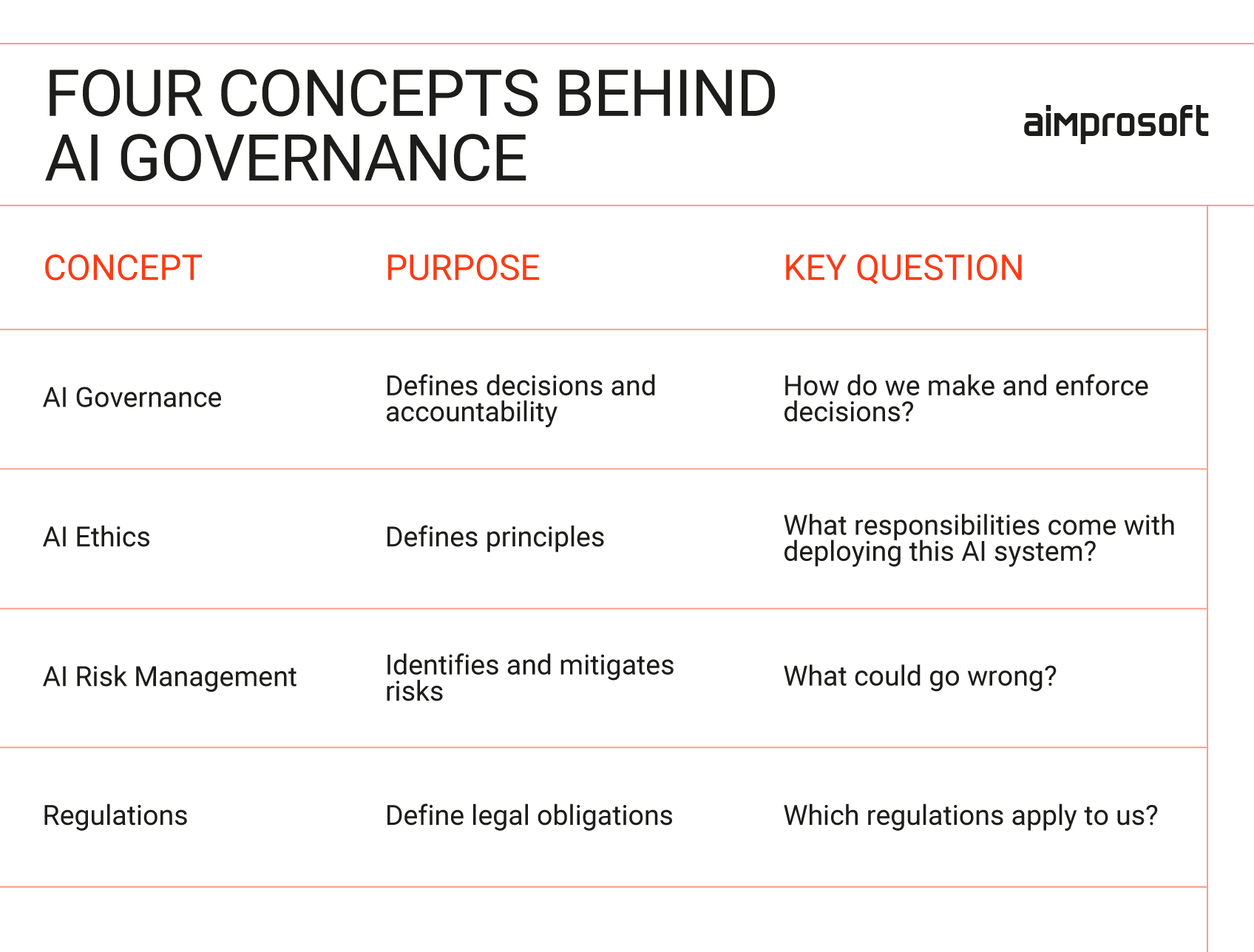
Strictly speaking, governance plays the role of an umbrella that unifies ethical principles, risk management, and regulatory obligations surrounding AI adoption.
Why AI governance breaks as AI adoption scales
The main reason AI risk governance collapses is the inability to expand oversight as fast as business teams embrace AI tools.
When your company uses two to three applications, a simple inventory and one owner is enough to track vendor licenses and basic data access limits. It’s easy to keep tabs on who owns them, what data they have access to, and what risks, if any, they create. But there are several ‘buts’. You can face governance challenges even with just three tools if:
- Teams experiment with publicly available AI tools, often without realizing that sensitive information may be shared with external providers.
- AI capability is part of the broader software stack but influences hiring, pricing, or approvals.
- Connecting a tool to internal databases via APIs creates data pipelines hard to monitor manually.
- If tools used for the purposes the EU AI Act classifies as high-risk, such as HR screening or healthcare decision support, it triggers additional conformity assessment and compliance obligations.
And surely, when the list of AI platforms used passes ten or twenty, informal alignment completely loses its effectiveness.
What AI risk and compliance issues might you confront when AI integration happens faster than expected?
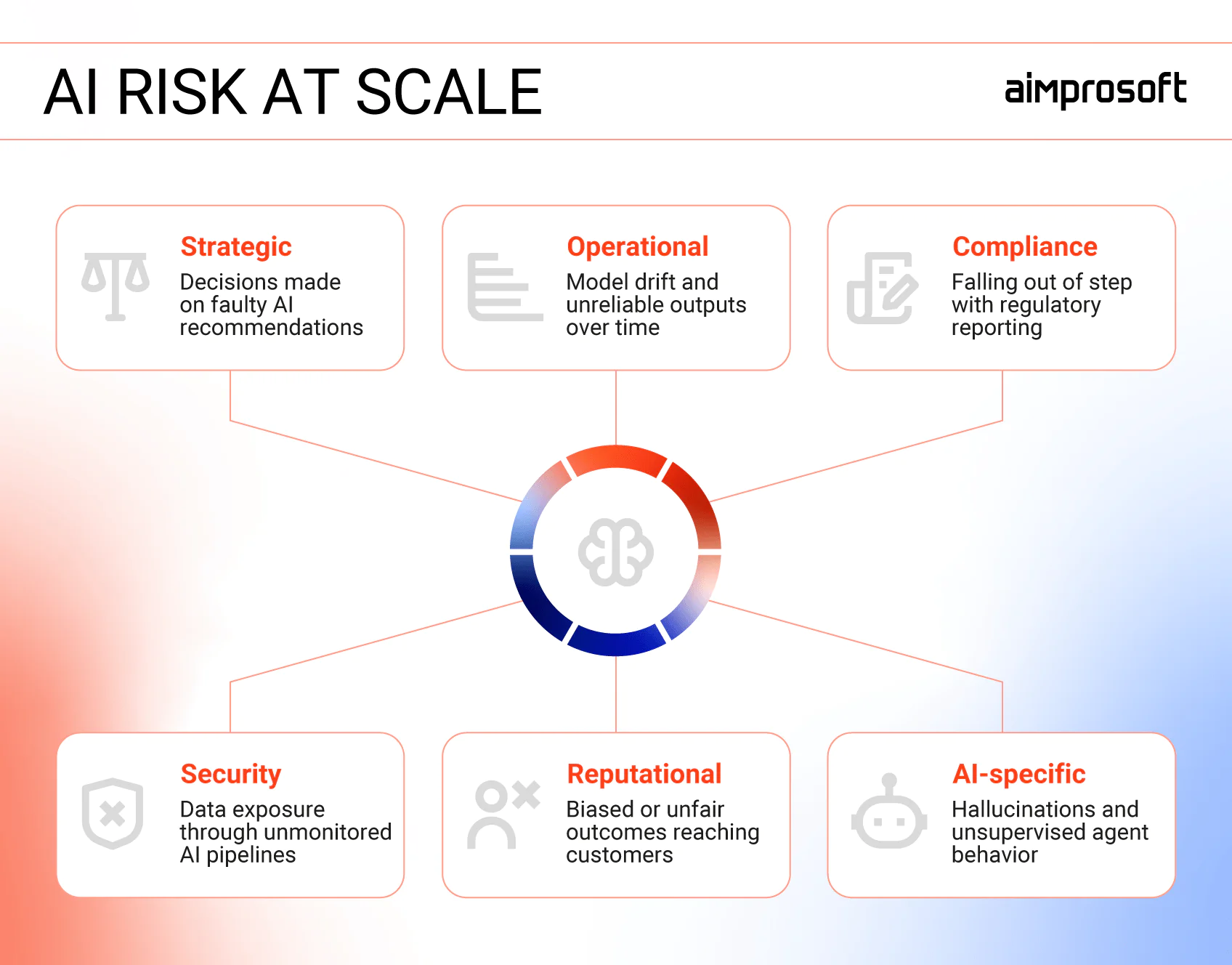
The more AI touches critical business decisions, the more risks you have to cope with. Regulatory compliance for AI becomes more difficult and less straightforward as different systems may be subject to different rules. The pressure to move quickly can lead teams to overlook some approval processes in favor of getting a quick win they can point to. At the same time, bias and fairness issues may go unnoticed because each team has different criteria for review.
The moral of the story is that you can’t manage tomorrow’s AI risks with yesterday’s manual habits, especially given its staggeringly fast adoption. The only way to ride the wave is to build a framework that aligns every team, tool, and workflow under one company-wide standard.
Core pillars of an enterprise AI governance framework
If we break down a working AI governance risk and compliance program into its building blocks, we’ll see how each one carries a different part of the load. While some of them get more attention, having all of them on the agenda, or better integrated with the rest, is necessary to put the framework together.
AI inventory and risk classification
Register of every AI system in use, which you should keep current as tools are added or retired, helps bring order to what’s already running. A complete inventory should cover:
- Internally developed AI systems
- Third-party AI applications
- AI features embedded in business software
- AI tools connected to company data
The role of classification is then to assign each system a risk level based on the data it uses and its potential impact on the business.
For example, a support chatbot helping customers track orders doesn’t need the same depth of review as an AI-powered hiring platform that influences who gets hired. It becomes your get-out-of-jail-free card, so to speak, when auditors or customers ask how AI is being used across the organization.
Policies and accountability structures
Internal standards and responsibility lines give your teams well-defined rules on how AI-related decisions are made. Everyone knows what they need to do to approve a subscription to a new tool or how to safely connect a third-party application. Or at least knows where to find these answers.
Ownership is the second vital piece, which simplifies the resolution of arguable situations. Formalized ownership should assign:
- designated system owners
- risk owners
- business owners
- model owners
- governance committees
Teams spend less time disputing responsibilities if a model goes off the rails and more time solving the problem at hand. Paying decent attention to AI accountability benefits everyone, since it often prevents problems from happening in the first place.
Human oversight and explainability
AI human oversight was and remains the main condition for using AI safely at all. However powerful an algorithm may be, it can produce false decisions, and you can’t blame AI for it. Organizations still need someone who can review outputs and intervene when necessary.
Explainability is the complementary half of the responsible AI frameworks. Regardless of whether you’re using custom solutions or closed-source APIs, from a compliance standpoint, you’re fully responsible for AI explainability. But put it another way, your teams can trace the reasoning to identify the source and fix the issue fast enough to avoid the consequences of letting one bad output snowball into many.
Security and data protection
Proper boundaries around data access help prevent employees from exposing sensitive company information through everyday AI use. The Samsung source code leak through ChatGPT through ChatGPT showed that the absence of any control and protection mechanisms can turn routine AI use into security incident. Intentionally or not, a user can trick AI into revealing data it shouldn’t with a well-crafted prompt.
The thing is, mitigating AI security risks is about policing behavior, data context, and probabilistic outcomes, unlike traditional software, which relies on straightforward door locking. Therefore, thoughtful data governance for AI is your best defense, since the threat doesn’t look like one.
Monitoring, auditing, and regulatory reporting
Continuous oversight and audit trails let companies verify whether their policies are enforced and produce the intended outcomes, which is the ultimate goal of any AI governance effort. You can’t call a PDF file stored somewhere on SharePoint and used only when clients ask, a working framework. Another crucial moment is that, despite the common treatment of monitoring as an instrument for catching misuse, in fact, it supports:
- visibility into actual AI usage
- understanding whether tools are used as intended
- monitoring costs and adoption
- identifying unused licenses
- measuring business value
Continuous governance review cycle
An AI governance framework is a living system you should keep up to date so the policies you enforce match your current realities. And those conditions change really fast:
- New tools come into use
- Regulations evolve
- Business priorities shift
- Employees find new use cases, etc.
The goal is not to rewrite policies every quarter but to check whether your AI governance framework is still useful and relevant. Periodic reviews help organizations identify gaps, retire outdated controls, and strengthen governance practices to better respond to emerging risks and opportunities. This is one of the most overlooked AI governance best practices that determines whether governance becomes part of everyday operations.
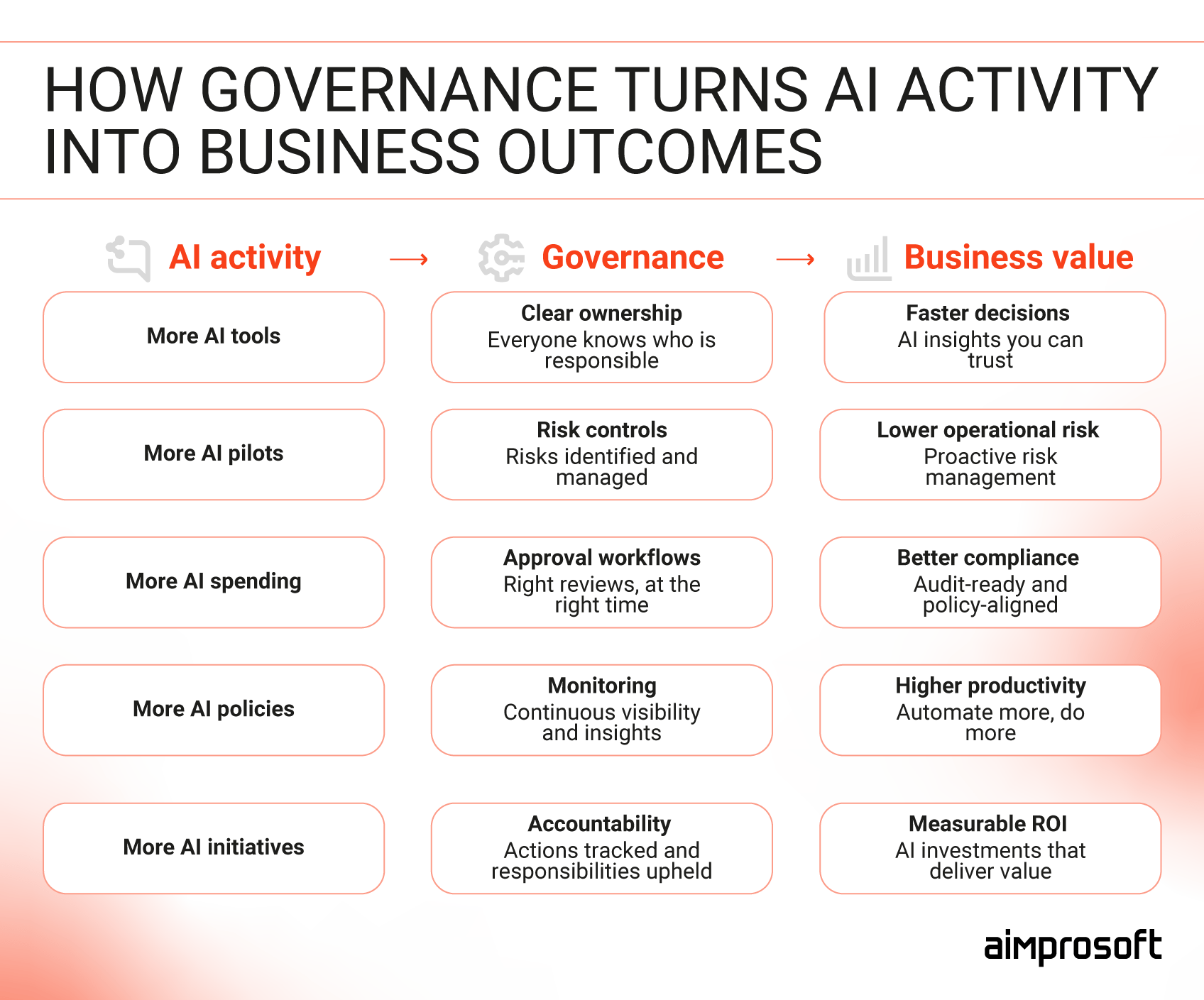
AI Governance Maturity Model
Let’s be honest, rarely will an organization start its familiarity with AI by developing a governance framework. Usually, they start by using a handful of AI tools to solve real business problems and don’t think about governance until something forces the question. It can be a client asking for your AI policy or a certification requirement. And there’s absolutely nothing wrong with that.
So, where does it leave you? The five stages below give you a quick way to assess your AI readiness and find out what to do about it.
Level 1. No formal governance
AI adoption happens naturally as employees experiment with tools that help them work faster. But you can barely tell who uses which tool, what data is being shared, or who is responsible for the outcomes. At this stage, even basic AI risk assessment is difficult because the organization lacks both internal policies and a way to track AI usage.
Warning signs:
- Teams adopt AI independently
- No inventory
- No policies
Next priority: Create visibility. Revise what AI systems are already in use, who is responsible for their use and management, and which business processes they are supposed to improve. These are the basic elements of visibility that make governance possible.
Level 2. Controlled Pilots
The first signs of governance appear once the organization launches formal AI initiatives and pilot projects. Teams may, on their own initiative, introduce approval processes or usage guidelines for selected use cases. However, these controls live only within individual projects. In this setup, responsible AI in the enterprise depends more on the people leading the pilot than on consistent governance practices.
Warning signs:
- Governance exists only for pilot projects
- Similar AI tools are reviewed differently by different teams
- New use cases require reinventing the approval process
Next priority: Build classification and ownership. Take what the pilot proved — which use cases are low-risk, who should own a given system, and the rest — and turn it into rules that apply company-wide.
Level 3. Defined Governance
At this stage, governance more closely resembles what it should be, with written policies, defined review steps, and owners. Now, the challenge is to operate the governance efficiently. What we mean is that the approval process or review criteria for the low-risk note-taking tool may not be as strict as for, let’s say, a loan scoring app, which bears far greater risks. Because it will delay approval without a reason.
Warning signs:
- Governance slows innovation
- Reviews become bottlenecks
- Teams find informal workarounds to avoid the approval process
Next priority: Introduce proportional governance that matches each system’s risk level to keep bureaucracy to a minimum for routine applications and give more attention to those that deserve it.
Level 4. Managed cross-functional governance
Governance is no longer owned by a single team. Legal, security, compliance, IT, and business stakeholders work together within a shared operating model, making AI risk management more consistent across the organization. This means you can confidently pass an AI risk audit today, but the process is so document-heavy that it slows down your product deployment and cross-departmental velocity.
Warning signs:
- Teams spend significant time preparing audits and reports
- Budget and usage oversight sit in different departments with no single owner
- Governance is enforced but not yet embedded into standard workflows, like onboarding
Next priority: Automate monitoring and reporting. Use tooling to simplify reporting and policy management while gaining better visibility into costs and compliance status in one place.
Level 5. Scaled governance embedded into the AI lifecycle
Governance stops feeling like governance anymore and becomes a natural part of how the organization works. A new hire in any department is onboarded to the approved AI tools with the appropriate access levels as part of the standard process. Just as they get a laptop and a Slack account.
Focus: Continuous optimization and KPI-driven improvement. Use governance data to refine policies, streamline reviews, and identify opportunities for improvement. This lets you understand whether your governance model continues to support the responsible use of AI.
Proportional Governance: The Key to Managing AI Risk at Scale
Most teams assume governance slows AI down. And partially they’re right, but not for the reason they think. Some oversight is necessary for every AI system. However, legal reviews, security assessments, audits, and approvals all require time from people whose schedules are already full. If you apply the same review process to every AI tool, high-risk initiatives compete for attention with low-risk ones.
That’s where the application of proportional governance can do the trick. The idea is simple: you apply different levels of oversight based on the risk a system poses to the business, customers, employees, or regulators.
For example, an internal summarization tool may only require periodic review of outputs, as any inaccuracies can usually be corrected after the fact. A hiring or healthcare application, on the other hand, needs stricter controls and documented approvals to prevent a harmful or biased decision from affecting someone’s job or finances.
The same principle applies to human-in-the-loop governance. For low-risk systems, it’s enough to check outputs, fix mistakes if needed, and move on. For high-risk applications, however, a responsible person should approve every AI result before the team can use it to make a decision.
Risk-based governance allows organizations to remain agile in terms of speed and innovation while still having a strong AI compliance framework.
6 steps to implement an AI governance framework
By now, building AI regulatory frameworks may seem like a massive undertaking, even tantamount to reinventing half of your internal processes. However, that’s not a one-day company-wide transformation project. What you need after assessing your current state is to go step by step and add one layer of governance after another until a coherent operating model begins to take shape.
1. Discover and document AI usage
Review software subscriptions and expense reports for AI-related purchases and ask department leaders which tools their teams use. And don’t forget to include software with AI features and AI-assisted software development workflows, which are often overlooked because they don’t appear in procurement records. For each system, document the following:
- What the tool does
- Who owns or uses it
- What data does it access
- Whether it was formally approved
Finally, create a simple process for registering new AI tools. Otherwise, your inventory will be outdated very quickly. And don’t be surprised to find several unofficial tools or use cases that were adopted through personal subscriptions or simple experimentation.
2. Classify systems by risk and impact
To assign the appropriate level of risk to each system, consider these four axes:
- Business impact. How much influence does the system have on decisions related to hiring, lending, health, or legal outcomes?
- Data sensitivity. How sensitive is the information processed by the system?
- Level of autonomy. Does the system assist humans or act on its own?
- Ease of reversal. How difficult would it be to correct a mistake after a decision has been made?
Use the results to group systems into risk tiers and define the corresponding level of oversight.
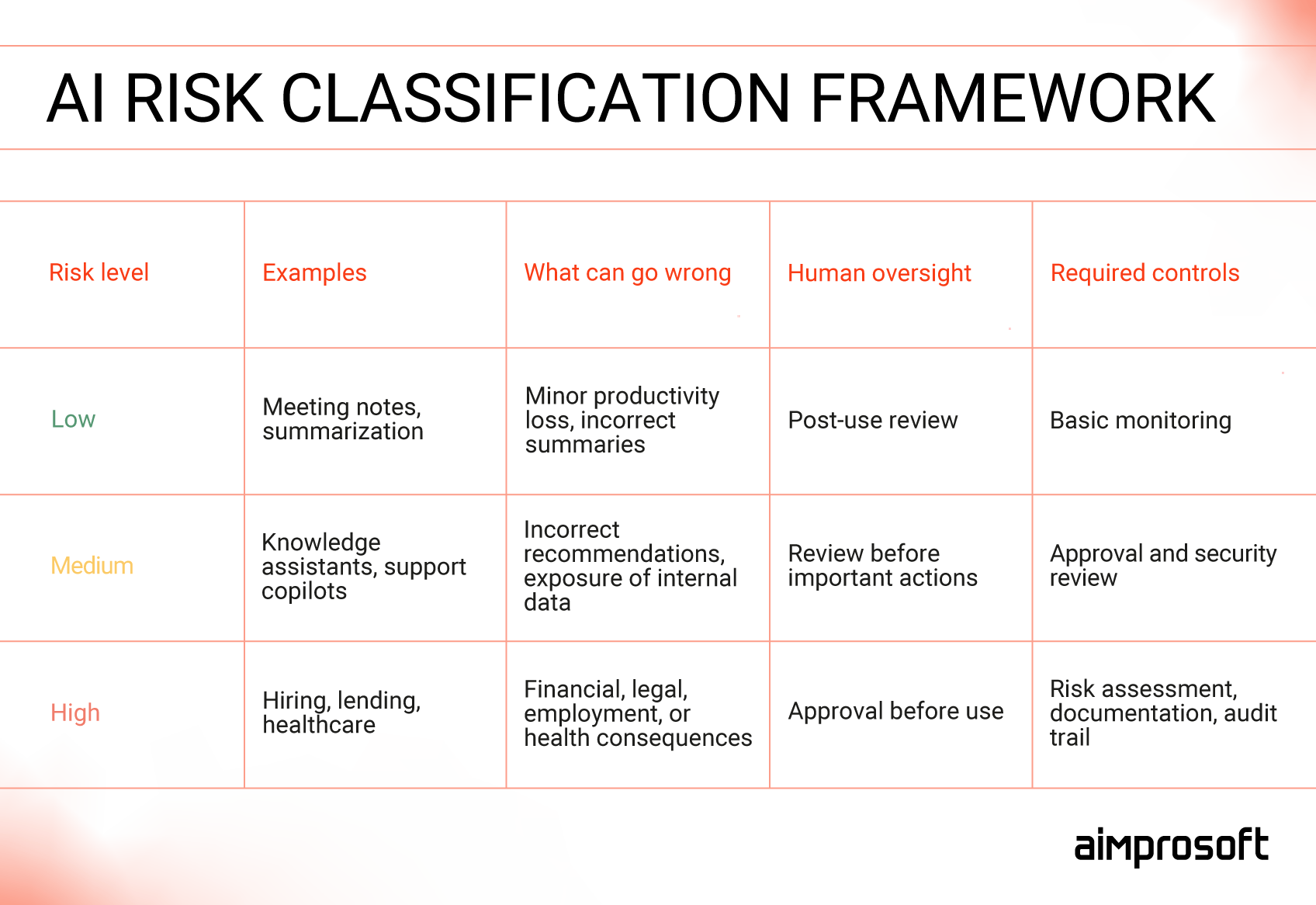
Record the assigned risk tier alongside each AI system in your inventory. Revisit risk profiles whenever a tool gains access to new data, becomes more autonomous, or starts supporting business-critical decisions.
3. Define approval and escalation paths
Create a simple approval matrix specifying who reviews AI systems at each risk level and under what circumstances the involvement of additional stakeholders is required. As a starting point, you can use a structure similar to the one below:
| Decision | Low risk | Medium risk | High risk |
| New AI tool approval | System owner or manager | System owner + security review | Governance committee |
| Access to sensitive data | — | Security review | Security + legal/compliance review |
| Customer-facing deployment | — | Manager approval | Governance committee review |
| Significant model or use-case changes | System owner review | Risk owner review | Full reassessment |
| Policy exceptions | Manager approval | Risk owner approval | Committee approval and documentation |
From there, define the specific triggers that will automatically route a system for additional review, such as:
- Access to sensitive or regulated data
- New customer-facing functionality
- Increased system autonomy
- Significant changes to the underlying model or data sources
- Regulatory or audit concerns
Document these workflows in a place where teams can easily find them, and make them part of procurement, deployment, and vendor review processes. Assign a clear owner to every single approval, exception case, and escalation path. This is the only way to maintain algorithmic accountability and avoid those “who was actually in charge here?” situations.
4. Assign cross-functional ownership
Define the roles responsible for driving your governance strategy and managing AI models at every stage of their lifecycle. Here’s a simple governance model where job titles might vary from company to company, but who does what must be well-mapped and transparent.
CAIO, CDO, or AI program lead — owns the governance strategy and coordinates activities across teams.
Legal and compliance — interprets regulatory requirements and reviews high-risk use cases.
Security team — evaluates data access, integrations, and security controls.
Business units — own the AI systems used within their functions and validate business outcomes.
Data and AI teams — maintain models, documentation, and technical controls.
Governance committee — handles escalations and reviews high-risk decisions.
Then create a responsibility matrix that specifies who owns:
- AI system inventory maintenance
- Risk classification updates
- Policy management
- Incident response
- Audit preparation
- AI regulatory reporting
- Training and awareness
5. Embed governance into business processes
Take a look at how your teams approach procurement, development, onboarding, or vendor management. Chances are, they already have some approval or review process in place. So, instead of inventing new governance workflows, add AI-specific checks to those existing checkpoints.
Procurement is often the easiest place to start. A few additional questions to the existing software approval process about data access, AI capabilities, and intended use can be enough to trigger the appropriate level of review. From an employee’s perspective, nothing changes. From a governance perspective, every new AI tool goes through a quick check before it’s approved for business use.
6. Implement tooling and continuous monitoring
As AI usage matures, you may discover that updating inventories or ownership records manually becomes difficult. That’s a moment for introducing governance tooling. The right solution depends on what you need to track and how many AI systems you manage. Most organizations can start with existing reporting and security tools.
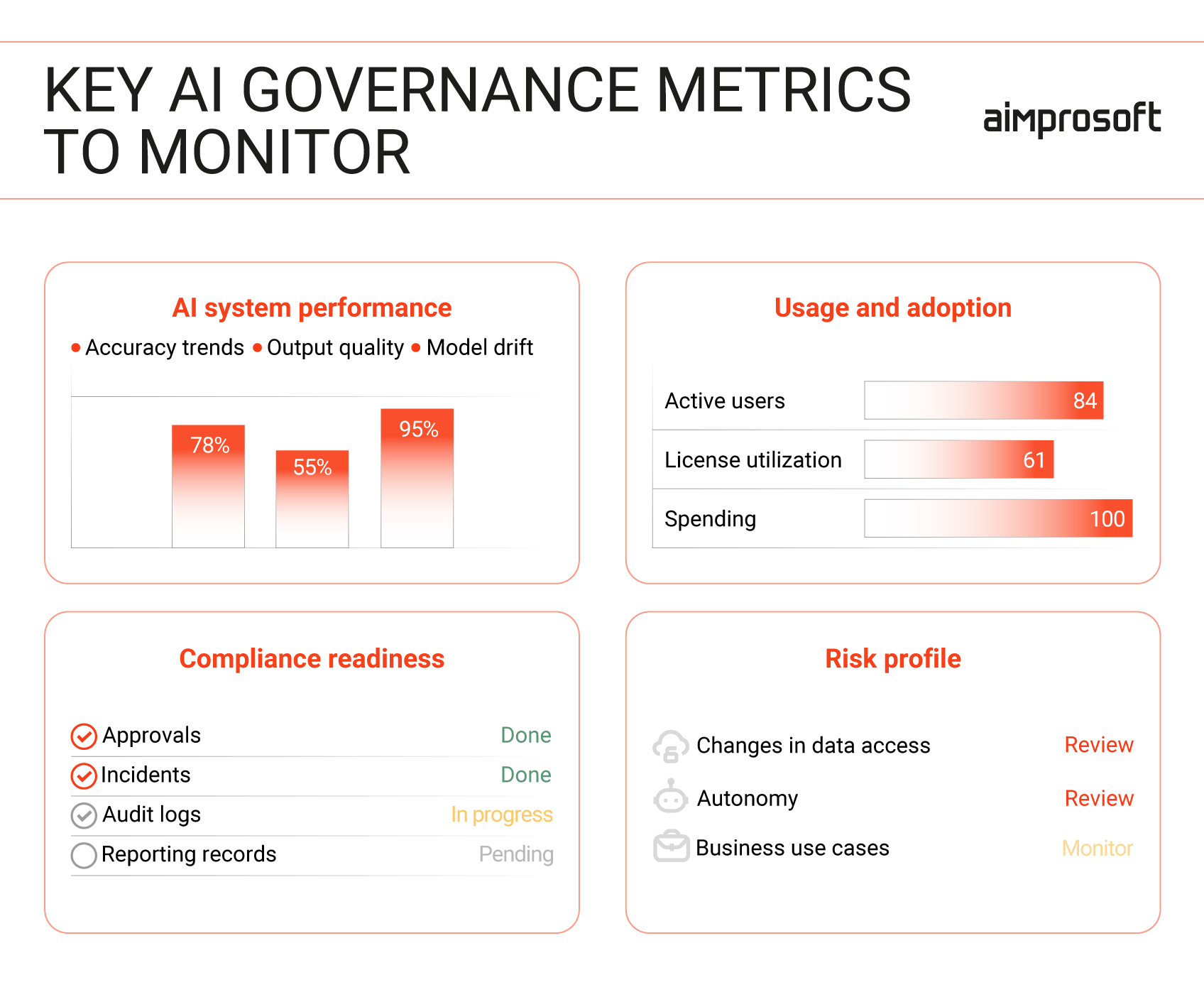
Pay particular attention to unused licenses and usage patterns that may reveal tools being used for purposes beyond the original intended scope. Monitoring not only aims to catch compliance gaps. It shows whether the organization is getting value from its AI investments and identifying opportunities to improve tool adoption.
Make governance metrics part of quarterly business reviews alongside operational, financial, and risk metrics. This is one of the simplest ways to embed responsible AI in the enterprise into routine decision-making.
Want these steps mapped to your tools, team, and regulatory reality?
Aligning your governance framework with regulatory requirements
Many teams see AI governance as another legal requirement to satisfy, but regulations and governance frameworks play different roles. Some impose legal obligations, while others provide guidance on how to build and operate a governance program.
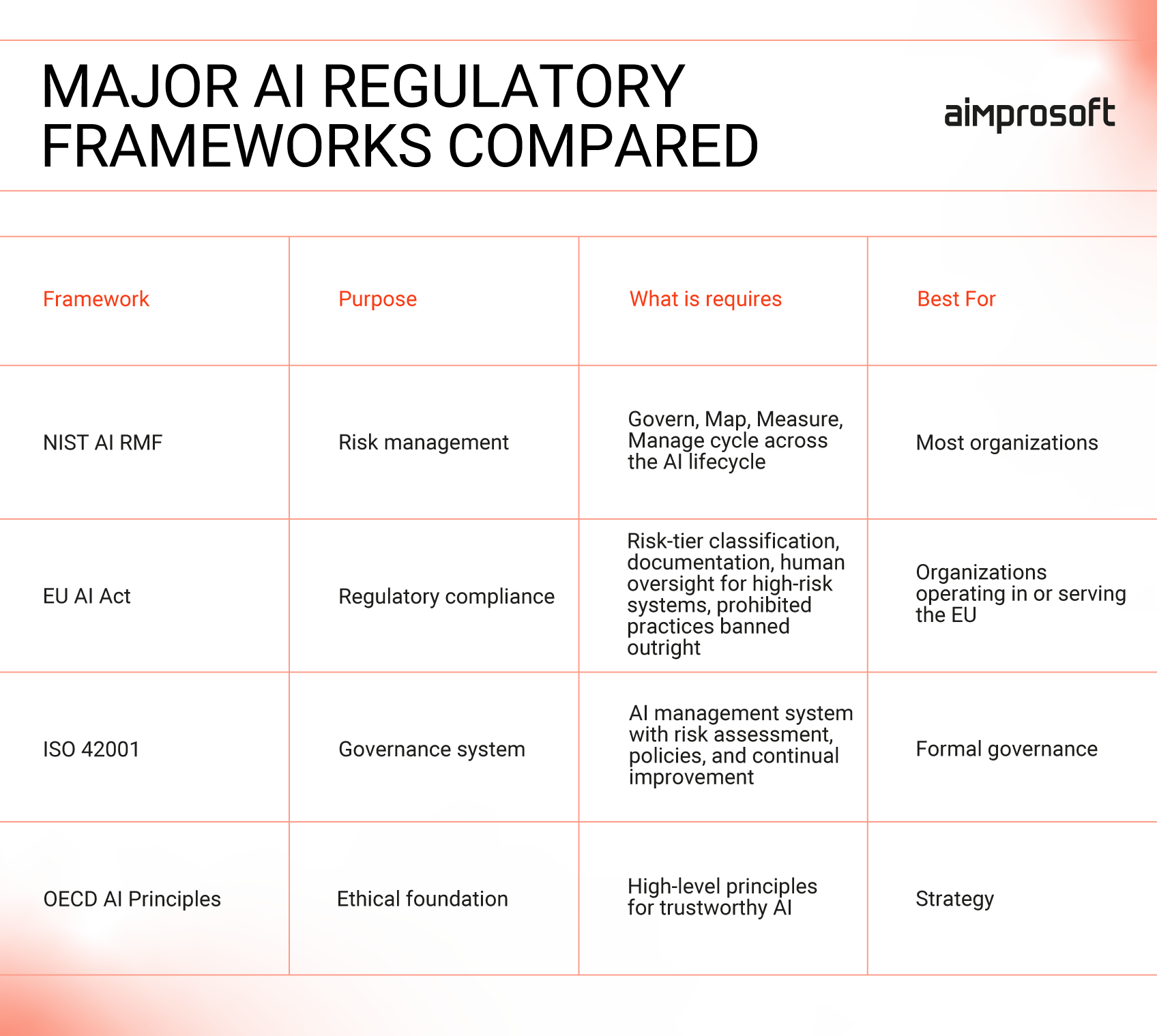
It’s also important to separate regulatory classification from internal risk classification. Put simply, regulations define legal obligations for certain AI systems, while your company decides how much oversight a concrete system requires in practice. For example, the Act may require human oversight for a high-risk hiring system. But your AI data governance framework specifies that HR must approve every AI-generated shortlist.
The key takeaway is that your legal boundaries depend more on how risky an AI system is than on the industry in which it’s used.
Common mistakes when scaling AI governance
You may ask what can go wrong when you have all the policies and governance structures in place. The crux is that day-to-day implementation is where many governance challenges originate.
1. Treating governance as a legal exercise.
Result: Risks are discovered late, and redesigning a workflow becomes far more expensive.
Fix: Involve business, security, and technical teams from the beginning to enable ethical AI development and adoption. This is especially important during the planning stage as governance gaps can be fixed with minimal loss.
2. No visibility into AI usage.
Result: Shadow AI opens the door to security leaks, compliance penalties, and operational headaches.
Fix: Set up a process for registering and reviewing new AI systems before usage.
3. Governance owned by a single department.
Result: Reviews slow other processes, and everyone points fingers when issues arise.
Fix: Establish cross-functional ownership with clearly defined responsibilities and decision-making authority.
4. Policies written once and forgotten.
Result: Governance slowly loses touch with your business goals and actual AI usage.
Fix: Review your AI policy regularly, ideally during audits, incidents, or major system updates.
Measuring success: KPIs for AI governance
Satisfying auditors is the last goal of the AI governance framework. Above all, AI governance framework should simplify AI workspace extension and create measurable business value. Here are a few metrics that can help determine whether it’s actually doing that.
- Visibility. Percentage of AI systems inventoried and risk-classified. If the number isn’t close to 100%, governance hasn’t reached everything it needs to.
- Efficiency. Average time from AI tool request to approval. A falling number means governance is becoming part of the workflow.
- Risk. Number of incidents per quarter and mean time to remediate. A declining incident rate over time is the clearest signal that AI policy implementation is working.
- Compliance. Audit pass rate and open regulatory findings. The metric legal and compliance stakeholders will ask for first.
- Business impact. Track AI adoption across business units in parallel with the utilization of licensed tools and the outcomes they enable, such as time savings or faster delivery. Because the number of active Copilot seats tells you nothing about whether its usage benefits the company in any way.
Putting it all together
Despite the common belief that AI governance is a paperwork beast, it’s a major enabler of AI innovation. Done right, it creates favorable conditions for teams to experiment and scale AI safely and responsibly while getting more value from AI investments.
If you look back a year from now and see more AI tools, spending, and policies, but not more value, something went wrong. This article provides enough guidance to identify governance gaps and begin addressing them. Yet, if you don’t want to spend another month or two guessing, contact Aimprosoft’s AI consulting team to accelerate the time to your first business wins.