How to Choose the Right AI Development Partner: 7 Must-Know Criteria
Published: – Updated:

You’ve decided AI is the direction. You can’t build it internally and, most importantly, getting it wrong isn’t just a budget problem. It’s six-twelve months gone, a system you have to tear out, and the same decision again from scratch.
So, you started looking at providers of AI consulting services. They all have case studies, a proven process, and someone who’ll say “partnership” in the first call. You have ten tabs open and no clearer idea of who to hire.
Part of the problem is that “AI project” can mean almost anything from a genuinely intelligent system to a manual workflow with one automated step bolted on. Both get sold with the same confidence.
Choosing an AI agencys is easier when you know which questions to ask. Here are 7 criteria to cut through that and spot warning signs before you sign anything.
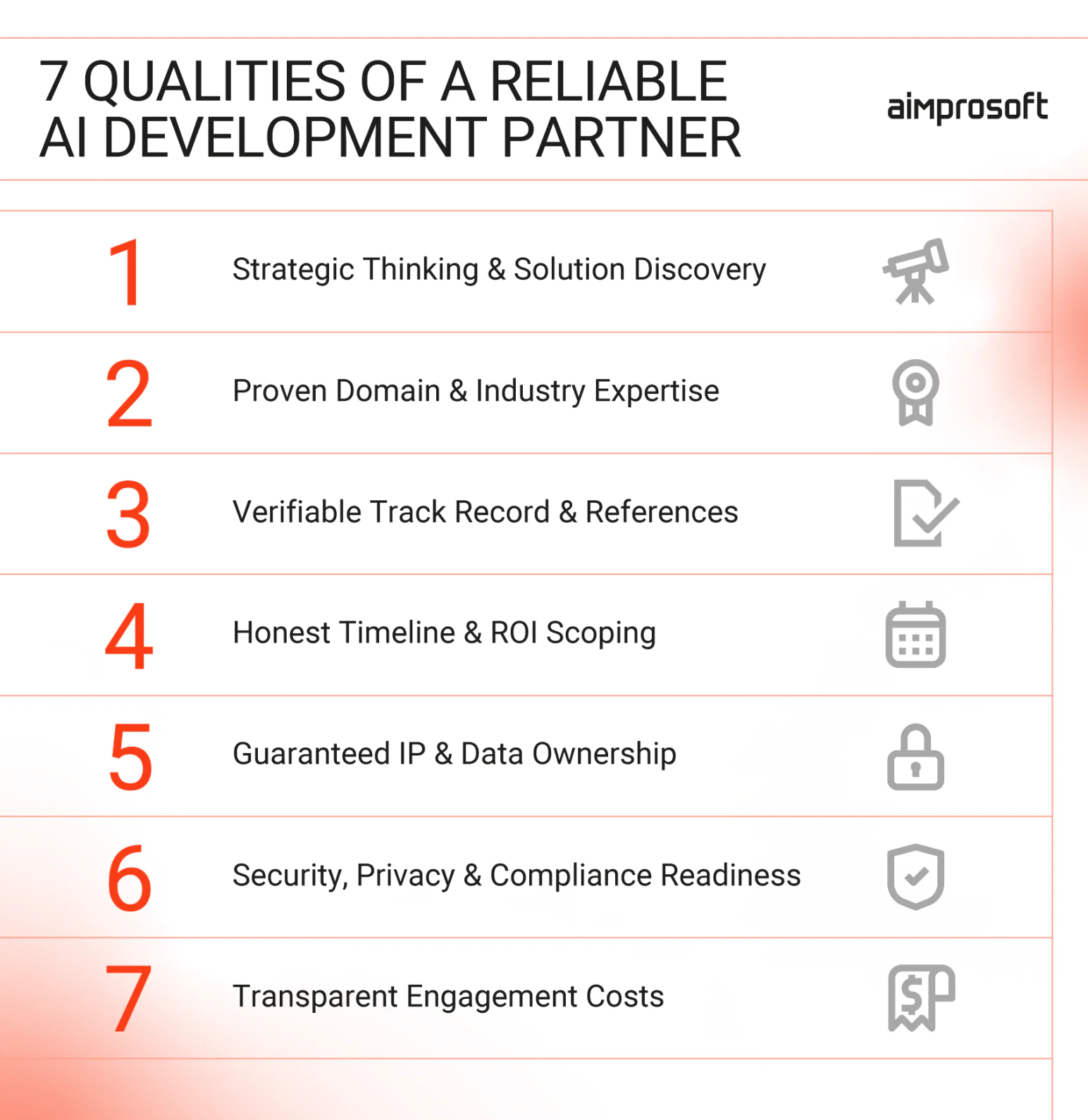
1. Industry and domain experience
An AI and ML development services provider without experience in your industry will spend the first few months of your project learning the nuances. That usually translates into rework, delays, and avoidable costs.
To implement AI for finance organizations properly, an AI outsourcing company should understand specific regulations, real-time processing, and the constraints those requirements introduce across the system. Healthcare AI is a completely different story with its own set of rules.
Even if the vendor is an excellent AI specialist, the absence of the relevant domain experience slows delivery at best. In the worst-case scenario, a development team could make wrong architecture and data choices.
What to look for in an AI development services provider
Ask for AI development case studies from your industry with concrete business outcomes. Then dig into the details and ask:
- What challenges or constraints shaped the project?
- Which regulations, data limitations, or operational realities affected the implementation?
- What would they do differently today?
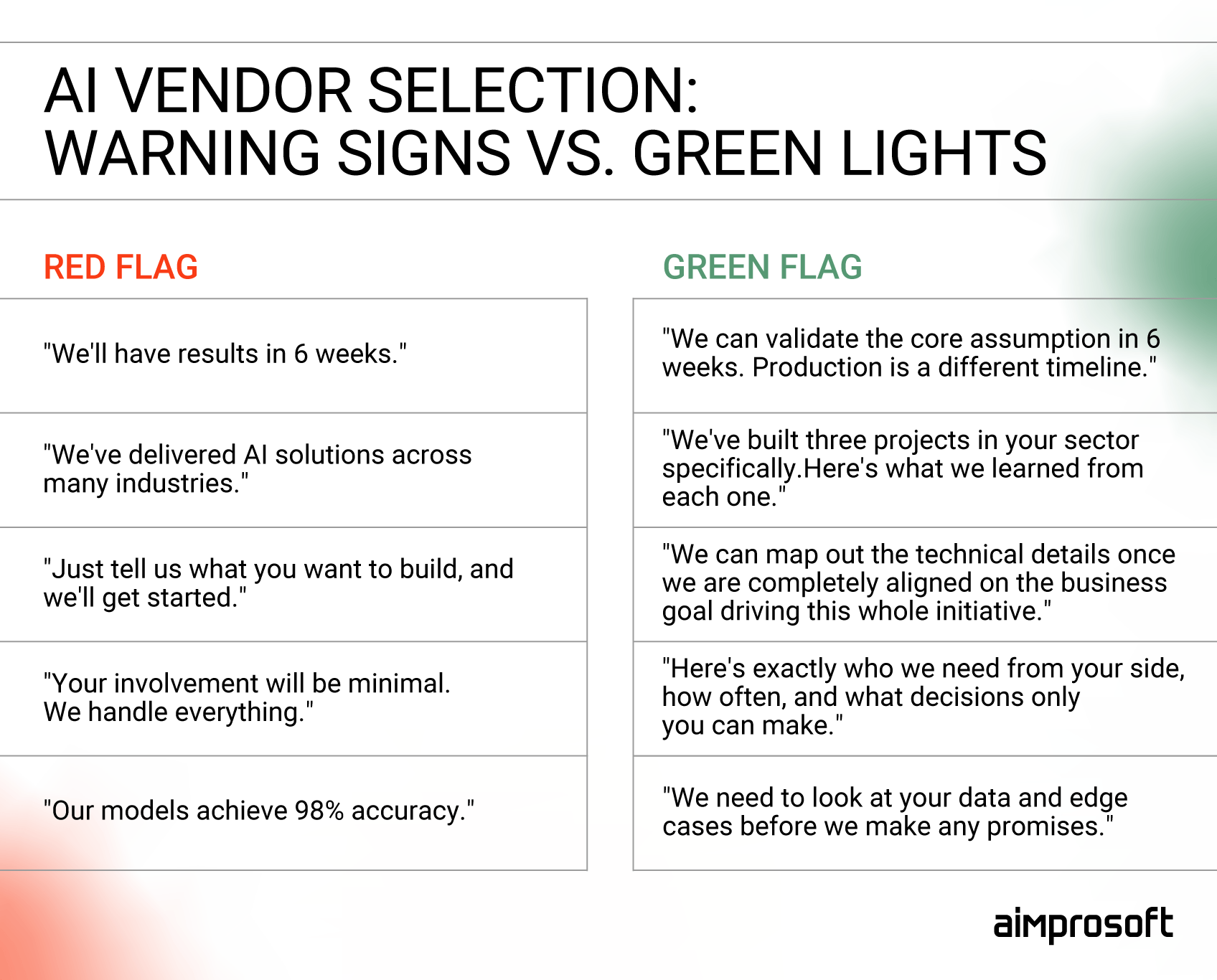
When developers know your niche, they’ll share stories about what went wrong and how they fixed that. Generic claims about “delivering AI solutions across industries” often mean the company lacks deep expertise in any one of them.
2. Proof beyond the portfolio
Every AI consulting and development firm will have case studies showing they’ve delivered something. What they rarely show is what went wrong or whether the client would hire them again. Part of the problem is that a case study looks the same whether the vendor built custom AI or just connected an API.
Many top AI consulting firms are integrators that connect existing models into workflows. Some wrap the existing models with a custom interface and positioning. Only some build custom models trained on your data. Knowing which type you’re talking to changes how you should interpret their case studies.
Check if there is evidence of:
- Production deployment, not just a demo or pilot
- Post-release support and maintenance
- Named team members with relevant experience
- Measurable before-and-after metrics
- Honest discussion of trade-offs
- References you can speak to
Two checks most buyers skip:
1. Ask to speak with a past client at least 12 months after the project launch. By then, clients can speak honestly about maintenance costs, delivery quality, and whether they got the results they were promised.
2. Ask every shortlisted AI consulting company about the project they walked away from or turned down, and why. It will tell you whether they evaluate fit fairly or take everything that comes through the door.
3. Strategic thinking
The right AI consulting partner won’t rush building what you’ve asked for. Instead, they will question whether it’s the right problem to solve in the first place.
Most often, decision-makers arrive at a vendor with a half-formed solution. They’ve identified a problem, sketched a direction, and are ready to scope the work. A vendor who executes straight on that brief is a delivery team.
If you want results, you should seek a partner that does real AI strategy consulting and thinks in terms of business impact, not project scope. Such a partner will challenge your assumptions and recommend a simpler, higher-leverage approach you hadn’t considered, taking into account your resources and capabilities. AI consulting for small business, for example, should be geared towards making the most of limited budgets and leaving less room for failed experiments. That’s how a true partnership looks.
Otherwise, you may end up building exactly what you requested but not what you needed.
3 test questions for the first call
- What business outcome should this initiative improve, and how will we know it worked?
- Is there a simpler solution we should rule out before committing to AI?
- What part of this initiative would concern you the most at this stage?
A vendor who takes these questions seriously wants to solve your problem. One who ignores them is just trying to ship code and invoice you.
4. Realistic promises
If an AI integration consulting vendor promises impressive results within weeks without narrowing the scope to a single, well-defined process, be skeptical.
Once implementation starts, reality usually looks very different. A provider discovers data split across 20+ legacy systems that can’t be connected to anything built after 2015. And a business process that turns out to have dozens of undocumented exceptions. That’s how a six-week timeline turns into six months.
ROI timeline reality
A well-scoped PoC now takes days to build, since coding is largely automated. Development teams spend most of their time gathering requirements, testing, tackling client feedback, integrating with existing systems, creating documentation, and managing compliance obligations. That side of enterprise AI development hasn’t gotten faster.
| Stage | What drives the timeline |
| Proof of Concept | Days to build; weeks to validate |
| Production MVP | 2-8 weeks of development; 3-6 months total, including integration, testing, and compliance |
| Measurable ROI | 12-18 months |
Timelines depend on how quickly your side can align on requirements, review outputs, and handle approvals. No AI outsourcing services company fully controls these factors.
Be cautious of vendors who cut corners without explaining what’s being skipped and why. Be equally cautious of vendors unwilling to commit to any timeline at all.
That misalignment never gets a chance to form when you choose the right partner.
5. Data ownership, IP, and what’s in the contract
Don’t assume you own the result when outsourcing AI development; make sure the contract states so. Unfortunately, the question of ownership is more common than many think, and the presence of AI adds to the complexity.
In traditional software development, owning the code means owning the product. In AI development outsourcing, code is only 10-20% of the equation. The trained model itself, data pipelines, and prompt architecture designed around your data are where the real value resides. And none of them are automatically included in a standard IP clause.
5 clauses to insist on
- IP ownership: all models, pipelines, and code built on your project belong to you
- Data usage scope: your data cannot be used to train systems for other clients
- Security and authorization: documented protocols for who can access your data and when
- Exit clause: full code and model handover if the engagement ends
- Post-deployment support terms: clearly defined SLAs for what happens after launch
If you’re unsure which clauses apply to your project, an AI governance framework can help you define the right controls and terms to address.
6. Compliance, security, and regulatory fit
A strong AI strategy insights provider should come into the project with a working understanding of your regulatory landscape. This knowledge influences many technical decisions. Missing that expertise, AI outsourcing companies can build a technically sound system that gets stuck in legal review for six months.
The EU AI Act introduces mandatory risk assessments and strict transparency rules for high-risk AI. GDPR is still actively enforced, and depending on your industry, HIPAA or PCI DSS may also apply.
Not all top AI implementation companies for IT consulting have hands-on experience dealing with these frameworks. Some know the theory. Even fewer have managed it for real projects.
What to verify before signing
- Has the vendor worked under your specific regulatory framework?
- How seriously do they approach compliance? Is it a part of their discovery phase, or a secondary concern?
- Who is responsible for compliance decisions on their team, and what kind of hands-on experience do they bring?
- How do they handle a scenario where a technical solution conflicts with a regulatory requirement mid-project?
AI didn’t change the principles of security or transparency. It just added more questions, and a vendor unfamiliar with your framework won’t know which ones to ask.
7. Total engagement cost
Paying a top AI solution provider for their work goes without saying. What vendors don’t advertise up front is the time and involvement on your side. Your team will have to spend their time onboarding the partner, reviewing the deliverables, providing feedback, and making decisions only you can make.
And you know what? If you’re available daily, the project moves accordingly. A vendor who tells you otherwise is either trying to close the sale or hasn’t scoped it properly.
Low-risk entry point
Use a scoped discovery or a small paid pilot as an opportunity to see how comfortable you’re working together. This low-commitment engagement lets you assess the provider’s communication style and day-to-day methodology.
If top IT companies offering AI consulting demand a massive contract with no option of this kind of pilot, that should set off alarm bells. A quick 4–6 week validation phase is a safety net for both parties, helping avoid a promising project being doomed by misaligned expectations.
Bottom line
The AI management consulting vendor market won’t get less crowded or less confusing. If anything, the noise is only growing. What changes is whether you walk into your next vendor conversation knowing what to ask, what to listen for, and what should raise concerns.
Download the vendor evaluation checklist and take it into your next discovery call, or get in touch if you’d like us to be the partner on the other side of those questions.
FAQ
How much does hiring an AI development partner typically cost?
Prices range from $50,000 to over $250,000 for a production-ready engagement, with scope and integration complexity influencing the final number. Ready-made AI with a custom interface costs considerably less than custom model development and enterprise integrations. A scoped discovery or pilot to validate the idea will cost you $10,000–$30,000.
What’s the difference between an AI consultant and an AI development partner?
An AI consultant advises on overall strategy and most promising use cases, but typically doesn’t build the software. An AI development partner designs, builds, and delivers working systems. Many firms claim to do both, but in practice, some consult and outsource the build, others build but lack the business acumen to guide your strategy. Make sure the contract covers who owns the strategy, who owns delivery, and whether that is the same vendor you’ve been talking to.
How do I know if a vendor can actually deliver?
After completing due diligence on the vendor’s background and deciding they meet the bar, begin with a low-risk pilot to assess their responsiveness in communication and their day-to-day handling of project requirements. Benchmark what they deliver against what they promised in terms of delivery time and quality, then decide whether to scale. If you do, to protect yourself further, include in the contract KPIs tied to delivery milestones and remedies for non-fulfilment.
How do I evaluate an AI development partner if I’m not technical?
Skip the technical evaluation and assess the factors you can judge:
Their communication in plain language that makes sense to you
Their commercial focus
Their transparency regarding ownership
Their alignment with your industry rules
Their willingness to start small
If they meet your expectations, request references from clients in a similar business context, and ask how they would assess the partner on both the business and technical fronts. To cover the technical part, you can hire an independent reviewer for the proposal stage only.