How to Choose an AI Readiness Assessment Provider: 7 Questions to Ask Before You Sign
Published: – Updated:

It’s not difficult to find a firm offering an AI readiness assessment; there are plenty. What is hard is figuring out which one will give you an honest answer when that answer is “you’re not yet ready.”
The reason is natural. Any firm that sells AI implementation has a commercial interest in your project moving forward. That conflict of interest doesn’t make an assessment worthless, but it does make it worth honest discussing before you sign anything.
This guide will help you ask the right questions beforehand. By the end, you’ll know how to choose an AI readiness assessment provider – and what answers to watch out for.
What makes a readiness assessment provider different from a general AI consultant?
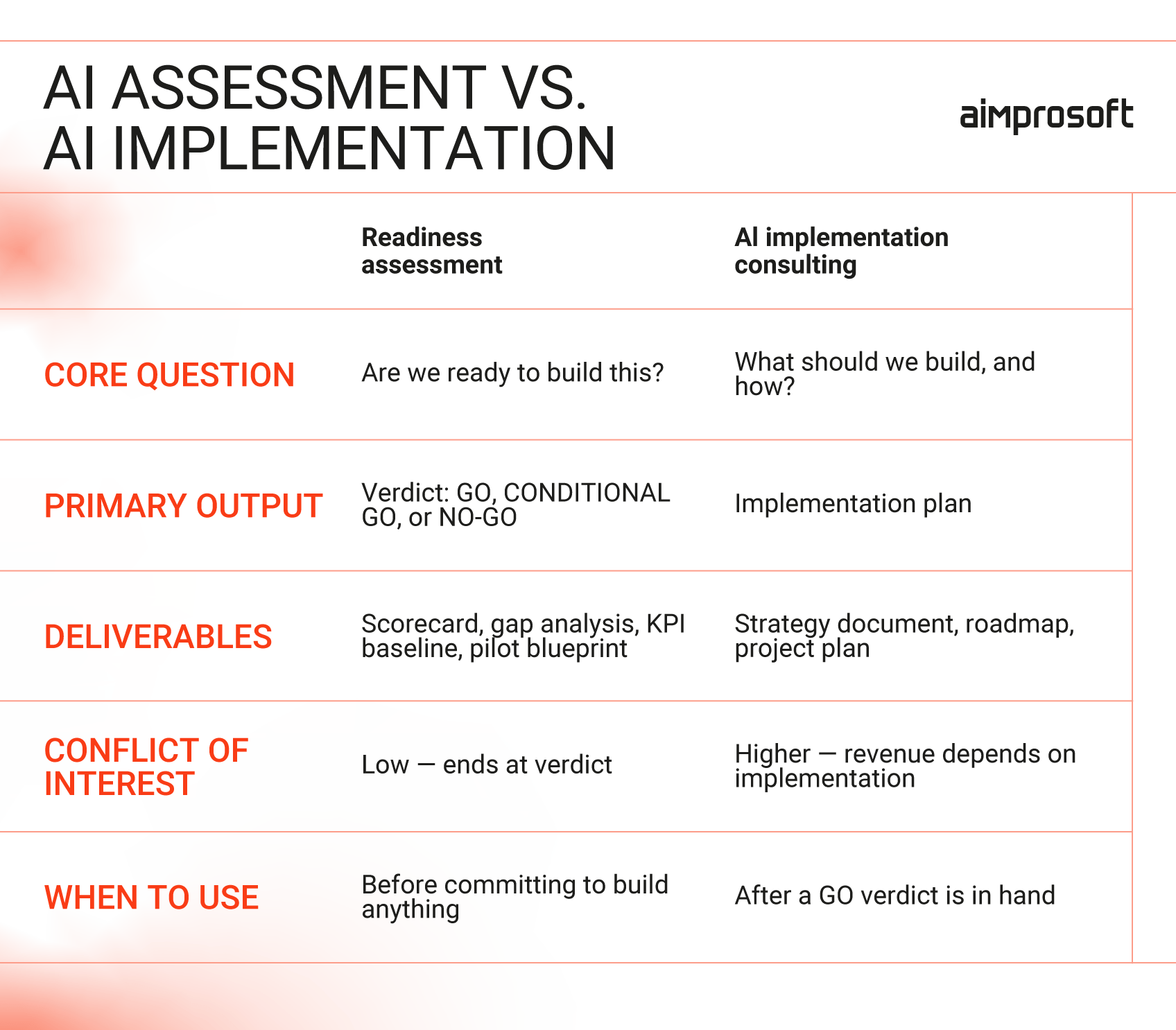
At first glance, these two engagements look very similar. They imply running interviews, documentation review, and a findings session. The difference lies in what each one delivers and the questions they are meant to answer.
AI implementation strategy answers “What should we build, and how?” An assessment determines whether the organization is ready to build the thing it’s considering. And, if not, what would have to change.
Assessment ends with a verdict: GO, CONDITIONAL GO, or NO-GO. Strategy culminates in an implementation plan. Buying the plan before you have the verdict is doing the work backwards. You commit to building a thing before you know whether your processes, data, infrastructure, or governance can realistically support it.
AI readiness assessment provider selection: 7 questions to ask
Question 1: What dimensions does your framework cover and why?
A credible provider can explain their AI readiness assessment framework in a couple of minutes and justify every dimension in it. Ask them what each one catches and why the framework is shaped the way it is.
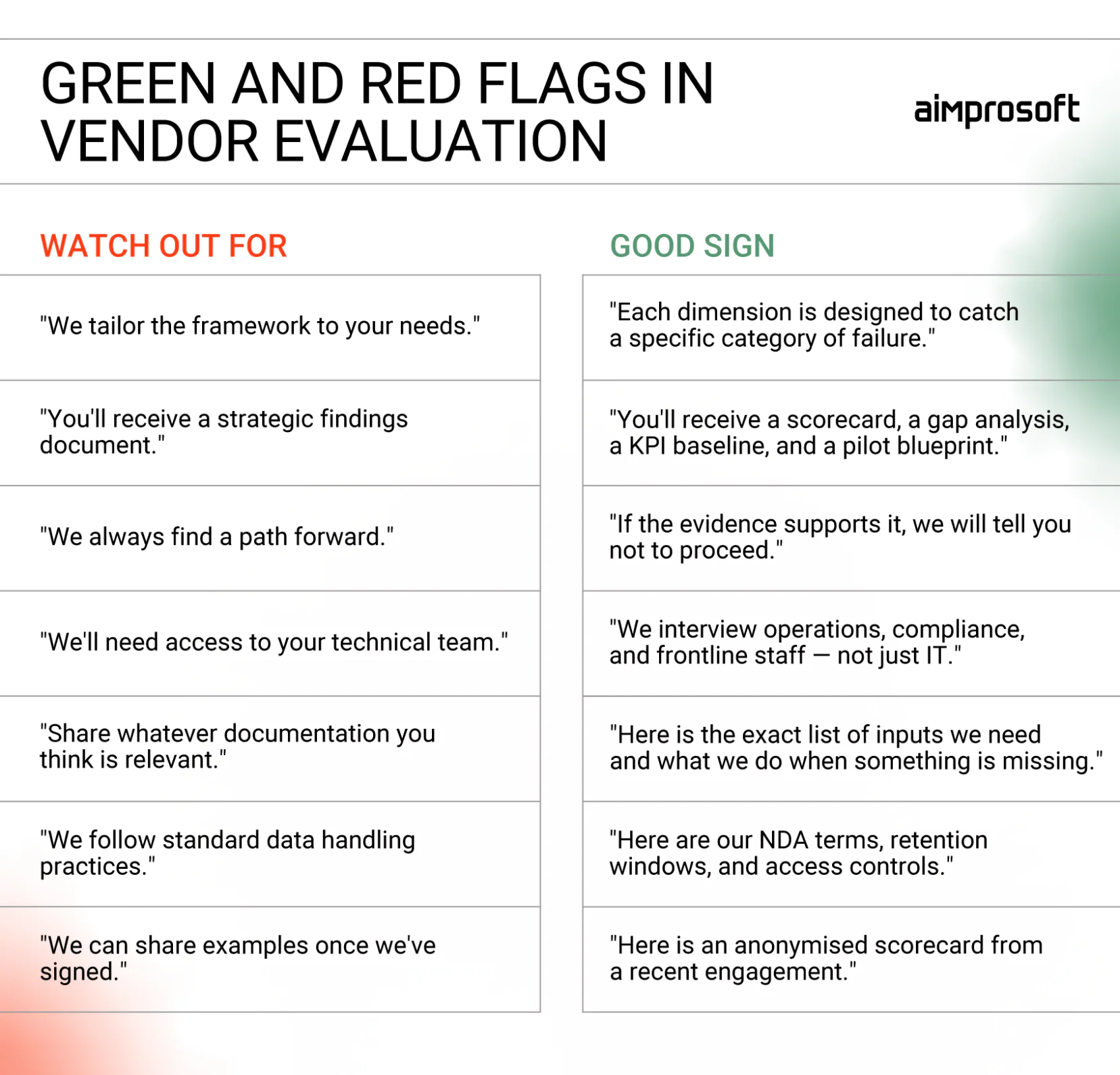
Watch out for vague answers such as ‘We tailor it to your needs’ or ‘It depends on the engagement.’ AI readiness assessment consulting is adaptable, but the framework itself must be defined and consistent.
If the framework piles on dimensions – eight, ten, twelve – ask the vendor to explain how each is scored, how they interact, and what outcomes they produce. A marked checklist and an average score tell you very little; read our article on AI readiness frameworks to understand why.
Green flag: Four to five clearly named dimensions, each tied to a specific category of failure the assessment is designed to catch. The provider can explain why those dimensions exist, how they interact, and how they reach a verdict.
Question 2: What are the concrete deliverables of an AI readiness assessment service?
Before signing a proposal, push for specifics in writing. Ask for clear names and contents of all expected artefacts – ‘a report’ or ‘a strategic insight’ are not deliverables.
Watch out for soft language like ‘recommendations document,’ ‘strategic findings,’ or ‘an action plan.’ That phrasing usually means the provider hasn’t standardized their output. Each engagement becomes a different deliverable, shaped by whoever runs it.
Green flag: A readiness scorecard with the evidence behind each score, a gap and risk analysis that ranks gaps by impact and likelihood, and a KPI baseline so you can measure value after launch. When the verdict is GO or CONDITIONAL GO, also pilot recommendations, specifying scope, success criteria, data sources, architecture, and timeline.
Question 3: Will you give us an honest NO-GO if the evidence supports it?
Because of the possible conflict of interest, this is a single most revealing question. For many AI readiness assessment consulting firms, revenue depends on follow-on implementation work that comes after the AI readiness assessment.
Watch out for answers that redefine NO-GO. A real one clearly states that you should not proceed with this initiative in its current form. If the provider is blurring the line between CONDITIONAL GO and NO-GO, their framework is designed to lead to implementation, not to give you an honest verdict.
Green flag: A direct yes, with a clear definition of what NO-GO means. Ideally backed by an example of an engagement that ended in NO-GO, or a few hypothetical situations that would.
Question 4: Who do you involve in the AI readiness consulting – business stakeholders or just IT?
AI readiness isn’t a technical question. Process maturity, governance, and adoption depend on input from the people who run the work. That includes operations, compliance, and frontline teams.
Watch out for assessments scoped entirely to infrastructure and data, with stakeholder interviews limited to the technical team. The reverse is just as problematic – interviewing managers but not the people doing the work day-to-day. Both perspectives are necessary.
Green flag: The provider tells you who they expect to interview and roughly how many hours of stakeholder time the assessment will require.
Question 5: What do you need from us, and what is your timeline?
The best AI readiness assessment services work from a defined list of inputs and a defined timeline – usually two to four weeks.
Watch out for ‘whatever you wish to show us,’ ‘documentation access,’ ‘some stakeholder time,’ and similar vague answers.
Green flag: The provider specifies exactly what they need – eight to twelve stakeholder interviews of roughly forty-five minutes each, specific process documentation such as SOPs, exception logs, and recent workflow changes, and sample datasets representative of what the AI will draw on. They also explain what happens when one of those documents doesn’t exist and ask for a single point of contact on your side.
Question 6: How do you handle sensitive data and compliance requirements?
Assessments require access to process documentation, data maps, and sometimes sample datasets. That access creates real obligations for the provider.
Watch out for providers who haven’t documented their data-handling policies, can’t produce a sample NDA on request, or get vague when you ask where assessment data is stored and for how long.
Also watch for providers who can’t speak knowledgeably about the regulatory regime your industry operates under – GDPR for European operations, HIPAA for healthcare, SOC 2 for any enterprise buyer, and increasingly ISO/IEC 42001 for AI-specific governance.
Green flag: Clear answers on NDA terms, data-handling protocols, retention windows, and access controls. For regulated industries, they should describe how their assessment process accounts for the specific regime, with concrete examples.
For any provider working with enterprise buyers in 2026, ISO/IEC 42001 is increasingly written into procurement contracts. A credible one should know exactly what the standard covers and how their AI readiness assessment services surface gaps against it.
Question 7: Can you share an output example or client feedback?
Ask any provider to share an anonymized example of a real assessment output at the proposal stage – a sanitized scorecard, a redacted gap analysis, or a sample pilot blueprint.
Watch out for reluctance to share examples before contracting, references who speak only generically about the provider, or references that turn out to be from implementation engagements rather than readiness assessments.
Green flag: At least one anonymized output example shared at the proposal stage. Alternatively, at least one reference client who can speak specifically about what they were hired to evaluate, what the assessment found, and what they did with the findings.
5 red flags to watch for in AI readiness assessment consulting engagement
Technology-only scope. If the assessment covers only infrastructure, integrations, and data architecture – while process maturity, governance, and people are excluded – it can tell you whether your tech stack can run AI. It can’t tell you whether your initiative will succeed.
No NO-GO outcome. When the provider’s recommendations are only ‘proceed’ and ‘proceed with caution,’ ask directly what evidence would produce a NO-GO. If they can’t answer, the framework doesn’t have one.
A questionnaire as a methodology. A self-evaluation survey reflects the client’s own perception. It can be one input into an AI readiness evaluation, but it can’t replace stakeholder interviews, independent document review, and data sampling.
Unnamed deliverables. Contracts that promise ‘findings,’ ‘a report,’ or ‘strategic recommendations’ are not committing to anything. A credible proposal names the deliverables in writing – at minimum, a scorecard, a gap and risk analysis, a KPI baseline, and where applicable, a pilot blueprint.
Assessment bundled with implementation. When the two are quoted together, the provider has a financial interest in recommending that you proceed. A diagnostic engagement should be priced and scoped on its own.
What to expect from a well-run assessment
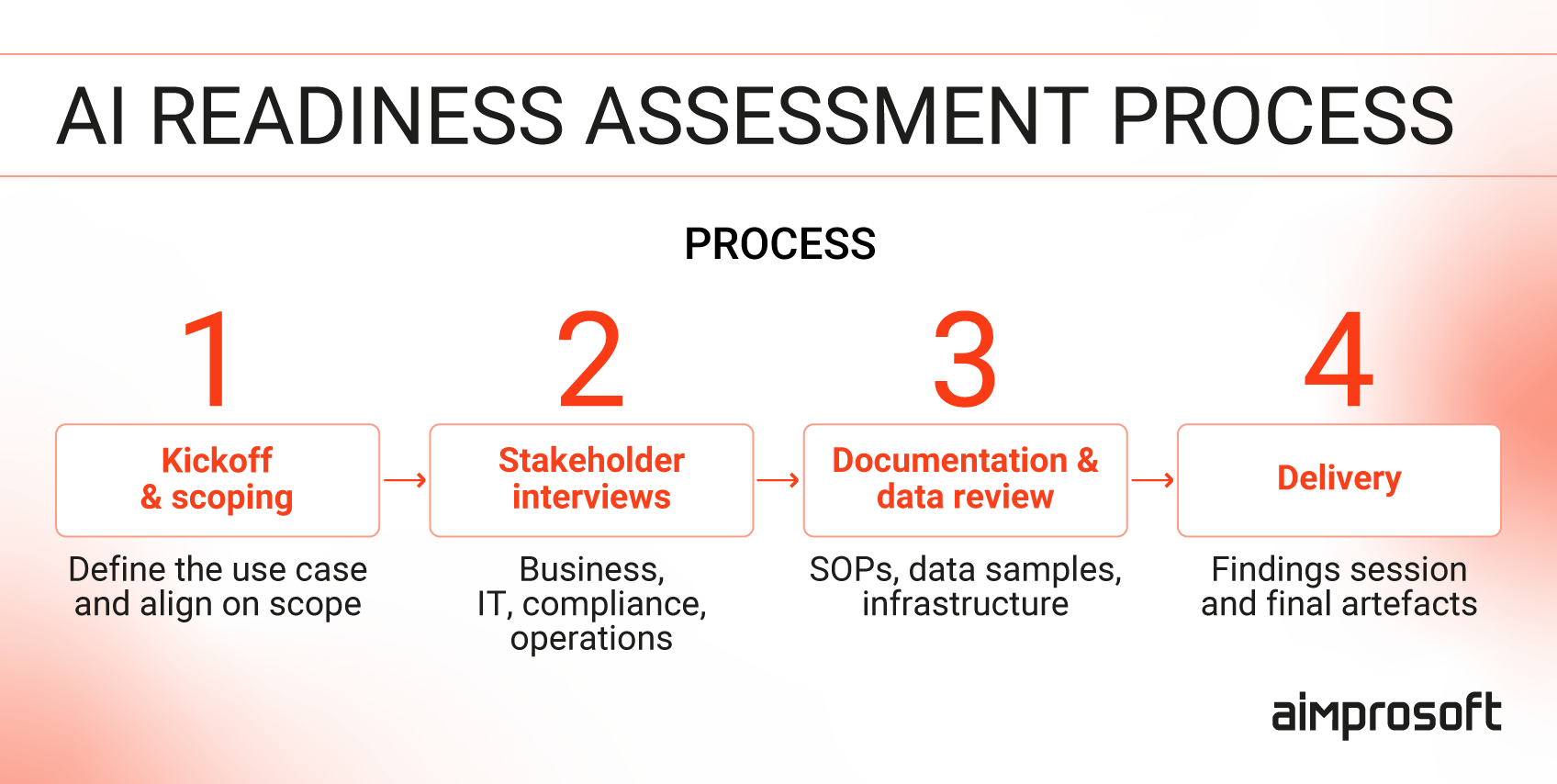
Knowing what good looks like in AI readiness assessment consulting makes vendor conversations shorter and decision-making easier. A well-run assessment for a single use case tends to follow a distinctive structure.
Process:
- Kickoff and scoping call
- Stakeholder interviews across business, IT, compliance, and operations
- Documentation and data sample review
- Deliverables compilation and delivery
Output:
- Readiness scorecard with evidence for each dimension
- Gap and risk analysis ranking issues by impact and likelihood
- GO, CONDITIONAL GO, or NO-GO recommendation
- Pilot blueprint with scope, KPIs, data sources, architecture, and a 90-day execution plan, when the verdict supports it
Timeline: Two to three weeks end-to-end. Sometimes longer for complex multi-process scopes or enterprise AI readiness assessment engagements.
Cost: A credible provider will give you a clear, itemised fee at the proposal stage. If the number only appears after you’ve committed to a discovery call, that’s worth noting.
Materially low fees usually signal a questionnaire-driven practice. A fee that scales with the implementation scope that follows usually signals a conflict of interest.
Key takeaways
- AI readiness consulting and AI implementation consulting do different jobs. The first diagnoses, the second prescribes. Buying the prescription before the diagnosis is the most common reason AI projects fail.
- Seven questions separate diagnostic partners from generic consulting engagements: framework dimensions, deliverables, willingness to give a NO-GO, business-stakeholder involvement, timeline and inputs, sensitive-data handling, and example outputs or references.
- The single most revealing question is whether the provider will deliver a NO-GO when the evidence supports it. Providers whose commercial model depends on follow-on implementation work have a conflict of interest there.
- A well-run assessment for AI readiness runs two to three weeks and produces concrete deliverables discussed upfront.
Book a discovery call