Building AI Strategy for Business: Roadmap for 2026 and Beyond
Published: – Updated:


If someone asked you right now, “What’s your AI business strategy?” what would you say?
Some CTOs and digital transformation leaders are still waiting for the right moment to start. Others have a confident answer: “We have a proof of concept running in customer support.” Ask what comes after that, though, and the confidence drains out fast.
Why does this keep happenning, and what do you do about it?
Most AI adoption playbooks were written for companies with dedicated ML teams, unlimited budgets, and three-year runways. Your reality looks different. A ten-year-old ERP system held together by institutional memory. A three-person IT team already drowning in tickets. A CFO who wants ROI numbers before next quarter’s board meeting. The frameworks aren’t just a poor fit, they were built for a company that isn’t yours, so the strategy stalls at the slide deck and the PoC quietly becomes the permanent answer.
This guide is for the mid-market company that needs an AI implementation strategy fitted to its actual systems, its actual budget, and its actual timeline, not the whitepaper.
How to find AI opportunities you already own
Use cases with the highest near-term value are usually hidden in the processes and systems businesses run every day.
Most companies don’t know where AI can help until they map their processes either themselves or with the help of AI strategy consulting services. From our experience, this exercise almost always reveals three to five workflows ready for automation with minimal to no changes to your existing infrastructure.
Case in point: A retail chain once asked us to build them a custom app. But once we mapped their day-to-day operations, we found out that their real problem was a set of manual processes. What they actually needed was a mix of business automation and AI applied to specific parts of the workflow. It delivered better results than the original idea would have and didn’t require building a new system from the ground up.
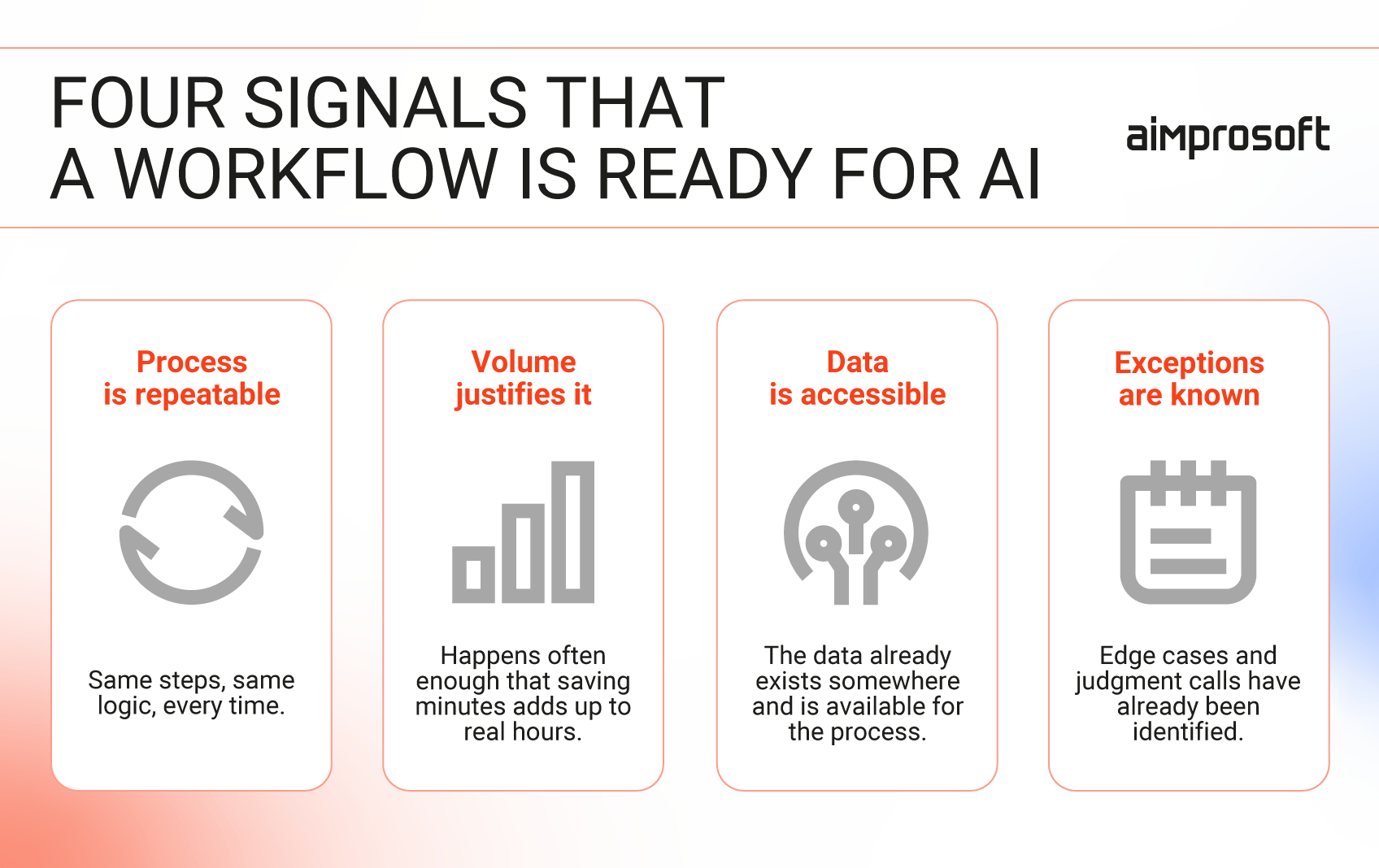
You don’t need to conduct a top-to-bottom, month-long audit to find them. Start by looking at where your team wastes time on the most consistent workflow day after day. The common candidates tend to be:
- Document processing — manually handling invoices, contracts, or intake forms
- CRM data entry — logging call notes, updating contact records, or drafting follow-ups after client interactions
- Approval workflows — routing requests through the same decision logic every time, with people mainly passing them along rather than making decisions.
The goal is to identify the easiest-to-implement AI use cases where the process is well understood. Starting this small lets your team see how AI applies to your everyday problems and delivers the first noticeable improvements. This is far more encouraging than betting everything on one large initiative, watching it struggle, and losing faith in technology altogether.
AI implementation roadmap for mid-market companies
By now, you have a shortlist of possible AI candidates. This is already a better starting point in artificial intelligence strategy than most organizations manage. The majority jump straight from “we should do AI” to searching tools. And have little consideration of whether they have the right conditions for any of it to work. Here’s what to do next to make sure your shortlist leads somewhere.
Step 1: Know your constraints
The companies that make it past the pilot stage are often the ones that start with an unbiased assessment of their current technical and organizational capabilities. Getting everyone on the same page — especially those approving budgets — simplifies decision-making as the AI adoption roadmap progresses.
Surprisingly, many of the biggest obstacles in AI strategy development don’t relate to the technical aspect:
- No documented process. If a workflow you want to automate isn’t measured or clearly defined, you can’t prove improvement or give engineers a blueprint to build from. Even when a process exists on paper, the chances of the decision logic behind daily judgments on non-standard situations being written down are close to zero.
- No clear ownership of outcomes. You can’t hold the AI accountable for the outputs it produces since you can’t jail or penalize the algorithm. You need a named person who will validate results and own the consequences when something goes wrong.
- No representative data. Clean datasets prepared for pilots that don’t reflect the nuances of the actual daily workflows lead to disappointing production results.
- No budget authority in the room. The person leading the AI integration strategy may not control the budget, and the person who does hasn’t been part of the conversation yet.
- No plan for the learning curve. Don’t panic if productivity drops right after you deploy a new tool. It’s completely normal as people need time to adjust to the new workflow before things start running faster. Teams that aren’t prepared for this interpret the early slowdown as evidence that AI doesn’t work. And that scepticism is hard to reverse once it sets in.
Address these roadblocks, and your first AI project has a better chance of becoming a production success.
Step 2: Set priority for use-cases
If you try to pursue every promising AI idea at once, you’ll likely stretch your engineering team too thin and spread your budget across projects that never fully deliver. The safest AI strategy for business is to choose one or two use cases that solve a concrete, existing bottleneck and carry zero regulatory surprises.
Before you go straight to the use case roadmap, specify the value you’re expecting. Estimate how many hours per person per week an automation may save and what business outcomes should improve as a result. That’s how you can prove the positive numbers early on and smooth the way for the next conversation about AI investment strategy.
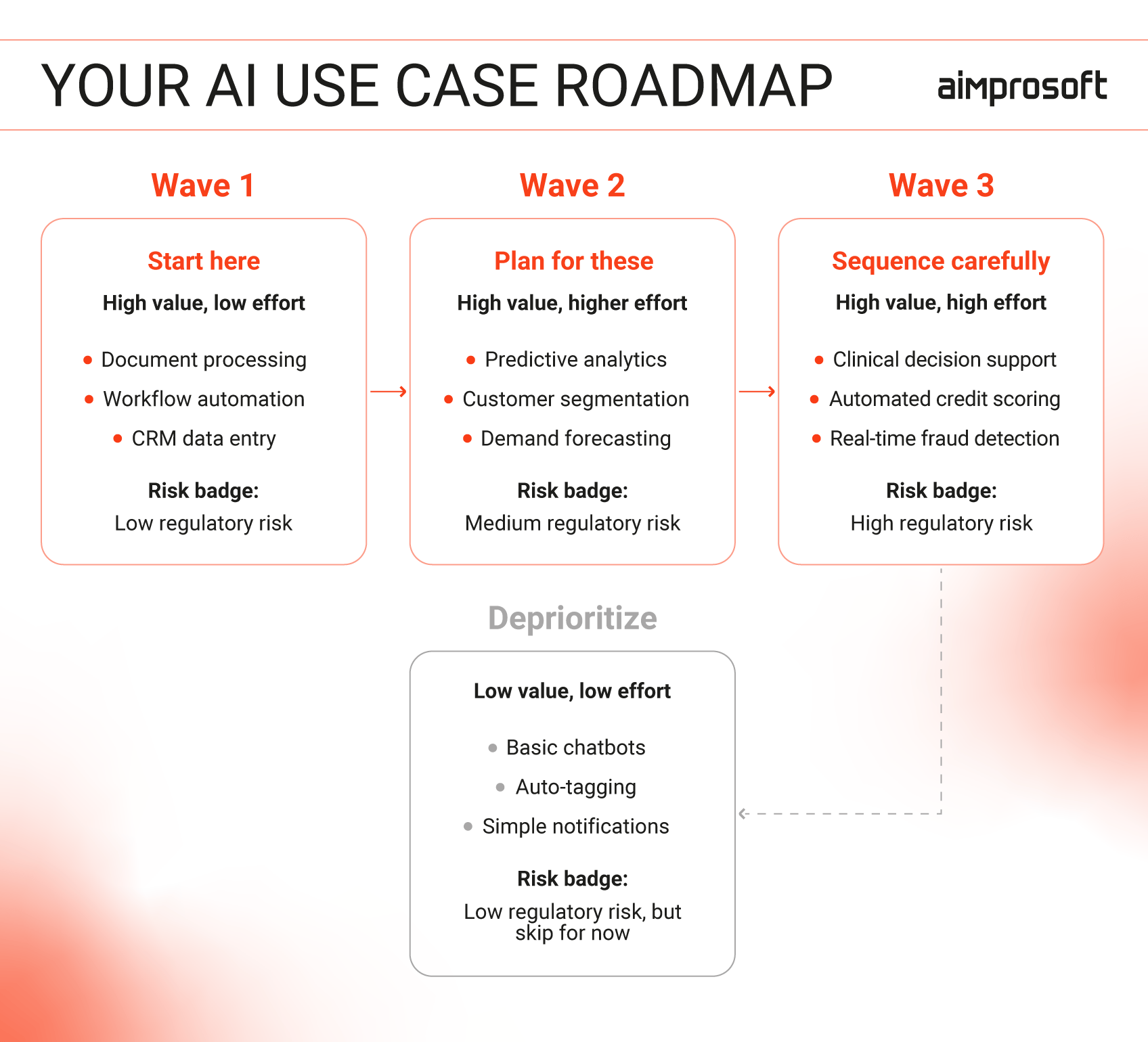
Wave 1. Start here. These are repetitive and time-consuming processes with few regulatory constraints, such as invoice processing or post-purchase follow-ups. The time to realize is weeks, with the first gains expected within 3-4 months. Internal buy-in comes as a bonus.
Wave 2. Plan ahead. These are high-value workflows that demand longer build cycles or closer attention to compliance, such as predictive analytics, intelligent customer segmentation, or demand forecasting. They can significantly improve your bottom line, but need dedicated project ownership to get across the line. Commit to these once Tier 1 has proven its ROI.
Wave 3. Sequence carefully. These are technically feasible automations, but they fall under any of the known regulations, be it GDPR, the EU AI Act, or you name it. Consider a clinical decision support system or real-time fraud detection. Since regulators have the final word on what goes live, set the timeline here. Put these on your long-term business automation roadmap, but don’t touch them until you develop a mature AI framework and cross-team legal trust.
Tier 4. Skip for now. These are low-value tasks, like basic auto-tagging or simple notification triggers, that make little sense to automate, even though they require zero effort. Return to these only when your higher-priority backlog is completely empty.
Step 3: Build, buy, or partner
One of the most costly mistakes in AI innovation strategy is investing in a capability without taking the time to think about the three important factors. Who owns it, how your data is used, or what happens if you need to switch providers later.
Here’s how to think it through and opt for the right path.
Buy a ready-made solution when the workflow is standard and proven tools already exist.
- The process is common across your industry
- Speed to deployment is more important than customization
The trade-off is dependency. If your vendor decides to discontinue the product or is acquired, you’re left dealing with the consequences.
Build custom AI solutions when the workflow is a competitive differentiator or requires capabilities that existing products can’t provide.
- Owning the IP is critical to your long-term enterprise AI strategy
- Mistakes have serious legal or financial consequences
- You’ll need custom features over time
- The process is central to your business
The trade-off is a larger investment in time, budget, and talent.
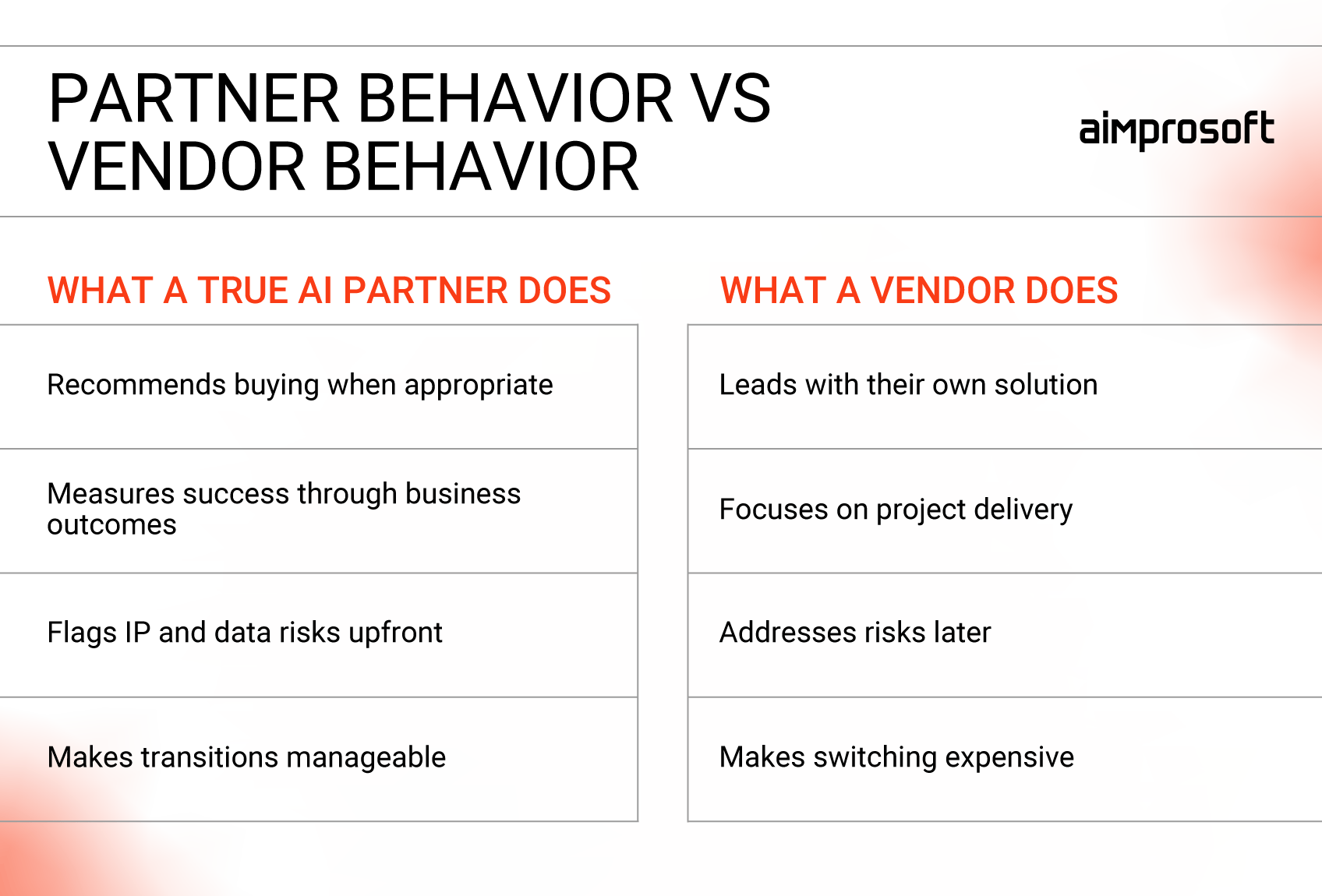
Partnering with an AI strategy roadmap consultancy when you know what to solve but not how to solve it at your scale and in your regulatory context.
- You need guidance from teams that have solved similar challenges
- Your team can operate the solution but not architect it from scratch
- You want objective advice, even if buying is the better option
The trade-off is finding the right partner who will be as invested in driving your business outcomes as you are, and thus give honest advice rather than sell engagement hours.
Choosing the wrong partner is the most expensive mistake in this decision. The wrong tool wastes budget. The wrong partner wastes budget, time, and undermines the internal credibility you’ll need for any new AI initiative.
Step 4: Data and governance foundation
AI governance is often seen as a way to avoid fines and legal issues, but it’s actually one of the biggest factors behind adequate AI performance in production. PwC’s 2025 Reponsible AI survey found that around 60% of executives associate Responsible AI practices with higher ROI and operational efficiency, while 55% report improvements in customer experience and innovation.
You can safely say that governance in your AI strategy framework is working when you have these three elements covered:
- Data ownership. Clear accountability for who can access data, where it’s stored, and who is responsible for protecting it.
- Audit trails. A record of AI-influenced decisions that allows teams to review and explain outcomes when issues arise.
- Bias and drift monitoring. Ongoing checks to ensure models continue to produce accurate answers even as data and business conditions change.
The second part of the AI governance strategy is regulatory fit. Requirements vary across regulations such as HIPAA, GDPR, the EU AI Act, and others. But most frameworks require you to:
- Use only the data you need
- AI can support decisions, but a person should remain accountable for them
- Be able to explain how the system reached its conclusions
Just as importantly, don’t leave compliance until the end of the project. The earlier legal, security, and compliance teams are involved in the project, the easier it is to avoid costly redesigns later.
Where to start: identify the regulations that apply to your business during the initial assessment phase. Then, pinpoint where your data originates and lands to understand where sensitive information is stored, who can access it, and which compliance requirements may affect the project later.
Step 5: Talent strategy
What you need to start is enough expertise to launch the first project and a plan to build internal knowledge. The key factors in selecting an AI strategy are avoiding extremes: overhiring too early or underpowering a project that needs expertise.
A pragmatic path may look this way:
- Start with external support. For your first one or two AI projects, engage external specialists while your team learns what it takes to implement and manage AI effectively. When internal capability is strong enough to lead the next project independently →
- Upskill existing teams. Focus on helping employees understand, validate, and improve AI outputs, especially those closest to the processes being automated. When the volume of AI initiatives exceeds what a part-time internal effort can support →
- Build a dedicated AI function. Once multiple initiatives are running in parallel and AI becomes a long-term priority, a formal AI team or Center of Excellence may make sense.
One lesson many companies learn quickly is that the biggest skills gap in AI strategic planning is judgment. As AI takes on more execution, the real value comes from people who can evaluate outputs, recognize issues, and make decisions on what the system should and shouldn’t do.
Start small, find a few internal leads to own the results, and build out your team as the demand grows. The right team structure for digital transformation with AI is the one that matches your needs.
Step 6: Phased roadmap and ROI measurement
At first sight, the perspective of saving an hour and a half per person per day may not impress. But when you multiply that across an entire sales team and factor in the additional client conversations and revenue opportunities it creates, the impact becomes much easier to see. To demonstrate the benefits of AI in business, connect time savings to business outcomes in terms that make sense for stakeholders and budget owners.
To help you put this into practice, we broke down the calculation into three steps.
Step 1. Set a benchmark. If you don’t already track the process, you can ask a group of employees to complete the task and time them with a stopwatch. Then, calculate the average, which is your starting point to measure the improvements against.
Step 2. Pin down target outcomes.
| Category | What to measure | Question to answer first |
| Operational efficiency | Time per task, error rate, process cycle time | How long does this process take today, and how often does it produce errors? |
| Customer experience | Response time, resolution rate, satisfaction scores | What do customers currently wait for, and how often do they escalate? |
| Financial impact | Cost per transaction, revenue per employee, incremental revenue from freed capacity | What does one hour of this team’s time cost, and what does it currently produce? |
| Compliance | Audit findings, policy adherence rate, incident response time | How many compliance issues surfaced in the last quarter, and how long did each take to resolve? |
Step 3. Review quarterly. Once a quarter, measure what shipped against these metrics — what improved, what didn’t, and what your team tackles next. This way, the artificial intelligence strategy stays aligned with the dynamic business environment. Leaving it to the annual review, AI-driven innovation risks becoming irrelevant.
The 30/60/90-day AI strategy launch plan for small to mid-sized businesses
Enough theory. Let’s get to the practice. Here’s a scenario of how to implement AI in business month by month.
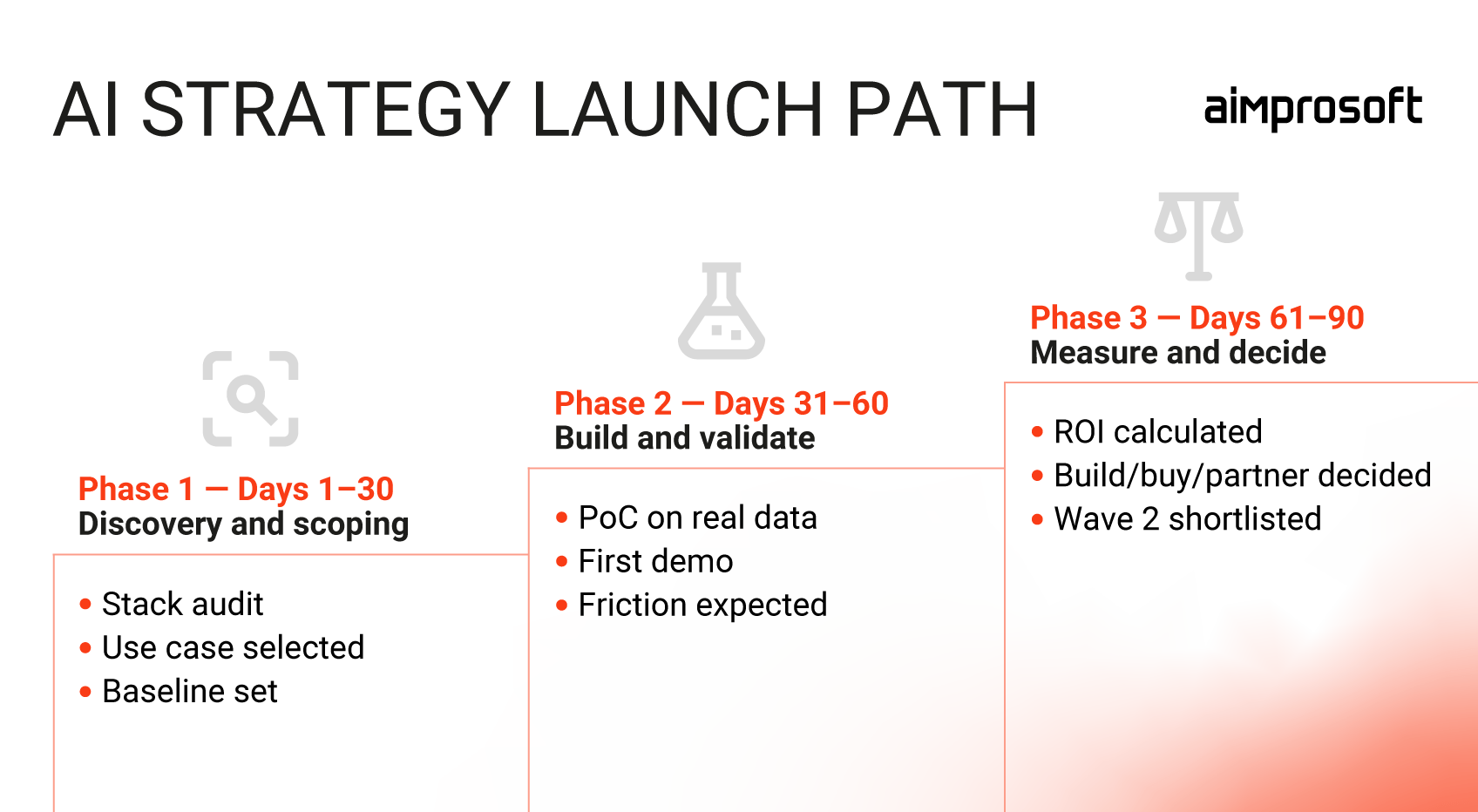
Days 1–30: Discovery and scoping
Pick one workflow that’s painful enough that people notice and complain about. Something like post-call CRM updates or client onboarding that touches four different tools. Then time it properly. And by “properly,” we mean counting every action your employee takes, including the time spent switching tools and following up on missing information. Every “did you remember to…” moment should be considered, as they add two minutes here and three minutes there.
What your team assume to be a five-minute task can turn out to be a twenty-five-minute operation. The first month is the hardest because you have to show progress in artificial intelligence in business strategy when nothing has been built yet.
The milestone: One validated use case, baseline metrics to measure progress, and a well-defined PoC ready for implementation.
Days 31–60: Build and validate
Since PoC development can now take days rather than weeks, let’s focus on what comes next. Run the PoC on real data to see where AI performs well and where it struggles with edge cases or missing context. That’s normal, but stakeholders should understand from the start that a PoC validates feasibility, not production readiness.
Another common challenge at this stage is the transition from a controlled development environment to your own infrastructure. Such details as integrations, permissions, and data structures may behave differently in production. To avoid this, involve someone from your infrastructure team during PoC development to flag any possible mismatches.
The milestone: a PoC running on live data, an internal demo completed, and a clear understanding of what needs refinement before moving to production.
Days 61–90: Measure and decide
At this point, after you’ve run the PoC on real data for a few weeks, estimate what improvements the project has delivered. Compare the results against the baseline in terms of time saved, errors reduced, or whatever your goal was. If the difference is meaningful, congratulations, you have a real case to present to leadership.
Keep in mind that a working prototype and a production system share almost nothing but the idea behind them. Scaling from PoC to production often costs several times as much, with some estimates putting it at around 10x. Because to get a system ready for enterprise use, one has to engineer it for stability. Where the investment goes into proper architecture, security, documentation, test coverage, governance, and CI/CD. In regulated industries, leave room for legal reviews.
The milestone: measurable improvements against your baseline, a clear decision on what comes next, and a prioritized list of next initiatives.
The takeaway
Don’t take on too much at once. Pick the most predictable and documented process that you know well enough to lay out in clear steps. Take the path of least resistance to get through the first AI pilot, prove it works, and then consciously plan investments into AI-powered digital innovation.
Now make it happen. If any of this feels overwhelming to do alone, book an AI readiness assessment and let our team help you find the right process and the right pace.

![How To Outsource Python Development: The Complete Guide [2026 Updated] cover img](https://www.aimprosoft.com/wp-content/webp-express/webp-images/doc-root/wp-content/uploads/2023/07/Outsource-python-development-768x300.png.webp)