AI/ML Development Services: Top Use Cases CTOs Need to Know
Published: – Updated:


Identifying high-ROI AI initiatives is harder than it looks. Enterprises globally spent $340 billion on AI in 2025 as per Oxford Economics. Yet MIT’s research found that 95% saw zero measurable bottom-line impact.
So, where does the value get lost?
Brittle workflows and poor integration take most of the blame, and fairly so. Model scope is less obvious cause of friction, and just as costly.
When you invest in custom machine learning development services, it’s tempting to build a universal tool for a dozen problems. In practice, a boring model optimized solely for HIPAA-compliant clinical billing delivers more value than a 95%-accurate generalist. And it’s far easier to defend to a CFO when the performance numbers come in.
Keep reading, and you’ll find out which AI implementations proved to deliver significant gains. We’ll also examine when custom AI/ML software development services justify the cost of each dollar spent and where off-the-shelf tools get the job done.
What AI and machine learning development services include
AI and ML software development services are engineering engagements in which a technical team builds custom models using a company’s proprietary data. Custom development gives companies a competitive advantage because it’s built on their data and operational logic. Nobody can replicate it even with the same model architecture.
A dedicated AI and ML development company usually helps businesses:
- Prepare data — faster model training and fewer integration surprises down the line
- Develop a model — full ownership of the logic, the weights, and the roadmap
- Integrate an AI system — no manual handoffs between AI output and business action
- Deploy — production-ready infrastructure that doesn’t disrupt live operations
- Monitor performance — with a human accountable for outputs, not just accuracy scores
Top-performing AI for business automation use cases
AI works well where processes already work well without AI. It’s not a magic wand that will bring order into chaos. AI won’t fix broken processes where a single status update takes six Slack threads and three follow-up emails.
Companies see the most consistent value when they automate the most predictable process, ideally documented from A to Z. A process that you understand inside out and can break into smaller steps with detailed instructions on what happens at each stage.
Let’s look at the AI business use cases that prove it.
1. AI document processing & OCR
Business impact: faster document turnaround at scale, improved compliance, reduced manual summarization effort
AI-assisted document processing cuts analysis time from hours to 7-15 seconds per file. Companies replace a day of manual effort with a background process that swallows thousands of documents at once. And AI-generated summaries save up to 60% of staff workload, without reorganizing how teams work.
The system takes whatever comes in — scanned files, emails, PDFs, bulk uploads across diverse formats — and returns structured data and ready-to-use summaries. Large language models (LLMs) perform extraction and summarization within the platform’s secure and fully compliant architecture.
Documents have predictable structures that AI can distinguish and classify, while the problem itself is specific enough to validate against clear criteria. Which is why this AI use case in business tends to show results fast.
Where the right AI development approach matters: unlike off-the-shelf tools that break down on unusual formats and edge cases, a custom system is trained on the full range of documents your operation produces — including the messy, inconsistent, real-world ones that make up most of the actual volume.
Best fits for: healthcare, legal, finance, insurance, accounting, real estate, any organization dealing with high document volumes.
2. ML-powered recommendation engine
Business impact: higher conversion rates, improved customer retention, increased revenue per user.
Companies that master 1:1 personalization generate approximately 40% more revenue than peers. For most businesses, personalization at that level sounds somewhat out of reach. It isn’t, and the underlying mechanics are quite straightforward.
An ML recommendation engine watches how users behave, what they browse, what they buy, what they like. It finds patterns in that behavior and uses them to predict what each person is most likely to want next. Over time, those predictions sharpen, while your customers always see a relevant experience without disruptions or manual updates from your team.
Why recommendation engines work is because behavioral patterns are surprisingly consistent and repeat across thousands of users. The model has a clear job, understands when it does it well, and knows how to improve its recommendations.
Where the right AI development approach matters: The hardest design part is defining what a model should show a first-time user. AI architects will help work through that during scoping by defining category defaults until the model knows enough to personalize.
Best fits for: retail, eCommerce, media, edtech, SaaS platforms, hospitality, any product with catalog depth.
3. Predictive analytics
Business impact: faster and more confident decisions, earlier detection of problems, reduced time spent on manual data preparation.
Companies using predictive analytics achieve 70% faster decision-making. Thanks to accelerated time-to-insight and improved report generation, the window between a trend appearing and a team acting on it shrinks to hours. People don’t have to be data analysts to pull their own insights and use them to plan pricing or resource allocation.
Predictive analytics use cases have the broadest business reach of any AI application. These AI tools for business automation change when and how top leaders make business-critical decisions and plan ahead.
A McKinsey market analysis reveals that, for banks, the move to advanced analytics drives 20% growth in under 3 years. Other industries see similar returns, particularly where AI in financial forecasting and demand planning replaces intuition with data.
The reason this use case is winning is that a well-trained model can find correlations in sales or operational data faster than a human analyst can. Basically, that’s a very tedious job you can safely delegate to AI. There are also clear metrics you can use to measure the outcomes of the investment: reduction in stockouts or overstock, faster budget reallocation, improvement in campaign ROI from better targeting.
Where the right AI development approach matters: The quality of your data defines the success of predictive models. If it’s fragmented or incomplete, predictions will be too. Data science teams will spot those issues during discovery, help prepare data, and build pipelines for consistent results.
Best fits for: eCommerce, retail, marketing, finance, logistics, SaaS, any data-heavy operation where the timing of decisions directly affects revenue or costs.
4. Object measurement and detection
Business impact: automated visual inspection at scale, reduced manual monitoring costs, improved operational safety and layout efficiency.
Large factories are the primary beneficiaries of implementing AI manufacturing solutions like object detection. AI-based quality inspection cuts costs by up to 50% and increases defect detection rates by up to 90%. Lower production costs let manufacturers protect both margins and customer relationships. And with defects caught earlier in the process, the ripple costs associated with rework, recalls, warranty claims, returns drop in proportion.
Considered one of the industrial AI solutions, computer vision has found applications across diverse domains. Retail is the second-largest technology adopter, with tangible benefits. Embedded in stores, an AI-driven object recognition system provides managers with tons of behavioral data. They can learn which product layouts drive more conversions, when traffic peaks, where customers linger, and more.
The beauty of measuring the model’s success here is simplicity — it either detects the object or it doesn’t. This makes performance straightforward to benchmark and improve over time.
Where the right AI development approach matters: Lighting changes, occlusions, unusual angles, and other real-world conditions will complicate visual interpretation and increase false positives in production. A development team will build training datasets that include those edge cases, so production performance matches what was promised during scoping.
Best fits for: retail, insurance, construction, healthcare, manufacturing, security.
5. NLP for unstructured data
Business impact: reduced manual processing load, faster response times, improved consistency across high-volume text workflows.
AI-powered support systems process customer queries up to 4.2 times faster than traditional methods, reducing operational costs by 31%. Shifting customer expectations and AI solutions in telecom are now inseparable. Subscribers look for instant answers through their preffered channel, and NLP makes that possible at call-center scale. The reason the opportunity is so large is the sheer volume of data it applies to. In 2025, approximately 89.63% of all enterprise information was unstructured. Most of it — customer conversations, support tickets, contracts — contains signals that never make it into a decision.
Some feel the weight more, some less, but the fact is, every business unit confronts dozens of incoming messages daily. The content varies for each, but the workflow repeats. You read the incoming text, extract the relevant information, copy and paste it into the appropriate systems, and advance the task to the next stage. From AI HR solutions to customer support operations, NLP models can do that automatically and at scale. With it, all you need to do is review and confirm.
These are among the most practical AI automation use cases for any organization looking to scale operations without scaling headcount. If a person can follow a written instruction to process a request, a model trained on enough examples of those instructions can do the same.
Where the right AI development approach matters: a generic NLP model will handle standard requests reasonably well. But your incoming requests use the industry’s terminology or specific phrasing. Data and engineering experts collect and label examples from your workflows to make the model work for your operation.
Best fits for: sales operations, customer service, legal, logistics, HR, professional services, any team processing high volumes of inbound text daily.
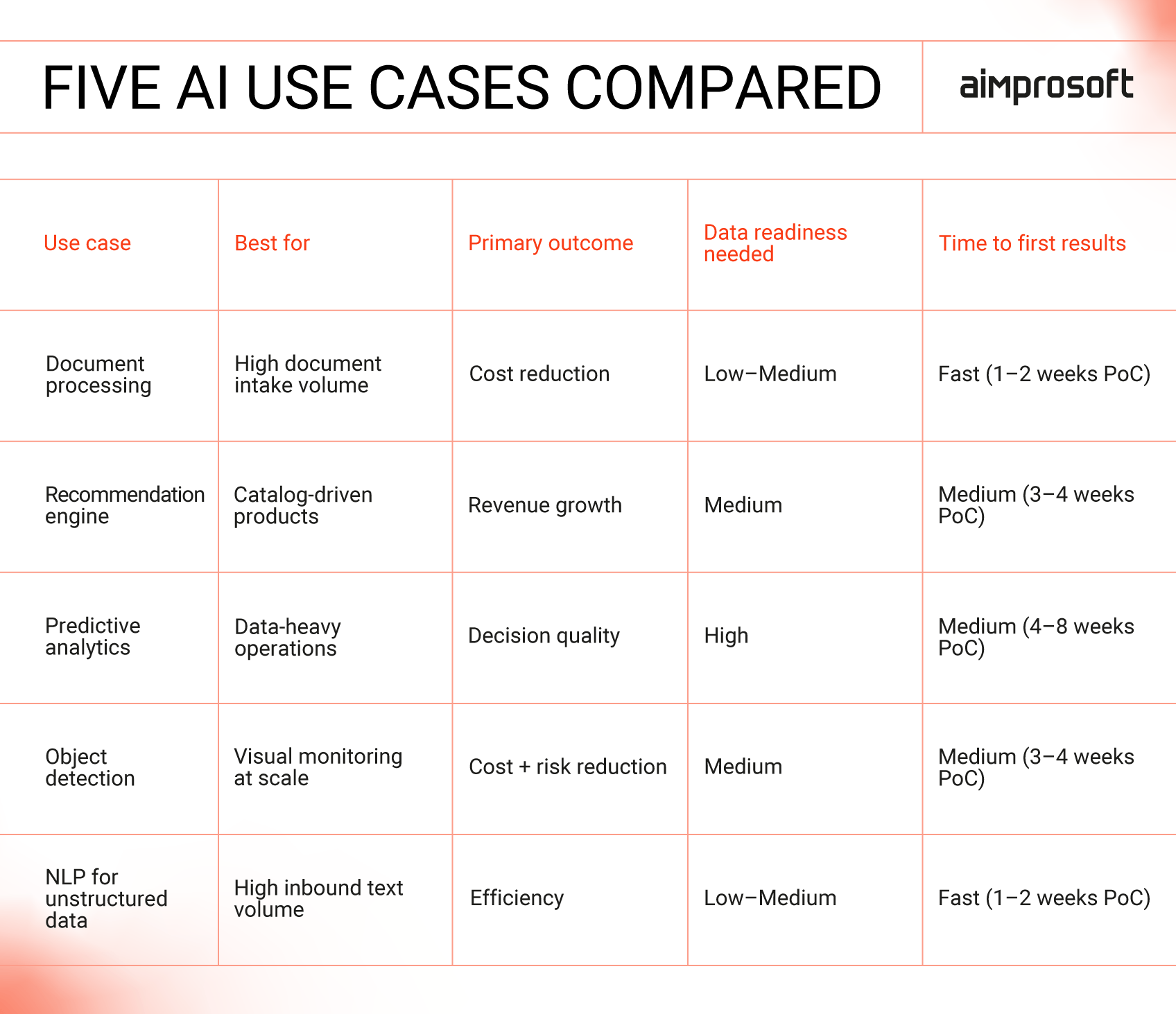
These AI use cases in business fall under the AI label, but they involve very different technologies, from ML and computer vision to NLP and LLMs. They all require different data, different technical expertise, and different ways of proving value. Once you identify which category your use case falls into, it becomes easier to estimate the real scope of work.
The best way to approach AI and machine learning development services
Choosing the right AI use case is only half the challenge. The other half is approaching development realistically. Many companies implement the idea of AI, not a solution to their specific problem. Lots of bold promises created the expectation that you could switch AI on and have it figure things out on its own. It doesn’t work this way.
That’s why proof of concept (PoC) is becoming a common starting point for AI and ML development services. A PoC is a short, scoped engagement that tests whether the data is ready, the integration is feasible, and the use case is technically and commercially viable.
Done right, a PoC delivers a working prototype in days or weeks. Thanks to AI-assisted software development, writing the model code in 2026 is the easiest part compared to the rest of the PoC work. Which includes data preparation and point mapping for integration. With AI PoC, teams can validate assumptions, demonstrate progress to stakeholders, and decide whether to proceed without spending most of the allocated AI budget.
But don’t get us wrong. PoC isn’t a product. Its only job is to prove that the idea works. The prototype you validate in two weeks might take a year to turn into something deployable and maintainable. But its beauty is that a failed PoC is just as valuable as a successful one. It lets teams surface blockers that tank most AI projects:
- Data quality issues
- Integration bottlenecks
- Legal or compliance blockers
- Cost-of-scale problems
Finding these roadblocks in week two of PoC is much cheaper and less painful than finding them mid-development.
At Aimprosoft, we see strong value in AI PoCs and offer them as a standalone engagement. They can also be the first phase of a full AI and ML development services and solutions project, depending on your stage and goals.
Want to know how well your business is ready for automation?
Build vs buy: when custom AI makes sense
This is the question that every organization faces at some point in their AI journey.
Off-the-shelf AI tools are a good to-go choice if you need a quick solution for a standard task. An AI model doesn’t need your proprietary data to draft an email or recognize a cat in a photo, while general language patterns are enough to do it well.
But even for those tasks, the existing model may not be as accurate as you’d expect and may make mistakes. So, you either accept some percentage of errors, which is fine for generic, low-risk tasks.
Or, if the error rate can make or break your business, train a model on your data. Average accuracy for regulated data or workflows where a wrong output has real consequences isn’t a trade-off worth making. Any experienced machine learning services company will tell you the same.
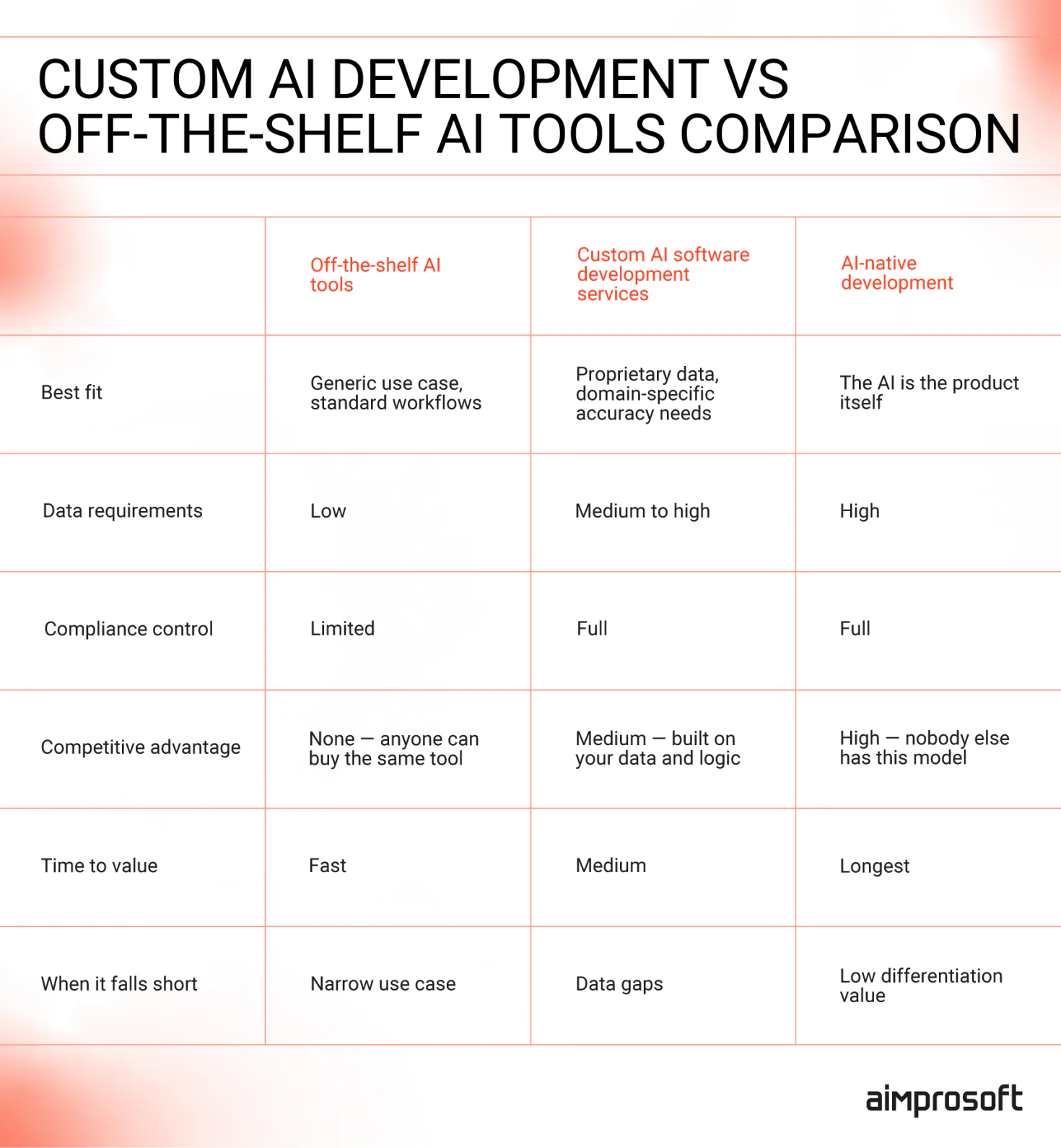
When you go custom, data preparation, system integration, testing, and deployment consume most of the time and budget. The model itself can be built in days once those foundations are in place. What you’re investing in is the production-ready system built around the reality of your operations. Which delivers insights you know you can trust and audit. That’s out of reach for off-the-shelf tools.
A third path — AI-native development — exists when the AI itself is the product. But that’s a different engagement model entirely, and it deserves its own article.
One honest note. As foundation models are commoditizing, retrieval pipelines and workflow engineering are now solving problems that required custom model training two years ago. Custom AI development still wins on proprietary data and compliance control. Yet, the right answer always depends on the particular use case.
Final thoughts
In 2026, you don’t need massive budgets or a perfect data infrastructure to see measurable returns from AI investment. What you need is to pick one of the most predictable business processes, understand how it works, and be ready to document it in enough detail.
Find an AI & ML development services company with a product mindset that will give an honest assessment of the business process and tell whether AI is even needed in your case. Sometimes, process optimization is enough to make things work. But when AI is the answer, start small, prove it works, and scale. That’s a recipe for AI business intelligence that delivers and builds your company’s competitive advantage.
FAQ
Which industries benefit most from custom machine learning development?
Finance, healthcare, legal, insurance, and manufacturing see the strongest returns as they handle mountains of data. But any AI ML development company will tell you the business domain is secondary to the workflow you want to automate. If the process is predictable, documented, and data-rich, custom ML delivers regardless of the vertical.
When does a business need custom AI vs. off-the-shelf tools?
Existing AI tools work well for common tasks that don’t involve sensitive data or aren’t a critical decision-making dependency. The moment compliance, proprietary data, or business logic enters the picture, custom AI development becomes a more reliable path.
How long does custom AI/ML development take?
A PoC typically takes days to a few weeks to build a workable version to validate the core idea. Full development ranges from 3 to 9 months, depending on data readiness, integration complexity, and scope, with data preparation often being the longest part of the process.