Strangler Fig vs. Big Bang: Which Legacy Modernization Strategy Is Right for Your System?
Published: – Updated:

The modernization strategy you choose can matter more than tools or frameworks you select later. Get it wrong, and the project runs for years, blows the budget, and leaves you with the same system you started with. This guide helps you get it right.
Most legacy application modernization strategies come down to two main options: Strangler Fig and Big Bang. One suggests rebuilding the system while it keeps running; another is about replacing it all at once and switching over.
This blog compares the two, shows where each fits, and gives you a framework for choosing the right legacy modernization strategy for your system.
How to modernize legacy systems: Strategies and techniques
Our legacy app modernization guide introduces five modernization approaches: Strangler Fig (incremental), refactoring, replatforming, rehosting (lift-and-shift), and Big Bang (full replacement). Strangler Fig and Big Bang are two broad strategies that describe how modernization is carried out, whereas rehosting, replatforming, and refactoring describe what happens to the application.
Strangler Fig and Big Bang are fundamentally different ways to modernize a legacy application. The first implies gradually modernizing the system, while the latter entails a full rewrite and a single major cutover.
- Strangler Fig or Incremental Modernization. Build the new system alongside the old one and move functionality over piece by piece. Both systems operate during the transition until the legacy components can be retired.
- Big Bang or Full Replacement. Build the replacement system, migrate the required data and functionality, and switch to it on a planned date. The legacy system remains in operation until the cutover, after which the new system takes over.
The Strangler Fig pattern: How it works
The name comes from the strangler fig tree, which grows around a host tree until it takes its place. Martin Fowler – a software engineer who introduced this pattern – saw the tree during his vacation in the rainforests of Queensland and borrowed the image for software. New code grows around the legacy system until the old one can be removed.
It’s the clearest answer on how to modernize legacy applications without downtime. Users don’t even notice anything happening under the hood and keep using the system as usual.
Let’s explore the mechanic.
You put a routing layer in front of the application. At first, it sends every request to the legacy system. Then you rebuild one function as a modern component and point that function’s traffic at the new code. The old function stops taking traffic but stays in place as a fallback. You repeat, function by function, until nothing routes to the legacy system. Only then do you retire it.
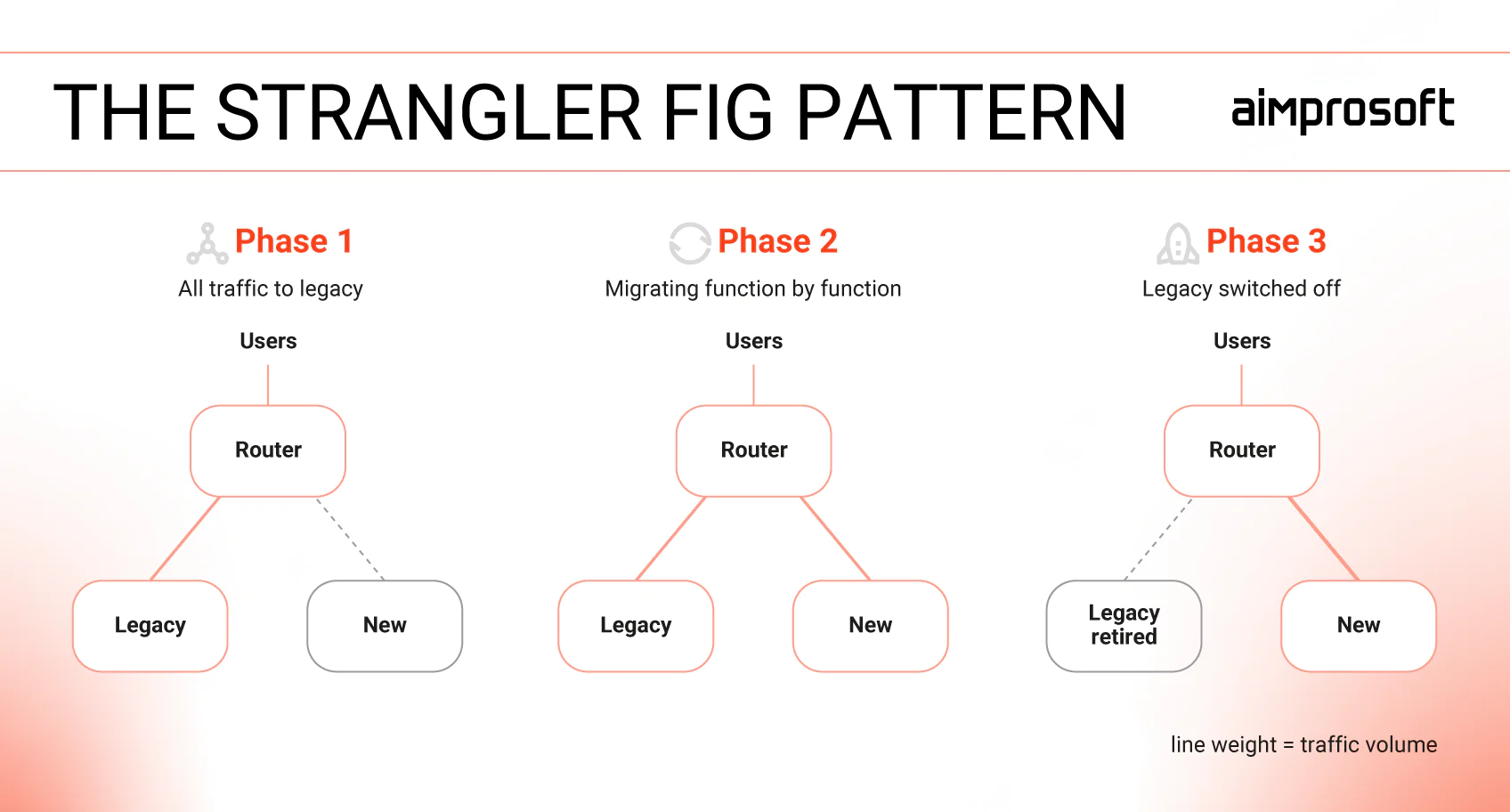
Because you move one slice at a time, you have complete control over the system and the process. There are also other benefits:
- All releases are reversible.
- The business continues to run without a cutover day.
- The first modernized module pays off before the whole project is done.
- You can re-order the work if needed.
This is why the strangler fig pattern underpins most microservices migration work, and most legacy software modernization on systems that can’t go offline.
At the same time, there is a trade-off. Running two systems in parallel adds cost and complexity during the migration. The routing layer needs careful design. And a program needs a knowledgeable owner for the final “retire the old system” command.
The Big Bang approach: When is it justified
The Big Bang has a poor reputation, and not without cause. Replacing the whole system at once means you’re exposed until the new one proves itself, and the switchover puts business continuity on the line. When a Big Bang fails, it fails expensively.
Still, it’s not always a bad idea. In some cases, replacing legacy systems in one move is the only reasonable option:
- The system is small enough that incremental work adds more overhead than it saves.
- It’s being sunset, so a clean switch to its successor beats a phased migration.
- The stack is so obsolete that there is no practical incremental bridge.
- A hard external deadline forces a single cutover date.
Big Bang trades ongoing complexity for concentrated risk, and that trade only pays off when the system is small enough, or dead enough, that the concentrated risk is small too.
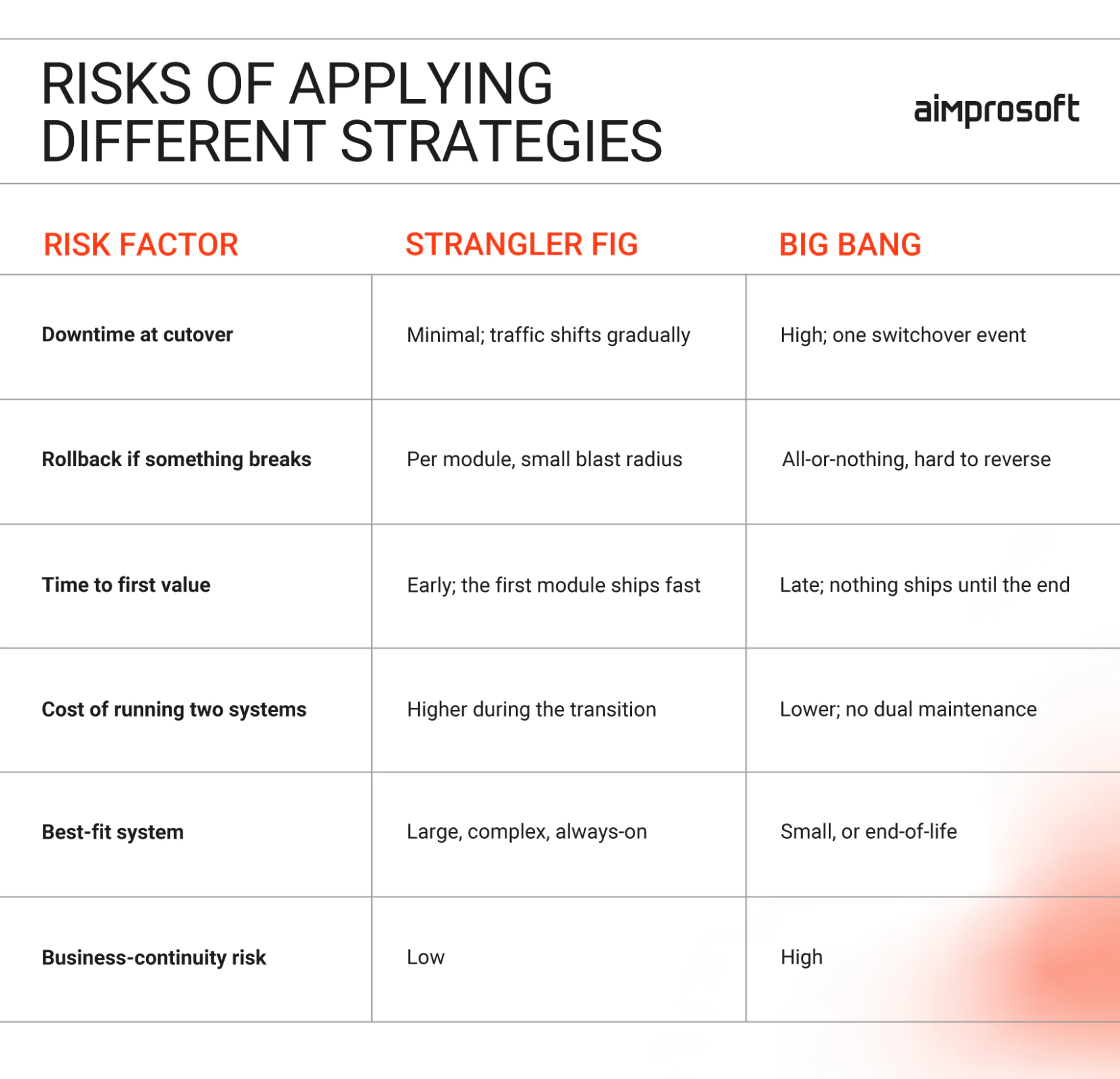
How to choose between two legacy system modernization strategies?
Understanding risks and differences of each legacy modernization strategy is not the whole answer. Score your system against each factor in the checklist below, then see which column it leans toward. It works for most modernization projects and is the fastest way to land on a strategy you can defend to the board.
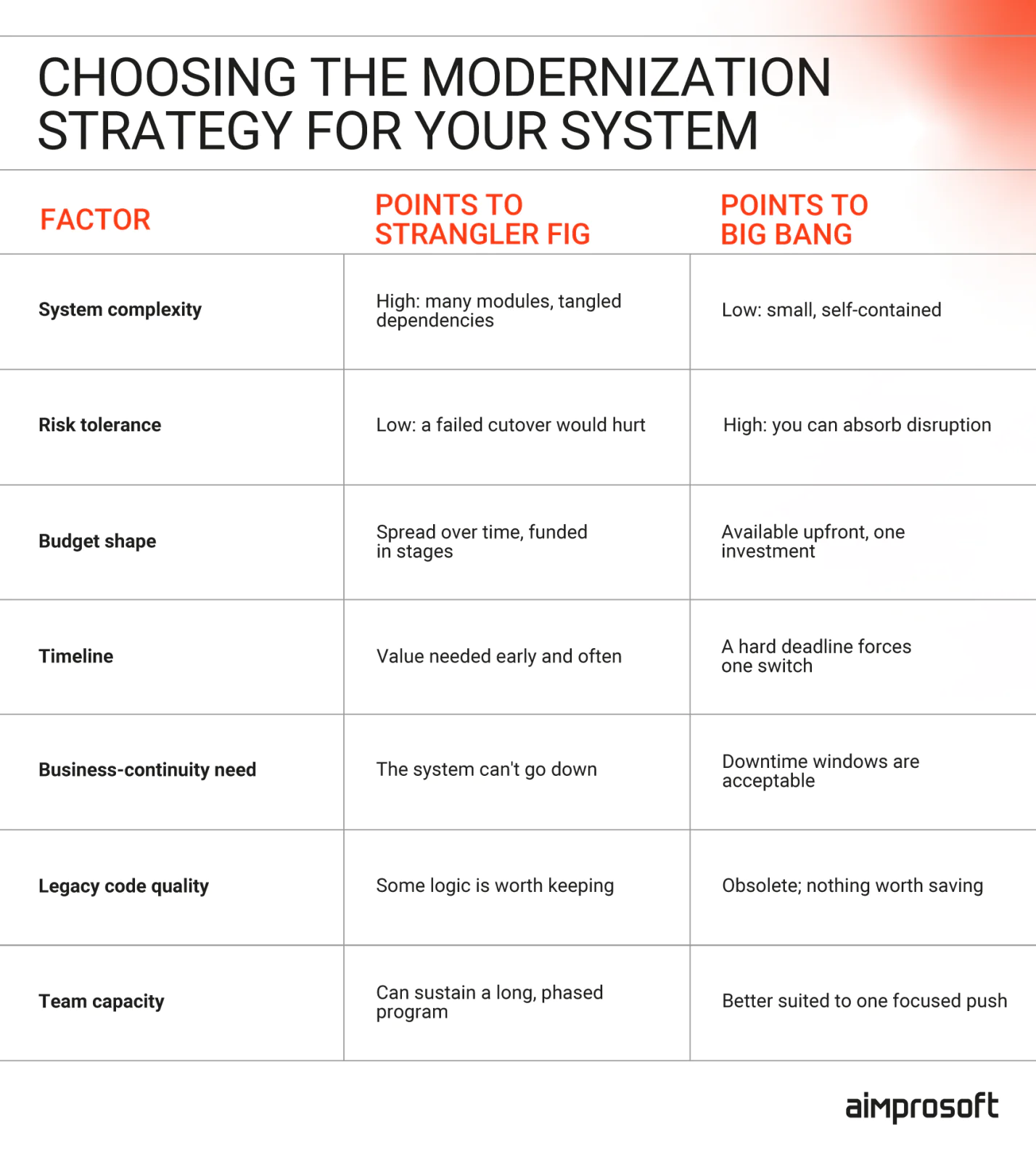
Reading the results:
- Mostly left answers point to the Strangler Fig. Most mid-market and enterprise systems land here.
- A clear lean right means a small system, an obsolete stack, and downtime you can absorb. That’s when a Big Bang makes sense.
The third option, which occurs more often than not, is a blend of the two: an incremental core with a contained Big Bang for one small, dead subsystem.
Factors that complicate (or simplify) the decision
Mainframe and COBOL systems. Old enterprise systems can carry deep, poorly documented business logic. Migrating legacy applications off these platforms usually forces an incremental approach, because you can’t safely replace what no one fully understands, and understanding it takes time.
Regulatory constraints. In finance, healthcare, and government, every change may need validation or an audit trail. That overhead favors small, testable steps over one large change that’s hard to verify.
Integration dependencies. The more systems your application connects to, the riskier a Big Bang gets. Every integration is another point of failure at switchover, so the more connected your system, the more you should lean towards a phased migration.
Team capacity. A phased program needs sustained attention for months or years. If the team can’t commit to that, or the people who know the system are leaving, the plan must account for it.
Compounding technical debt. The worse the technical debt, the more the incremental approach pays off. Each slice you modernize retires a piece of that debt and banks the benefit now, instead of deferring it to a distant launch.
Common mistakes with each approach
As your decision takes shape, focus on avoiding mistakes typical of each strategy. Strangler Fig and Big Bang reduce different risks, but they also present distinct challenges. Knowing them upfront helps teams plan the modernization more effectively and avoid costly problems during the transition.
Modernizing legacy systems piece by piece: Strangler Fig mistakes
- Having no end date for the legacy system. If there’s no retirement owner, the teams modernize the easy 80% and leave the hard 20% running forever, multiplying maintenance costs.
- Building a weak routing layer. A poorly designed facade becomes its own bottleneck and a source of bugs.
- Choosing what to modernize based on ease, not value. Always start with the parts of the system that reduce risk or deliver the most business value, rather than simply modernizing the easiest parts first.
Replacing legacy systems wholesale: Big Bang mistakes
- Overlooking hidden logic. Legacy systems often contain years of business rules and edge cases that haven’t been documented – properly or at all. Miss them during modernization, and the new system fails in production.
- Having no rollback plan. If the new system does not work as expected after the cutover, you need a reliable way to return to the legacy system. Without one, a failed launch becomes a major business problem.
- Testing only the happy path. Test more than the standard user journey. Include edge cases, realistic data volumes, system load, and failure scenarios to make sure the new system works as intended.
Which one fits you?
If your system is complex, always-on, and holds logic worth keeping, an incremental legacy modernization strategy built on the Strangler Fig pattern is almost always the safer path. If it’s small, obsolete, and can tolerate downtime, a Big Bang can be faster and cleaner. Or, maybe, your systems sit between the two.
To choose wisely and avoid costly mistakes, you need an experienced partner who maps your specific system to the right strategy. They cover your system’s complexity, dependencies, risk profile, and business constraints during the initial architecture assessment, and then recommend approaches that align with them.
Not sure which strategy fits? Get a free architecture assessment
FAQ
What is the Strangler Fig pattern in legacy application modernization?
It’s an incremental strategy where new components are built around a legacy system, and traffic is moved to them function by function, until the old system can be retired. The application stays live throughout, so there’s no single high-risk cutover.
When should you choose a Big Bang rewrite over incremental modernization?
Mainly for small systems, systems being retired, or stacks so obsolete that no incremental bridge would be practical. Also, it’s only acceptable when the business can tolerate downtime.
What are the risks of a Big Bang legacy modernization approach?
Downtime at cutover, an all-or-nothing rollback problem, and hidden logic that appears only in production. Because the entire system switches at once, a single missed edge case can disrupt the migration and threaten business continuity.
How long does the Strangler Fig approach typically take?
Longer end-to-end than a Big Bang, because you migrate module by module, but it delivers value along the way instead of all at the end. Timelines scale with system size and the number of functions to move, from months for a focused system to an ongoing program for a large platform.
Can you combine Strangler Fig and Big Bang approaches?
Yes, and it’s a common strategy. Many programs modernize the complex core incrementally while replacing one small, obsolete subsystem in a contained Big Bang. The right blend depends on each part’s size, risk, and dependencies.
What is the safest modernization strategy for a system that can’t go down?
For most complex, always-on systems, incremental modernization is the safer call. Traffic shifts gradually and each change is reversible, which protects business continuity in a way a single cutover can’t.
How do I choose between rehosting, replatforming, and modernization?
Rehosting (lift-and-shift) moves the system as-is and doesn’t make structural fixes. Replatforming moves it with targeted upgrades. Modernization re-architects it to meet current needs. If the goal is to fix the reasons the system is slow or fragile, rather than just change where it runs, choose modernization.