Enterprise RAG Implementation: Cost, Timeline and What to Expect
Published: – Updated:


There are dozens of videos on YouTube telling you that all it takes for RAG implementation is 15 minutes. While this is true for a demo with a single use case and clean data, the enterprise RAG implementation is not just an LLM connected to your proprietary data. It’s a staged delivery process that includes data readiness, retrieval quality, access control, evaluation, and ongoing maintenance.
So, what does it take to get an enterprise RAG system ready for production? Would your team have the capacity and experience to build this in-house, or does it make more sense to bring in a partner?
These are the questions we’ll answer in this article, along with timelines and what to expect at each stage.
What enterprise RAG implementation actually involves
At its core, enterprise RAG architecture does three things: Retrieves the right information, gives the LLM enough context to generate a response, and makes sure users have access only to the data they’re allowed to see. What you do with it can look very different.
You can build an internal knowledge base and ask questions you’d normally take to a colleague. You can help customer support teams find answers faster or work with document-heavy processes. You can even preserve knowledge that would otherwise leave the company together with the people who hold it.
Because companies don’t have a problem with knowledge (they have plenty of it), but with finding and making use of it. And this is where RAG comes in.
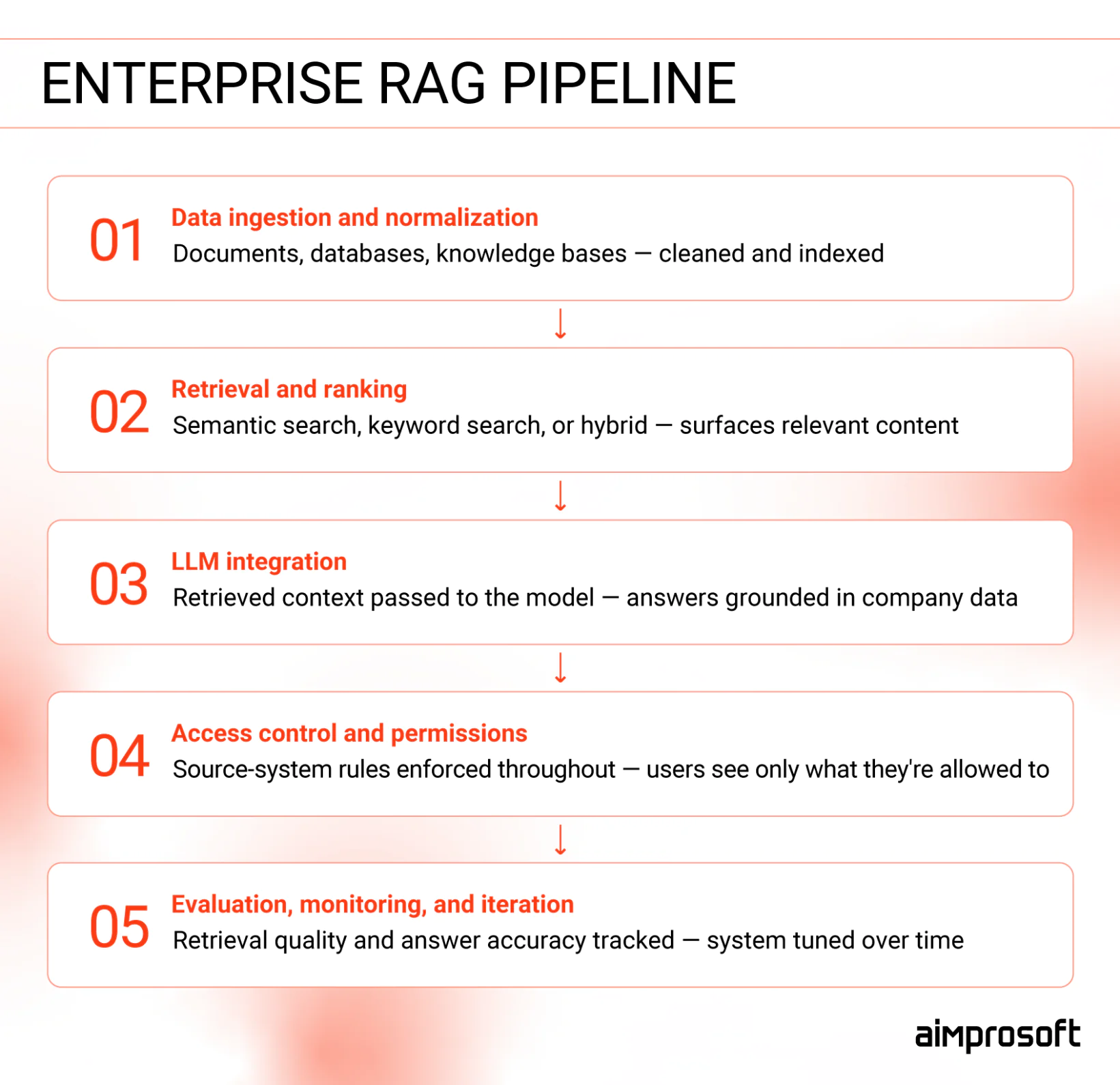
To make it work reliably and securely, five components need to work together:
Data ingestion and normalization
Information from documents, internal systems, and other sources needs to be collected, cleaned, and structured before the RAG system can use it. Different sources may have different formats, update cycles, duplicates, or outdated information. The pipeline also needs a way to keep that data current after launch.
Retrieval and ranking
The retrieval layer indexes that information and identifies the most relevant content for each query. Depending on the use case, this may involve semantic search, keyword search, reranking, or hybrid approaches. The setup then needs to be tested against real questions to see whether it consistently retrieves the context users need.
LLM integration
The retrieved information is added to the model’s context, so it can generate an answer grounded in company info rather than relying only on its training data. Choosing the right LLM model is highly connected to your project’s needs – since different models vary in speed, price, and context limits. At this stage, teams also need to decide how the model should use retrieved information, cite its sources, and respond when it doesn’t have enough information to answer.
Access control and permissions
For enterprise use, existing access rules need to be carried through the entire RAG pipeline. If an employee isn’t permitted to see a document in the source system, the RAG solution shouldn’t expose information from that document in its response. This becomes more complex when the system connects data from several sources with different permission models.
Evaluation, monitoring, and iteration
Teams need to test whether retrieval returns the right information and whether generated answers are accurate and useful. There is no single accuracy target that works for every RAG system, so evaluation criteria should reflect your use case. After launch, teams continue monitoring performance and improving the system as data, user behavior, and business requirements change.
At this stage, developers also establish a process for keeping the RAG system’s knowledge up to date. As new information is added or existing content changes, the data pipeline processes those updates and refreshes the index, so the latest information becomes available for retrieval.
Together, these components turn a basic RAG pipeline into an enterprise system that is secure, auditable, and reliable enough to be used across an organization.
How long enterprise RAG implementation takes
Timeline usually comes down to just three things: How ready your data is, how complex your access permissions are, and how well-defined your initial scope is. The rest is just execution.
The implementation usually follows these stages:
1. Discovery and use-case scoping
Before writing a single line of code, the team defines what the RAG system should do. This includes answering questions like: Who will use it? What should it help them do? Which data does it need, and what would count as a good answer? At this stage, the team also looks at where that data is stored, which systems need to be connected, who should have access, and whether any security or compliance requirements could add more work.
For a well-defined use case, planning can take around one to two weeks.
2. Data preparation and system integration
The next step is preparing the company data the system will use, whether it comes from document repositories, knowledge bases, internal tools, or several systems at once. The team checks its quality, removes duplicate or outdated content, and prepares it for retrieval. At this point, the team also establishes principles on how that data will stay up to date.
3. Build and configuration
Once data preparation is complete, the team builds and configures the RAG pipeline. This step includes retrieval, ranking, LLM integration, and the application components users will interact with.
This is where poor technical decisions become expensive. Get chunking or retrieval wrong, and the system returns confidently wrong answers. Catch it in testing, and it costs time. Catch it in production, and it costs trust. That’s why this stage is most time-consuming, it comes in rounds for a better outcome, not a plug-and-play.
4. Testing and evaluation
At the testing stage, the team checks how well the system answers the questions it was built to handle. Does it find the right information? Is the response accurate, relevant, and useful? Testing with real questions helps uncover where the system misses important context, retrieves the wrong content, or produces an answer that doesn’t meet users’ needs. Ideally, the RAG system should not provide answers it has no context for, so pay attention to this factor.
5. Production rollout
Before rollout, the system needs to pass the required security and compliance reviews, integrate with the production environment, and apply the right access controls. The team also prepares users and establishes how feedback and issues will be handled after launch.
Enterprise requirements can make this stage considerably longer than an MVP deployment. Security reviews, complex permissions, and approval processes often involve teams beyond engineering.
6. Iteration and optimization
RAG implementation doesn’t end at launch. Real users provide queries that weren’t tested before, as they’re mostly hypothetical. Their feedback helps the team improve retrieval, update evaluation sets, optimize performance, and address new requirements.
Example from our work
To provide some more visibility into how we work, we’ve prepared a short timeline from working with our client in the legal field. They needed an AI assistant that would interpret regulatory content and respond accurately to users’ queries.
In this particular case, the client required more than the core RAG system. They also needed a complete web application that could be offered to professional firms on a subscription basis. The project also included specialized AI agents for different regulatory areas, with the ability to work together when a query required information from several domains.
Here is how the development was divided across the project:
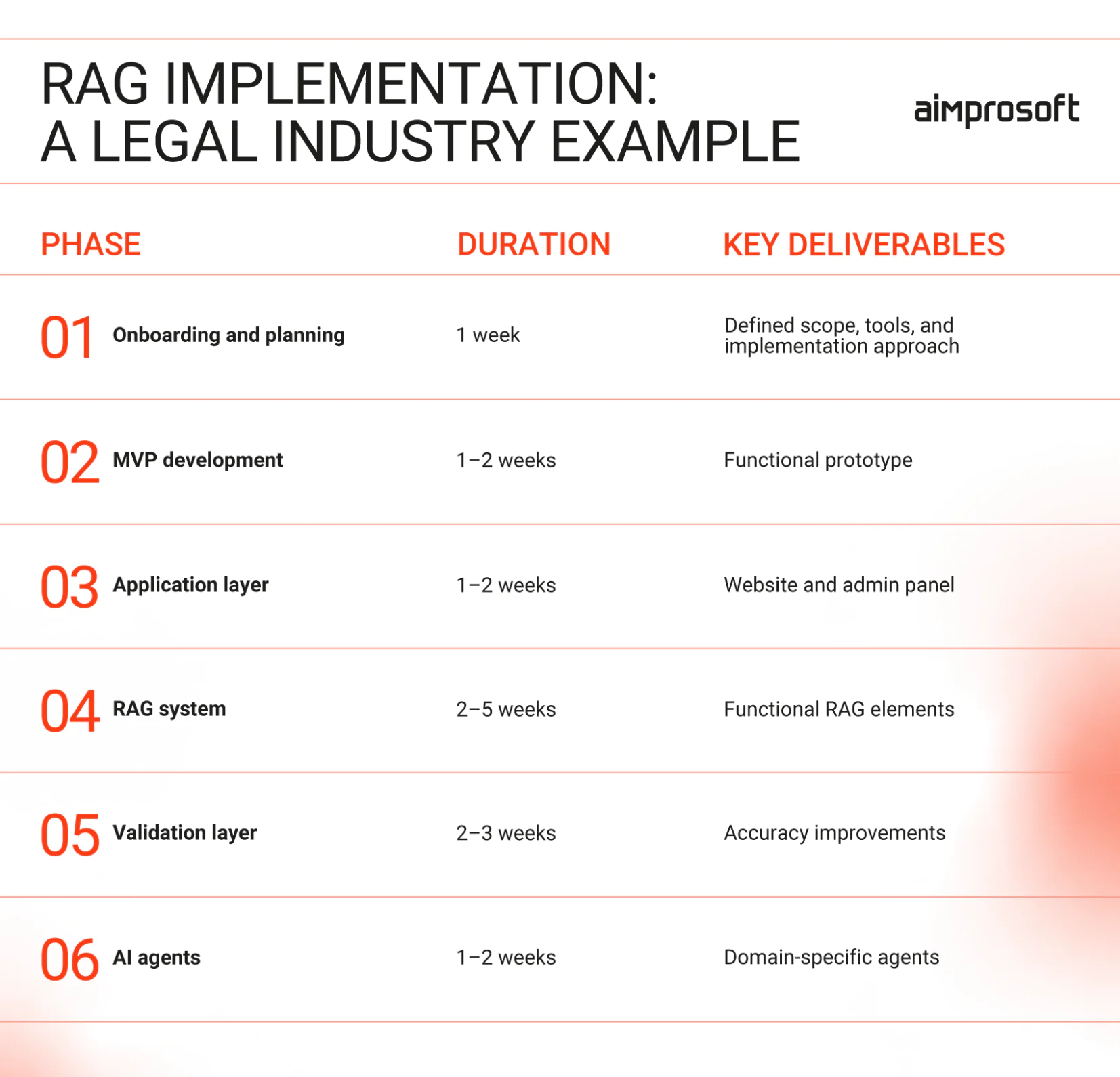
One of the most important RAG implementation best practices is to estimate the project around the full production scope, not just the first working MVP. A working RAG pipeline may be available within weeks, but it shows only that the idea works and is worth further investing in; it’s not the final goal.
How much enterprise RAG implementation costs
RAG development cost ranges from $10,000 for a basic prototype to $150,000 and beyond. But these are market benchmarks rather than Aimprosoft pricing, and the range is wide for a reason: Two RAG systems can have similar use cases but very different implementation requirements.
The same factors that affect the timeline also shape the upfront cost. Data needs to be prepared, source systems need to be connected, and access rules need to work correctly. The more sources, document types, user groups, and use cases the system needs to support, the more engineering work the project requires.
But development is only one part of the budget. The overall cost of AI implementation also depends on how the system is built, who will maintain it, and how heavily it will be used.
Build or use a managed platform
A managed RAG platform provides the infrastructure needed for RAG-powered solutions and AI assistants. Pricing, capabilities, and tech teams needed for development vary, but for some organizations it’s a smart choice to start. While custom RAG development requires more upfront engineering compared to managed services, it also gives the company greater control over its architecture and future customization.
Internal and external expertise
Even if your team has all the right AI and security talent on paper, that doesn’t automatically mean a faster timeline or lower budget. Because these engineers need to be available for development, and in most companies they aren’t.
The decision comes down to whether you have both capability and time. If yes, then internal implementation makes total sense and does make RAG development cost-efficient. But if either piece is missing, an external partner can help. They can bring in the expertise, dedicated development capacity, or both without forcing your existing team to drop what they’re doing.
Ongoing infrastructure and usage
A production RAG system costs money to run. Things like query volume, document volume, model choice, and how often the knowledge base is updated – all feed directly into the bill. For a small, focused internal tool, these ongoing costs are usually modest. But as you scale up to include more users, departments, and everyday use cases, those numbers grow.
Maintenance and improvement
Company information changes, new documents are added, and users ask questions the original test set didn’t cover. To maintain response quality, the system needs ongoing monitoring, data updates, testing, and adjustments.
A realistic estimate should never be focused only on the initial implementation, as the system needs to function after the launch, and it all needs resources to do so. Another important point while considering costs is to remember who will work on that retrieval solution – your internal team or an external partner providing RAG development services.
What to expect at each stage (and what your team should be ready for)
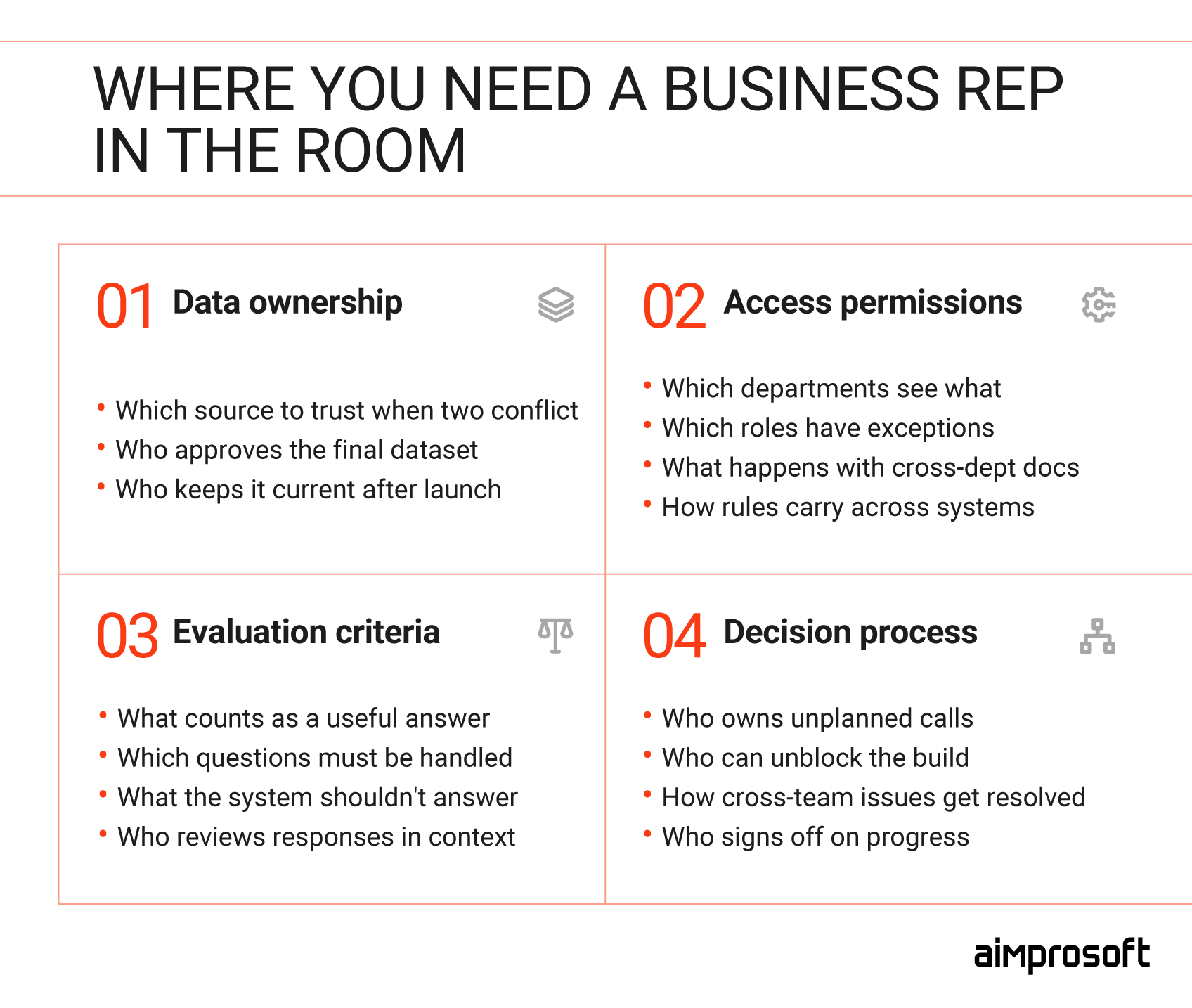
Enterprise RAG implementation is not something you can simply hand over and come back when it’s ready, whether you do it in-house or with an external partner. Above, we mentioned points that are essential for proper implementation written from the perspective of the team, but what does it mean to you, a stakeholder in a company?
Here are the areas where your involvement matters most.
Decide which data the system should trust
Data is everywhere. That’s the easy part, but deciding which version is correct doesn’t sound like it. During data preparation, you may discover outdated documents, duplicates, or even several sources saying different things about the same subject. The development team can flag that, but they can’t decide which version to trust, because they simply don’t know.
This is why someone who understands and owns the data becomes critical. If no actions are taken, technical questions can quickly turn into a business decision nobody knows who should make.
Define who should have access to what
The same rule applies to permissions. Your development team can implement access controls, but it’s your organization that needs to define what those controls should be.
Which departments can see what, which roles have exceptions, and what happens when a document spans more than one category – these are business decisions, not technical ones.
The earlier those rules are defined, the less likely you are to discover during testing that the system can retrieve something a particular user shouldn’t see.
Agree on what a good answer looks like
RAG systems can be measured for retrieval accuracy, relevance, and factual consistency. But none of those scores tell you whether the answer was actually useful to the person who asked.
That’s why subject-matter experts need to be involved in evaluation. They can submit real questions, review responses in context, and help define what the system should and shouldn’t answer.
Agree on those criteria before testing starts. If the team waits until validation to decide what “good” looks like, every review cycle produces a new opinion instead of a decision.
Establish a clear decision process
A subject-matter expert may flag an answer as unsuitable. Security may identify a problem with the proposed access rules. A data owner may discover that two sources contradict each other. In each case, the development team needs to know who can review the issue, make the final call, and unblock the next step.
This becomes particularly important when a decision affects several teams. You don’t need every stakeholder involved in every discussion, but you do need a clear path from identifying a problem to resolving it.
How to choose an enterprise RAG implementation partner
If you’re leaning towards external expertise to build your enterprise RAG, we recommend starting with a consultation. This serves as a starting point for both parties to understand the primary objective, technical requirements, and the challenges you intend to address.
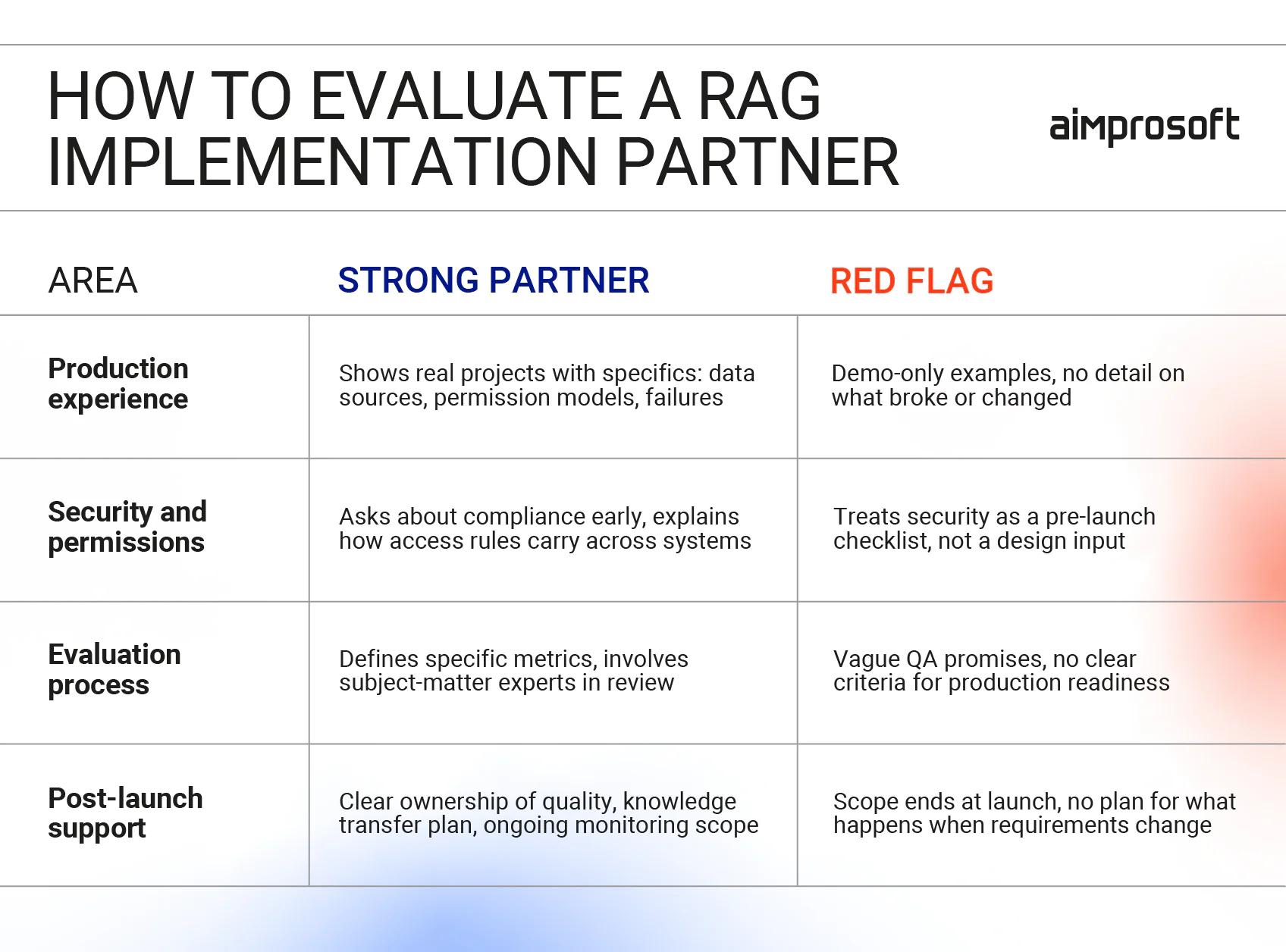
During the consultation, make sure to mention these points.
RAG beyond demo
Ask about projects that made it into production, not just proof-of-concept. An experienced partner should be able to walk you through the real-world details: what data sources they wrangled, how they locked down permissions, what broke or changed between the early prototype and the final rollout, and where the project took an unexpectedly complex turn.
How security and permissions are handled
Security isn’t the last checkbox to tick before launch, and an external partner should understand that. Ask how your existing access controls will carry over into the RAG system, how sensitive data gets protected, and how the architecture lines up with your compliance requirements.
This becomes critical the moment you start pulling together data from multiple places, each with its own messy web of permissions.
How they know the system is working
“We’ll test it” is not really a quality assurance strategy. Ask for specifics. What metrics actually matter? How are test questions built? Who’s on the hook for reviewing answers, and what’s the exact threshold for calling it production-ready?
A strong process should test both retrieval and generated answers. It should also include your subject-matter experts, because technical metrics alone can’t determine whether an answer is useful in the actual business context.
What happens afterward
Before signing anything, you need a clear understanding of what happens between start and launch. Ask what the key milestones look like, what your internal team needs to provide, how you’ll sign off on progress, and how scope changes get handled when they pop up.
Same applies for the post-launch. Who will monitor the system, handle issues, update data integrations, and improve retrieval as requirements change? Will there be a knowledge transfer sessions?
Because even if the partner continues supporting the system, your team still needs to know how it works, why such architectural decisions were made, and what it takes to keep it running.
Choosing a RAG implementation consulting firm comes down to more than finding someone who can build the pipeline. You’ll need a team that can help take it from a working concept to a system your organization can securely use.
If you’re planning an enterprise RAG implementation and want to scope it properly before development starts, talk to our team. We’ll look at your data, existing systems, and production requirements, and tell you honestly what the project involves.