AI Integration Consulting: What to Expect, What to Ask, and How to Avoid Costly Mistakes
Published: – Updated:


IBM’s AI-powered cancer treatment tool didn’t survive contact with real clinical notes and data that were never structured. It was part of Watson Health, a unit IBM built with roughly $4 billion of acquisitions and later sold in part for a reported $1 billion. If a company of IBM’s size can bear the weight of costly experiments, a $50k mistake can be fatal for small to medium-sized companies.
So, is it possible to do AI right the first time? You can certainly stack the odds in your favor if you get the use case, the tech basics, implementation, and ownership right. In this context, AI integration consulting services help you address all four under one investment. This move can help you avoid wasted time and capital, but it will also introduce new considerations related to partner selection.
Continue reading, and we’ll show you how to find the right partner in this oversaturated market, where practically everyone is selling AI capabilities. However, most businesses need someone who can make those capabilities work with what they’ve already built.
What goes into AI integration consulting
AI integration consulting is a range of services that help companies solve their business problems with AI. Despite the word consulting at the end, it may involve strategy and validation as well as technical implementation and depends on how far you’ve come with the idea.
Let’s go into more detail about what it includes.
1. Scoping
This part of AI integration consulting services helps turn your AI idea into a solution you can realistically build.
If you come with a requirement like “I want an AI assistant,” the range could be anywhere from $5,000 to $100,000 — so broad that it’s meaningless. The consultant’s job is to shrink that range down to something real by asking the right questions, breaking the idea into features, and pricing them. With AI, however, the data quality and model performance may only be confirmed after testing. A good estimate names those uncertainties and explains how to validate them.
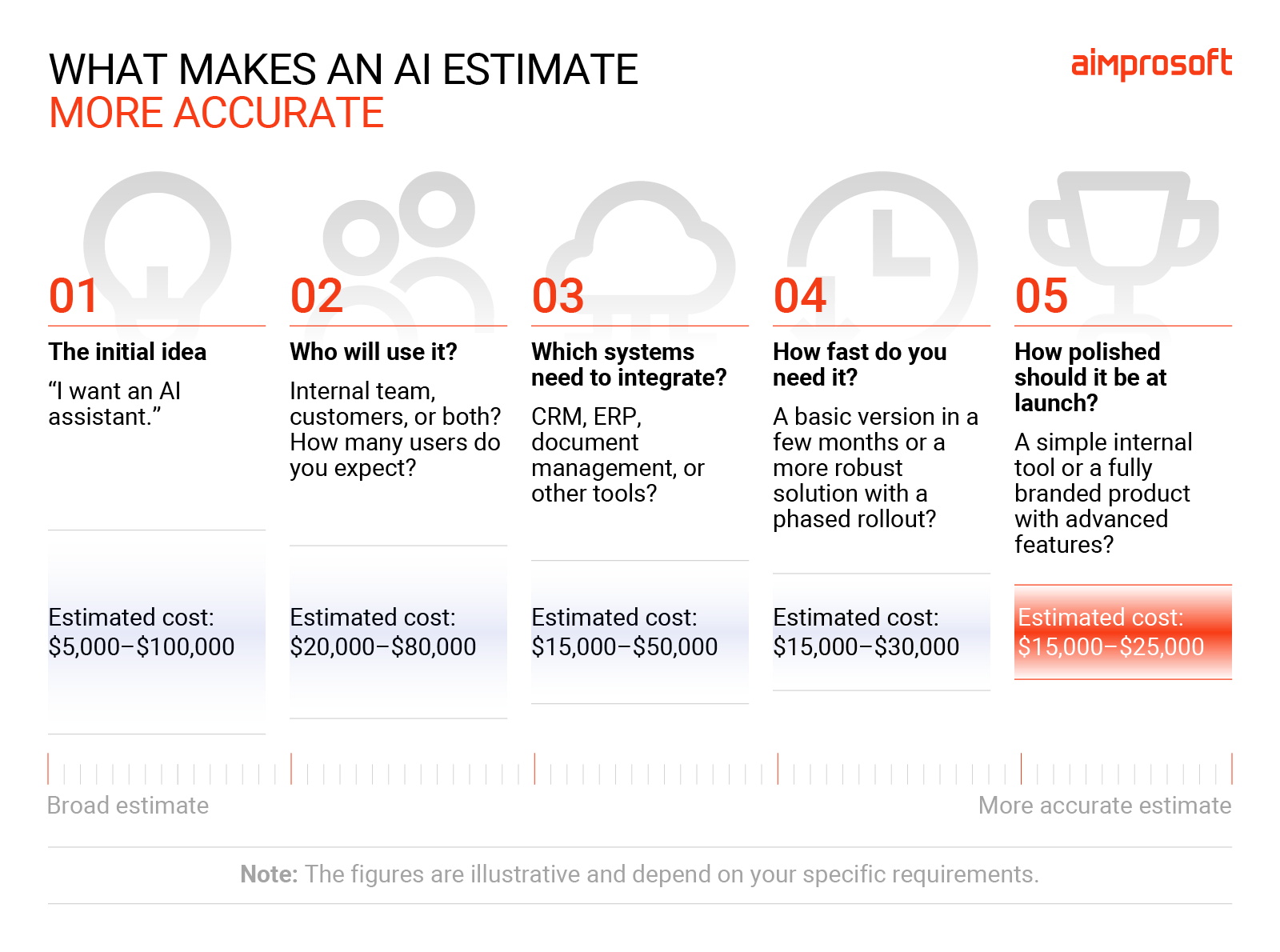
Output: A defined scope, feature breakdown, key assumptions and risks, plus an initial time and cost estimate. For less defined ideas, this may also include a simple functional prototype.
Decision point: Scoping either gives you a green light with defined scope and timeline, or reveals that you need to address more fundamental constraints first.
2. Architecture
Many people think building architecture is about choosing the right tech stack, but it isn’t. The real task is understanding each option’s trade-offs and accepting them knowingly. Every choice comes with downsides: a scaling limit, high maintenance cost, or a vendor dependency you may struggle to replace later. A good consultant names those risks at the start along with possible impacts on the product later.
Output: A solution architecture, key technical decisions, and documented trade-offs and risks.
Decision point: Know what you’re signing up for in terms of costs, constraints, dependencies, and risks that may follow the architecture into production.
3. Implementation
To make AI a working product for your business, it needs to interact with certain systems and data. The number of integrations (CRM, ERP, document management system, and every other tool counts) and the work required to adapt or connect them largely define project complexity.
Sometimes your setup may need changes to enable AI implementation. Or, in some cases, the team may need access to your systems to understand what can be integrated as is and what needs modifications. Assign a technical contact on your side to answer system-specific questions and coordinate any possible changes.
Output: A working AI solution integrated with agreed systems and workflows.
Decision point: Identify integration work that could affect the timeline and budget.
4. Handoff
Agree upfront who owns the solution after launch and what SLA applies. Every system needs ongoing support, and AI is no exception. If your team has the required expertise, the consulting company will provide the documentation and knowledge transfer needed for a successful handoff. If you want the provider to remain responsible, you should sign a support agreement that states the hours, response time, and cost.
Output: Technical documentation, knowledge transfer, and a support arrangement.
Decision point: Make sure someone on your side understands how the solution works well enough to recognize when it needs a fix and when to call a provider.
Prep work that makes scoping faster and cheaper
You don’t need to have all the answers on how to integrate AI into your business before talking to a consultant. But coming to the first scoping call with no basic information on your processes will extend discovery and increase your bill. AI won’t fix a process you don’t understand well enough or data you can’t access.
That said, preparing a few key details about your business and processes before the first scoping call gives both sides a better starting point and lets the team get to a real estimate faster.
Conduct a preliminary data audit
The goal is to understand whether your data in its current state can power the AI use case you have in mind. Here’s a checklist to prepare:
- What data will the AI solution use?
- Where does that data live?
- Is it structured, accessible, and up to date?
- Does the data pipeline need to be built or changed?
- Are there data quality, access, privacy, or security constraints?
Why it saves money: Messy or out-of-reach data is one of the biggest bottlenecks in AI projects. Knowing your data assets’ location and condition keeps paid consultant time focused on solution design rather than basic data discovery.
Map the system AI needs to work with
Some companies rely on legacy systems that are more than a decade old and less architecturally flexible than applications built with modern tech today. Therefore, integrating with these business systems may require additional integration work. What to find out:
- Which systems will the AI need to connect to?
- Which tools and data sources will AI touch?
- Which of those tools are ready to integrate and which need custom connectors?
- Who on your team can explain how these systems work?
Why it saves money: Every unknown integration discovered after development affects the timeline and price. Even a seemingly small change to a system may require custom development or extra testing.
Decide how you’ll measure success
An AI project in itself provides no value to the business until it makes the process faster, cheaper, or better than before. To know how effective AI is, make sure you have defined:
- What business outcome should the AI business solutions improve?
- Which metrics will show whether it’s working?
- What are the current numbers or baseline?
- What metric or ROI would justify this investment for your team?
Why it saves money: A baseline lets you compare the current cost of a process with its cost after introducing AI. To know whether replacing four people with one operator and an AI agent saves money, add server and AI infrastructure costs, maintenance, and human review. Otherwise, you may reduce one cost only to add another.
Set a realistic project timeline
Sometimes, the timeline is dictated by outside pressure — a launch date, an investor update, or a public announcement. AI integration specialists can assess whether that deadline is realistic and what needs to change to meet it. To determine how to implement AI within the available time, they will need answers to:
- What’s driving the deadline?
- Which parts of the project, if any, can be postponed if something takes longer than expected?
- Does the timeline assume the systems and data are ready to use, or does it leave room for scoping?
- Who decides if the deadlines need adjustments once the scope is done?
Why it saves money: If you don’t discuss priorities and trade-offs, a consulting company may cut corners on important aspects to hit deadlines.
Plan for post-launch AI ownership
Every product, be it a car, software, or AI tool, can’t do without maintenance. When something breaks in your car or goes out of date, you know where to turn for repairs. The same thing applies to AI systems. So, agree on who will take care of:
- Who owns the solution once it ships: your team or the provider?
- If it’s your team, what documentation and knowledge transfer do you need to drive AI functionality?
- If it’s the provider, do you have formal SLAs mentioning response times, support hours, and ongoing costs?
Why it saves money: Routine maintenance or an unexpected AI-related issue may require unplanned consulting work. And a support agreement negotiated after something breaks costs more than one negotiated calmly initially, and the terms may be worse.
Not sure how your project scores on these five areas? We can review your current setup and tell you where the hidden risks are before they cost you.
What to ask a potential AI integration partner
Separating qualified consultants with a product mindset from superficial vendors is easier in the first conversation when you know how to force them off their boilerplate sales pitch. Use it to test providers’ approaches, thinking, problem-solving, and risk management so you can choose the right partner.
1. What do you see as the main business problem behind our request?
A vendor who just nods and repeats your brief back to you is scoping the AI you asked for. Yet that doesn’t guarantee the resulting system will solve your problem or deliver the desired outcomes. AI isn’t an answer to every “efficiency or automation challenge,” and a true strategic partner will tell you so and offer better ways to address them.
2. What exactly is included in the scope?
Building an AI business solution can hide a lot of work, especially around integrations, data preparation, testing, and edge cases. Ask the provider to spell out what they will deliver and, more importantly, what is outside the engagement to draw clear lines between deliverables and extras.
3. How will we know if the solution delivers business value?
See whether the AI integration vendor ties the solution to any improvements in time, cost, revenue, quality, or any other baseline. In an ideal scenario, each feature should carry a stated value against its cost to help you decide whether the investment is going to pay off.
4. How do you handle the security and privacy of our data?
The way a technical partner approaches security and governance aspects in an AI project says a lot about how well they understand the risks involved. If left until the end of the project, these requirements can force fundamental changes to the architecture, delaying deployment and incurring unplanned expenses.
5. What will the solution cost to operate after launch at our volumes?
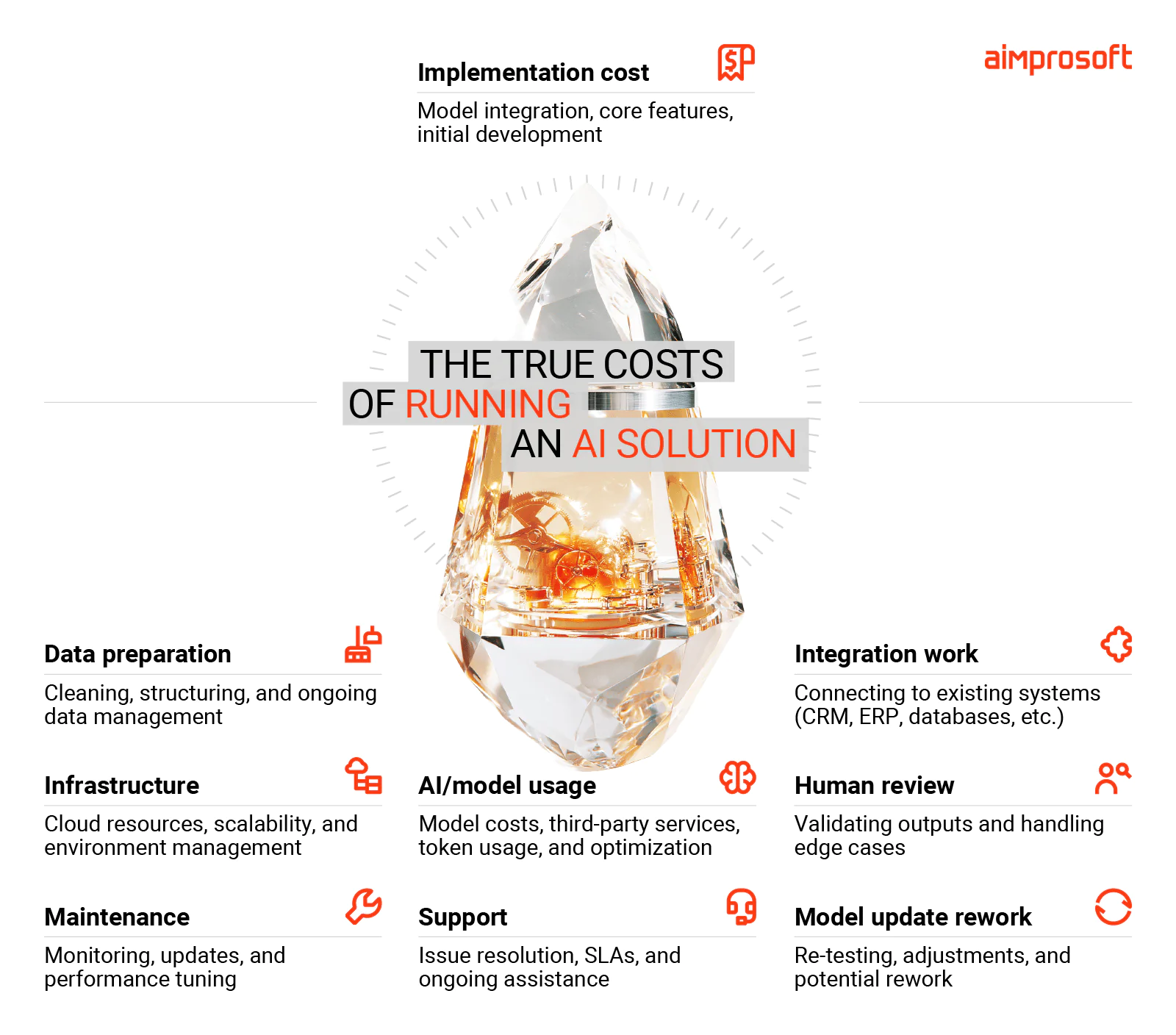
To project the true cost or time savings from an AI implementation, consultants should mention that AI comes with its own running costs. Yes, it can work 24/7 and doesn’t ask for a salary, but running it on a daily basis means paying for servers, AI usage, not to mention maintenance and human oversight.
6. What happens when AI starts to hallucinate or make a wrong decision, and who fixes it?
A model can start to behave differently after an update even if nobody has touched the solution. This question helps you understand whether an AI integration company plans for this ahead of time or expects your team to solve edge cases alone.
7. What does your handoff documentation include?
This question protects you from becoming dependent on the vendor after the project ends. Make sure the handoff entails what your team needs to understand, manage, and troubleshoot the system if needed.
Major red flags in AI integration consulting to watch for
The percentage of AI integration pilots failing to reach production is too high, close to 80%, to ignore when choosing a provider. While there may be exceptions, in most cases, the signs below show whether the provider’s approach deserves a closer look or raises enough concerns to walk away.
| Red flag | Vendor A | Vendor B | Possible risk |
| Quote before reviewing your systems | Fixed quote after the first call | Price follows a scoping review | Missing integration work and scope changes |
| No production examples | Only demos or proof of concept | Relevant production examples | Unknown production and maintenance challenges |
| Vague milestones | No specific dates tied to specific deliverables, e.g., development → launch | Stage deliverables, e.g., a few weeks per phase | Unclear progress and disputes over what done means |
| No post-launch support plan | Not discussed | Support scope and ownership defined | Unexpected maintenance work or dependency on the consultant |
| One-size-fits-all pitch | Same pitch regardless of the business | Scoping starts with your specifics | Solution may not solve your integration need |
| No discussion of operating costs | Not discussed | AI, infrastructure, maintenance, and ongoing costs outlined | The project budget looks acceptable while the ongoing cost remains unknown |
If a vendor says their approach has no risks, don’t take that as a sign they’ve figured every potential issue out. They may not have looked hard enough or lack the production experience to recognize them. A good partner should help you see the full picture of the solution, not only the benefits and expected savings.
How to tell if your AI integration partner is delivering well
High-quality delivery leaves you with concrete things to review at every milestone and keeps you close to the work in progress. You shouldn’t have to wait until the end of development to find out whether the architecture works or whether the integrations behave as expected.
That’s what a well-run engagement looks like in rough terms and how you can tell it’s on track.
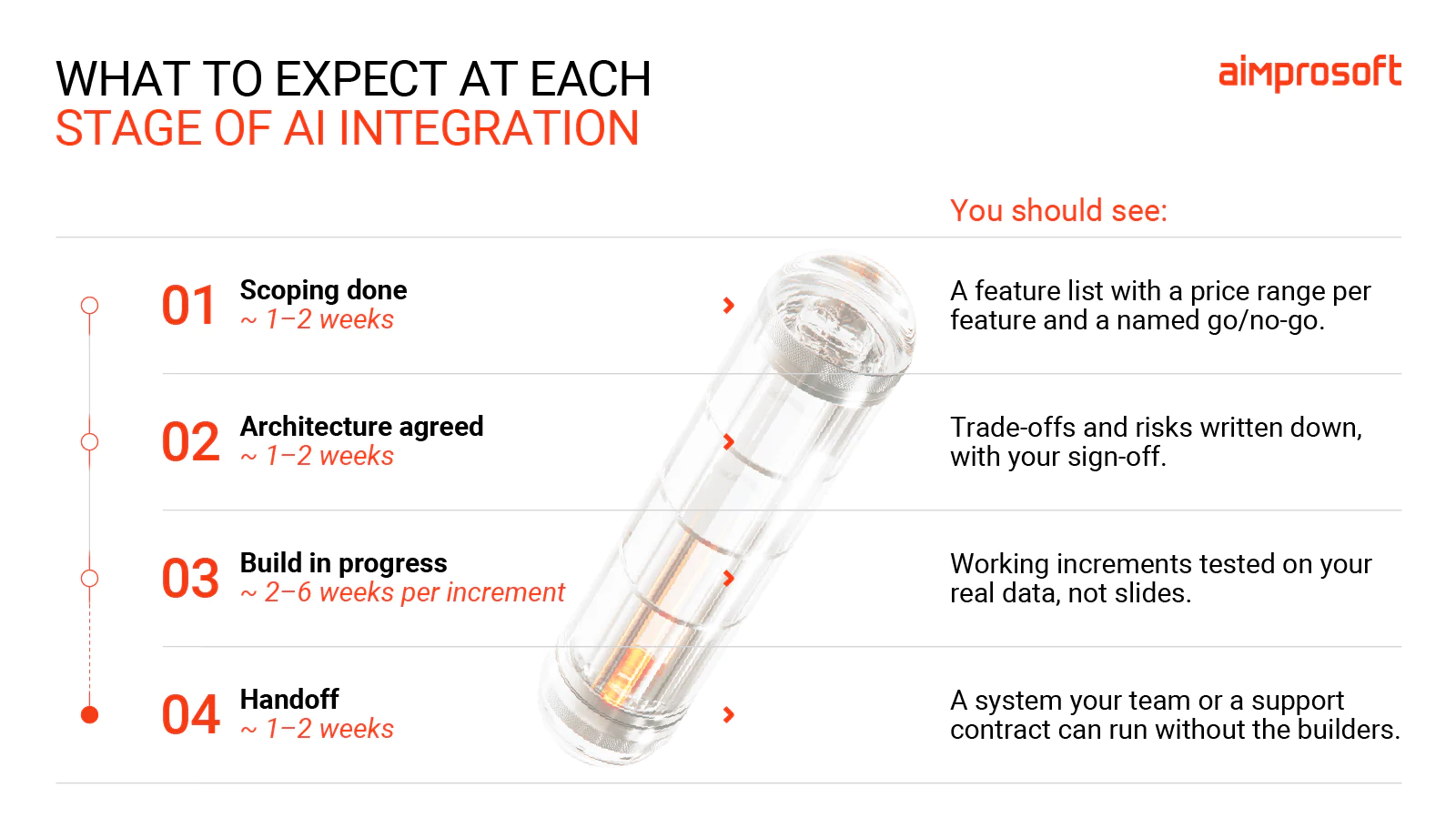
Regarding handoff documentation, here’s the bare minimum you should get:
- Architecture diagram and integration map
- Runbook on how to monitor, restart, and fix common issues
- Test set and results used to accept the solution
- Model, prompt, and configuration versions
- Access and credential inventory
- Training session for the people who will run it
If you’re mapping out an AI timeline, know that you usually spend a lot of time making decisions and getting the right people involved at each stage. The more stakeholders, the more approvals you need, so consider that review time during planning.
One way to make delivery easier to manage is to agree on escalation rules for different scenarios before the work starts. This is also how we approach delivery at Aimprosoft. We set SLAs before the first sprint and provide live dashboards to track delivery performance across key KPIs.
If you remember one thing from this AI integration consulting guide: a good partner can show you what could go wrong, what it will take to address it, and how those decisions impact the investment, instead of promising a risk-free project.
Ready to scope your AI integration?
FAQ
What is AI integration consulting?
AI integration consulting helps businesses determine where AI can add value and how to connect it with their existing systems and workflows. At Aimprosoft, AI integration consulting services include the strategic work to validate the use cases and full technical delivery to bring an AI idea to life.
How much does AI integration consulting cost?
The price of an AI business solution depends on how many systems you integrate, the state of your data, and the features you need. A detailed brief gets a much tighter estimate than a one-line request. We estimate each feature separately, so you can weigh their costs against the expected value and decide what is worth including.
How long does AI integration consulting typically take?
How specifically you define your AI needs influences the estimated project time a lot, while the amount of work around data and integrations affects the rest of the timeline. Scoping can quickly narrow the timeline and give a realistic schedule.
What is the difference between AI consulting and AI integration?
AI consulting covers high-level strategy and use case selection. AI integration takes those decisions into implementation by connecting AI to your systems and workflows that follows. Our AI integration consulting services are designed to solve the business problems, so they can cover both depending on where you are in the process.