How to Build an EHR System: Step-by-Step Guide, Examples & Cost
Published: – Updated:
Almost every US hospital already runs a certified EHR. After the introduction of the HITECH Act over a decade ago, 99% of non-federal acute care hospitals have adopted an Electronic Health Record system. Now, their goal is to adjust it to the clinicians’ work.
Ineffective EHR systems remain among the most-cited sources of physician stress in the AMA’s 2025 national data. As a company, you are paying for it in staff turnover and after-hours charting. This guide distinguishes an EHR from an EMR (Electronic Medical Record), provides examples of custom builds, and explains their costs.
What is an EHR system? EHR vs. EMR
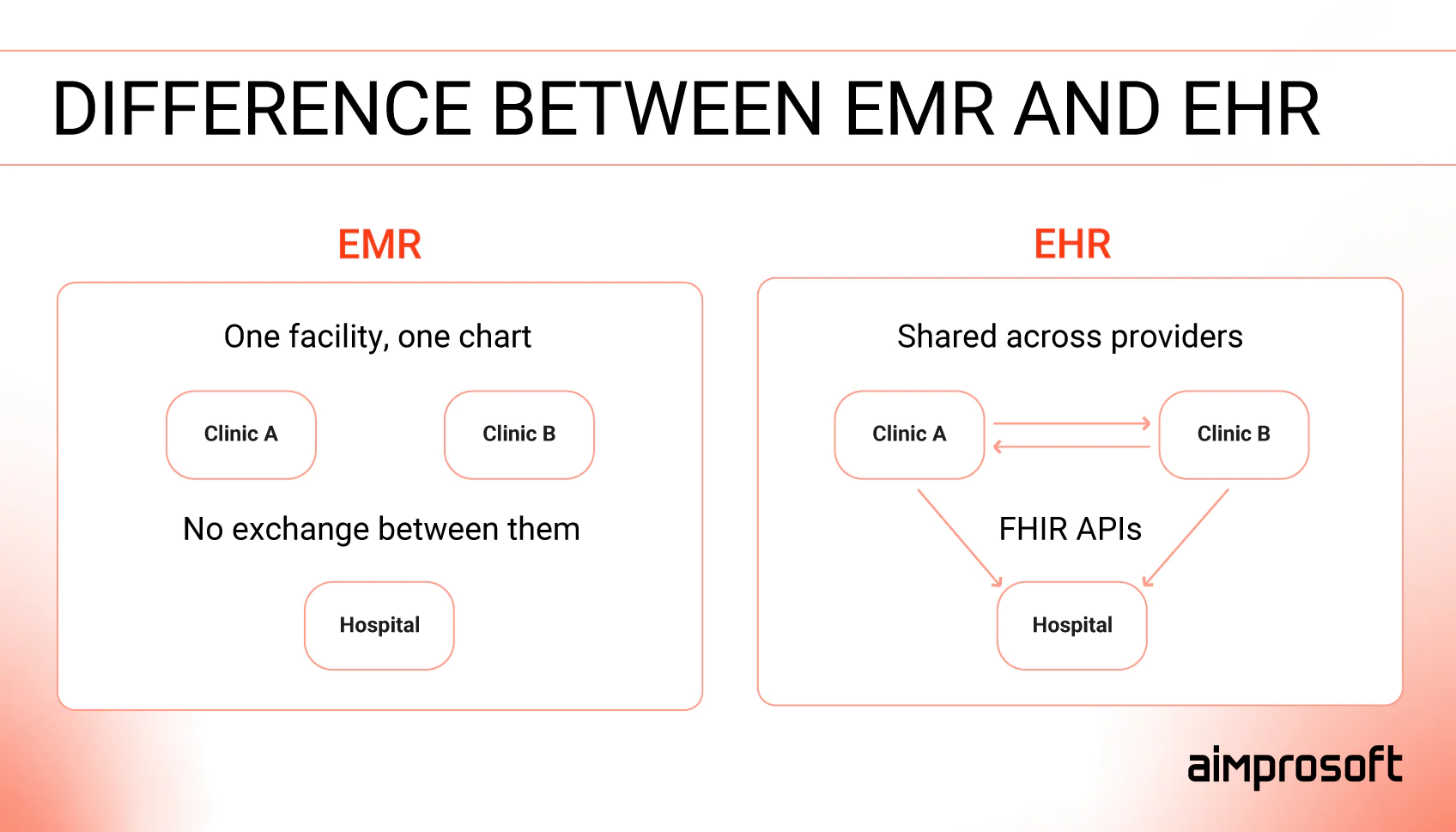
Electronic Medical Records (EMR) software is a digitized version of a patient’s paper chart. The records cover the medical history and treatment of a patient at one particular medical facility. EHR development focuses on exchanging medical records between different practices. It provides a fuller and more nuanced view of a patient’s medical history.
That distinction is why EHR and EMR systems get evaluated on completely separate criteria. Patient record systems built for a single clinic can get away with a closed data model. An EHR can’t. The moment a patient moves between providers, the system either shares cleanly or becomes a compliance problem.
Common challenges in EHR implementation
Cybersecurity
Healthcare has been the costliest sector for data breaches for over a decade. IBM’s 2026 Cost of a Data Breach Report puts the average healthcare breach at $6.6 million – the highest of any industry for the thirteenth consecutive year. The global cross-sector average climbed 12% to $4.99 million. One in four malicious breaches was AI-enabled, a 56% year-over-year jump, and those breaches averaged around $6 million.
Those are the reasons the EHR design now demands audit trails on every record touch. Role-based access that maps to specific clinical duties rather than broad groups. Encryption in transit and at rest. Identity verification at the help desk that accounts for synthetic voice, since deepfake impersonation and AI-generated malware accounted for most AI-enabled breach activity.
High cost
Budget kills most EHR projects before they even start. Hospitals understandably worry about iterative upgrades, maintenance, and vendor fees that stack up beyond the original business case assumptions.
The counterweight is that a system matched to your workflow reduces the recurring costs left by off-the-shelf platforms, such as duplicate data entry, paper handling, and the customization fees you pay a vendor to make their product behave close to what your clinic needs.
Poor usability
Facilities often fail to nail down which features they need and end up with a system stuffed with unused functions and a tricky UI, which reflects in costs and staff retention. The AMA’s 2025 national physician comparison report finds that 41.9% of physicians report at least one symptom of burnout. The same survey shows that 20.9% of physicians spent more than 8 hours a week on the EHR outside normal working hours – the same figure as in 2022.
At the same time, the 2025 study in JAMA Network Open found burnout among ambulatory clinicians fell from 51.9% to 38.8% after 30 days using an ambient AI scribe, with measurable improvement in after-hours documentation time. This tendency tells us that usability is fixable, but it must be treated as a design requirement.
Information overload
Moving paper records and legacy data into a new EHR can create duplicates, mismatches, and lost documents unless the migration is properly planned. As a result, you as a clinic can face the following problems:
- Patient identifiers that never matched cleanly in the old system produce two charts for one person.
- Free-text notes have no structured field to land in, so they arrive as undifferentiated blocks of text.
- Scanned documents come across without metadata, which makes them invisible to search.
Clinicians end up untangling all of this during the exact weeks they’re least familiar with the new interface. Tebra’s 2025 Physician Burnout Survey found many primary care physicians spend two hours on paperwork for every hour of direct patient care. Some of that is regulatory and unavoidable, but a big share of it is design.
Lack of interoperability
Interoperability used to be a nice-to-have that vendors advertised; now it’s enforced. Under ONC’s HTI-1 final rule, certified health IT has had to support United States Core Data for Interoperability version 3 using FHIR US Core profiles since January 1, 2026.
Enforcement has teeth behind it: on February 11, 2026, ASTP/ONC announced it had begun issuing letters of nonconformity to certain certified EHR developers over API performance, interoperability, and potential information blocking, alongside data showing nearly 500 million records exchanged through TEFCA. Those letters can lead to corrective action plans, suspension or termination of certification, or referral to the OIG. The rules also require the public posting of actors found to have engaged in information blocking.
This changes how you sequence the project. FHIR APIs and USCDI conformance shape the data model itself, so they belong in the architecture from the first sprint. Bolt them on at the end, and you reopen settled decisions about record storage, fields structure, and access logs. That is an expensive and time-consuming kind of rework.
EHR systems: Core features and examples
Start by defining what your facility needs. Take this list as a starting point and cut what doesn’t apply.
- Electronic document management. Clinical histories, assessment reports, and lab results stored where doctors can find them without hunting.
- Task management. Sign notes, review lab results, track patient progress. Workflow that matches how the department already operates.
- E-prescribing. The fastest route from prescription to pharmacy. With decision support attached, the prescriber gets automatic warnings on allergies and contraindications.
- Role-based access control. Hospital administrators, specialist surgeons, and registered nurses have different duties. Access levels should match them.
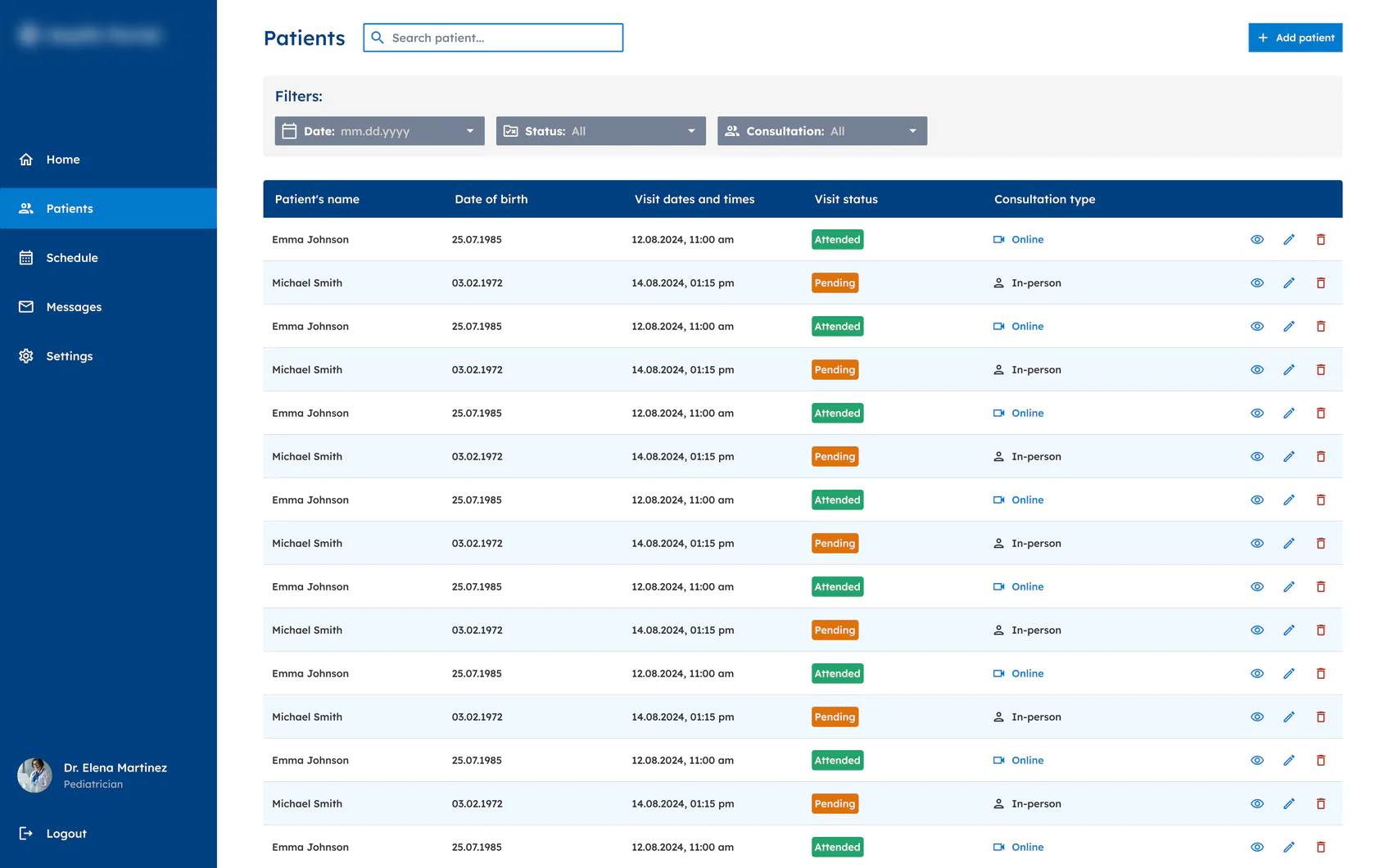
- Lab integration. Reviewing lab results in the EHR rather than in a separate system saves minutes that matter in acute care.
- Electronic communication. Secure messaging for assessments, diagnoses, appointments, and record exchange.
- Clinical dashboard. Templates and order sets that get filled in during a visit and reused for similar presentations. Electronic charting systems live or die on this screen.
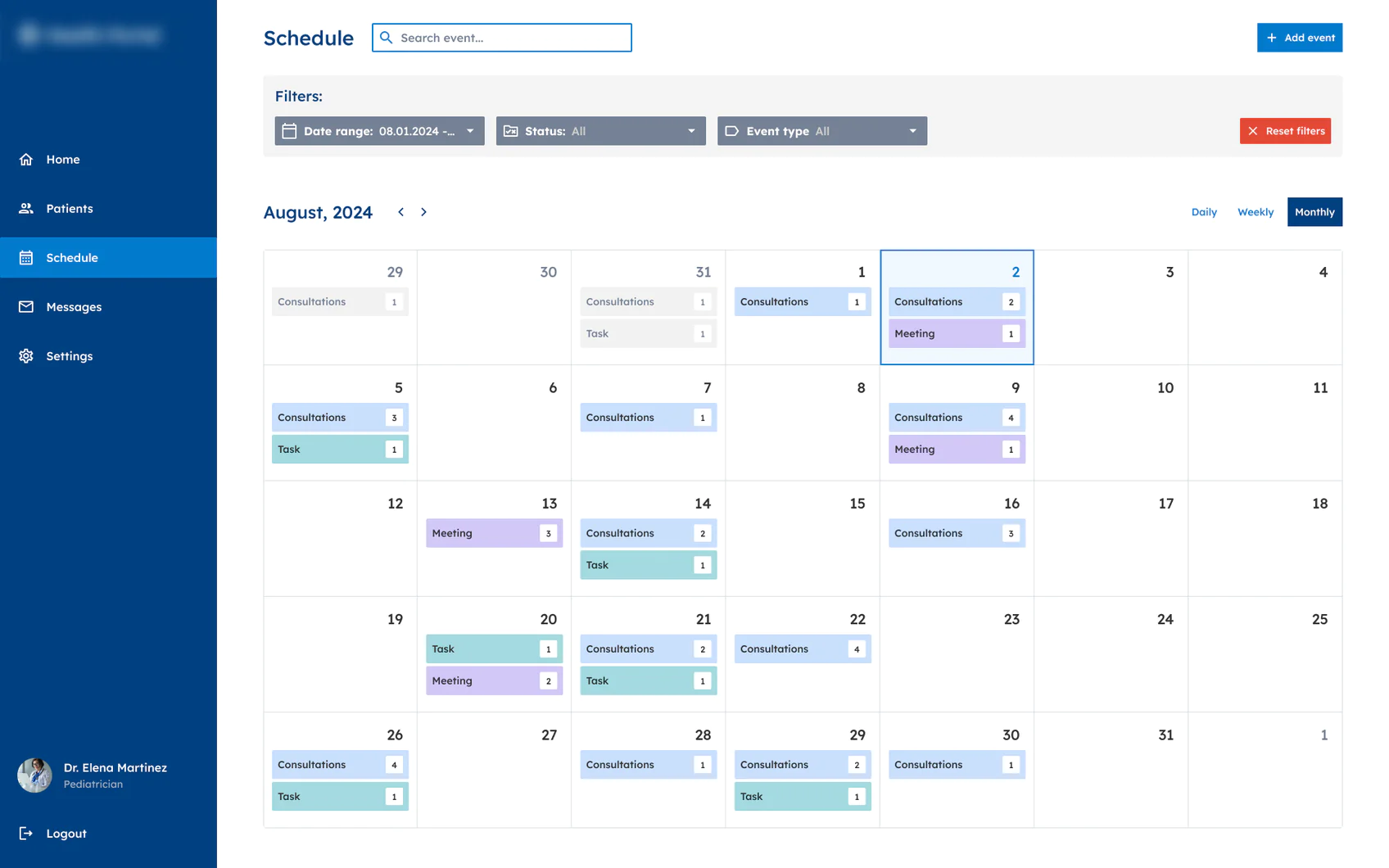
- Patient scheduling. A schedule that sends notifications so patients turn up at the right time.
- Patient support. Integrated chat lets patients report new symptoms early, rather than waiting until the next appointment.
- Reporting. Drug interaction reports, diagnosis registries, and billing reports for whoever holds reporting access.
- 24/7 access. You won’t know which device staff reach for in an emergency. Assume all of them.
- Cloud hosting. Flexibility, disaster recovery, and easier collaboration across sites.
- Intuitive user interface. Drag-and-drop, clean screens, minimal clicks. Every extra click is multiplied by thousands of encounters a month.
Good electronic medical records software doesn’t stop at the clinical core. Four more areas do most of the remaining work.
Patient portal
The portal is where patients fill in intake forms, book appointments, view lab results, and read guidance on managing their condition. Every intake form is completed before arrival, which means a nurse no longer has to spend time on data entry.

Electronic health record forms
Forms are the source of most daily friction. Intake sheets, consent forms, referral templates, and specialty assessments all need to be configurable without a developer, versioned for audit, and pre-populated from existing chart data.
Medical billing
The billing module ensures providers are paid for the care they deliver. The useful version autofills claims for procedures and services already recorded in the patient’s chart, reducing both admin time and the rejection rate.
Evaluation and management coding
Diagnoses, injuries, treatments, exam findings, and procedures must be translated into alphanumeric codes before a claim is submitted to the insurer. Ask any prospective development partner directly how their system handles E&M documentation standards. Getting it wrong results in denied claims, and denied claims mean the system costs money instead of saving it.
How to build an EHR system: A step-by-step guide
EHR software development runs in six stages: discovery, compliance and architecture design, technology selection, development, testing and certification, then deployment with data migration. A focused single-practice system typically takes 6–9 months; a hospital deployment runs 12–24 months. Compliance work starts in stage two.
Step 1. Discovery and workflow mapping
Run interviews with the clinicians who will use the system daily and map out their work, including any workarounds. Those workarounds are your requirements list. Skipping discovery is the most common reason EHR projects deliver expensive features that are never used. The output of this stage is a prioritized feature set, a list of the systems you must integrate with, and a scope boundary.
Step 2. Compliance and architecture design
Next, decide the regulatory perimeter. HIPAA sets the baseline for protecting patient health information. If you’re going for certification, USCDI v3 through FHIR US Core is now the standard. GDPR applies if you handle EU patient data.
Be extra cautious when making architectural decisions: how audit logging works, where PHI lives, how access control is modeled, and how you’ll evidence conformance during a review. Capture that evidence as the system gets built, because reconstructing it later will bring enormous costs.
Step 3. Technology approach
Pick the stack and the base. The options range from a fully custom build, through an open-source or platform-based solution such as Alfresco for content-heavy document management, to a headless EHR core with custom clinical layers on top. A platform-based solution gets you to a working system faster. A custom build gives you full control over the data model and no licensing tail.
There’s no universally right answer, since your integration count, compliance scope, and five-year plan vary the decision-making factors. Our technology consulting team works through exactly this comparison with healthcare clients.
Step 4. Development
Build in vertical slices that a clinician can test, not horizontal layers that only become visible at the end. Start with the clinical core (charting, scheduling, access control), then add billing, labs, and patient-facing modules. Integrations run in parallel because they’re the most likely thing to slip.
An EHR developer working in healthcare must have robust domain knowledge. HL7 and FHIR message handling, clinical terminology sets, and audit requirements are vital for understanding at this stage.
Step 5. Testing and certification
We run functional, security, and interoperability testing separately. Penetration testing and access-control validation matter more here than in almost any other software category, given the cost of breaches. If you’re pursuing ONC certification, budget also for time and third-party testing fees.
Step 6. Deployment, migration, and training
Data migration from the legacy system is a complex and time-consuming task. Plan for dirty data, duplicate patient records, and fields that don’t map. Run parallel operations for a defined period. Train by role rather than by feature, since a nurse and a billing coordinator need entirely different halves of the system.
Related reading: building a healthcare app covers the patient-facing side, and connected medical devices covers device data ingestion.
How much does it cost to build an EHR system?
Custom EHR development cost in 2026 ranges from roughly $30,000–$80,000 for a focused single-practice system, $60,000–$255,000 for a multi-site clinic group, and $250,000 to over $1 million for a hospital or enterprise build. Annual maintenance adds 15–25% of the initial build cost. Scope, integration count, and compliance requirements drive most of the variance.
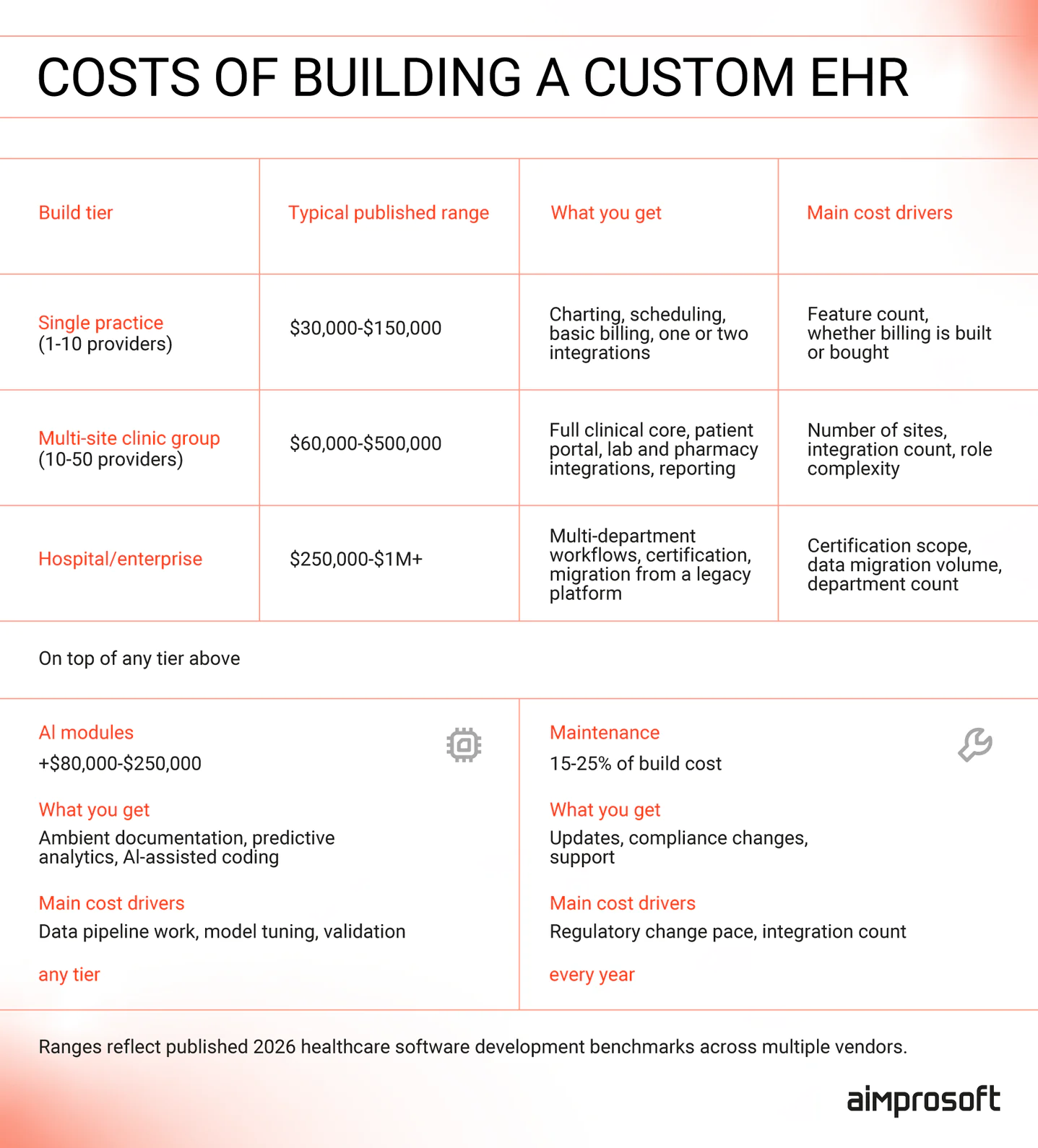
Published EHR cost ranges vary wildly across sources, and some quote figures that differ by a factor of 10 for what sounds like the same system. It’s because “an EHR” covers everything from a single-specialty charting tool to a multi-hospital platform. That’s why any estimate must ask you about your integration count and compliance scope.
Additional scopes include data migration and the annual maintenance tail. A $200,000 build carries somewhere around $30,000–$50,000 a year behind it for as long as you run it. If a proposal you’re comparing leaves both out, it looks cheaper, but you’ll meet these costs later. Ask every vendor to price those two lines explicitly so you get the full picture.
Should you build a custom EHR or buy an off-the-shelf one?
The answer depends on whether your workflow is just a workflow or a differentiator. Buy off-the-shelf when you need a certified system of record, your processes look like everyone else’s in your specialty, and you are happy to pay a subscription fee. For many standalone practices, this is the right call, and no amount of custom development can beat Epic’s regional data exchange if that’s what you need.
Build custom when your care model work includes specialty workflows, unusual multi-site structures, research protocols, and integration layers between systems that were never designed to connect. The customization fees on a commercial platform will exceed the cost of building the custom system.
The trade-off of a custom system is that you own the roadmap and maintenance. There’s no vendor to escalate your problem to. That’s why the most honest recommendation is often a hybrid – a certified platform as the system of record, with custom software development filling the blind spots around it.
For similar work across the sector, see our healthcare software development practice or read about how machine learning and computer vision in healthcare are being applied to clinical data.
Where to go from here
An EHR project starts with two decisions: what your clinicians need and what regulations your system must meet. These decisions give shape to everything that follows – technology, integrations, development timeline, and cost.
If you’re deciding between a custom EHR and a commercial platform, or planning integrations around an EHR you already use, the next step is to define your integration requirements and compliance scope. Then, choose a vendor who will become your technical partner in this enterprise.
FAQ
Can I create my own EHR?
Yes, organizations build custom EHR systems when commercial platforms don’t fit their clinical workflow. The realistic entry point is $30,000–$80,000 for a focused single-practice system. Going custom, you take on the compliance obligation, meaning HIPAA safeguards plus USCDI v3 through FHIR US Core if you want certification, along with the ongoing maintenance.
How much does it cost to build an EHR system?
Published 2026 benchmarks put a focused single-practice build at $30,000–$80,000, a multi-site clinic system at $60,000–$255,000, and a hospital or enterprise deployment at $250,000-$1 million. Add 15–25% of the build cost annually for maintenance, and $80,000–$250,000 for AI modules such as ambient documentation.
What are the top EHR systems?
By US acute care market share in 2026, Epic leads with 43.7% of hospitals and 56.9% of beds; Oracle Health follows at 21.9%; and MEDITECH holds 14.7%. In ambulatory settings, the market is more fragmented, with Epic, eClinicalWorks, and athenahealth taking the largest shares.
Is there a difference between EHR and EMR systems?
EMR is the digitized version of a patient’s paper chart at a single facility. EHR is an API-enabled system that other healthcare institutions can connect to and exchange data with. Both hold health information; the EHR gives a fuller picture of a patient’s health across providers and over time.
Are there any barriers to a hospital adopting an EHR system?
The main ones are cost, migration, and staff training. Established vendors bring long implementation timelines and customization fees; smaller vendors bring viability risk. A custom or hybrid build avoids the licensing tail but puts the maintenance on you.
Does an EHR have business process automation and workflow management?
It is supposed to. Workflow capability belongs in the core of the system, covering clinical tasks, handovers, approvals, and administrative document routing. Automating the repetitive paths is usually the main time-saver.
Can I get EHR/EMR and practice management software in one?
Yes. EHR/EMR software is clinically focused, while practice management covers billing, scheduling, reporting, and claims processing. Look for a platform that handles both, or build the clinical layer to integrate cleanly with your existing practice management system.
Which US standards does an electronic health records application need to meet?
HIPAA for protecting patient health information, and FHIR for data exchange. Under ONC’s HTI-1 rule, certified health IT has had to support USCDI v3 using FHIR US Core profiles since January 1, 2026. FDA requirements apply when the software meets the definition of a medical device. Information blocking rules under the 21st Century Cures Act now carry active enforcement, including letters of nonconformity to certified developers and public posting of actors found in violation.