Why AI Projects Fail Before They Start (And How to Prevent It)
Published: – Updated:

Despite the hype around AI implementation, a very low percentage of companies see measurable results.
RAND Corporation found that over 80% of AI projects fail to reach production – twice the failure rate of standard IT projects. MIT NANDA reports that 95% of organizations saw zero measurable P&L impact from generative AI implementation in 2025.
In almost every such failure, the root causes trace back to the same things. Workflows that were never ready to be automated. Data that was never fit for purpose. Governance that arrived too late. Users who had no reason to trust the solution.
In this article, we break down six failure patterns behind the majority of AI project failures. What drives each one, and how pre-launch AI readiness assessment keeps your budget and reputation secure.
When you need an AI readiness assessment, and when you don’t
A structured AI readiness assessment is not a tool for every situation. It’s designed for organizations committing real budget to a production AI initiative.
You probably don’t need one if you are:
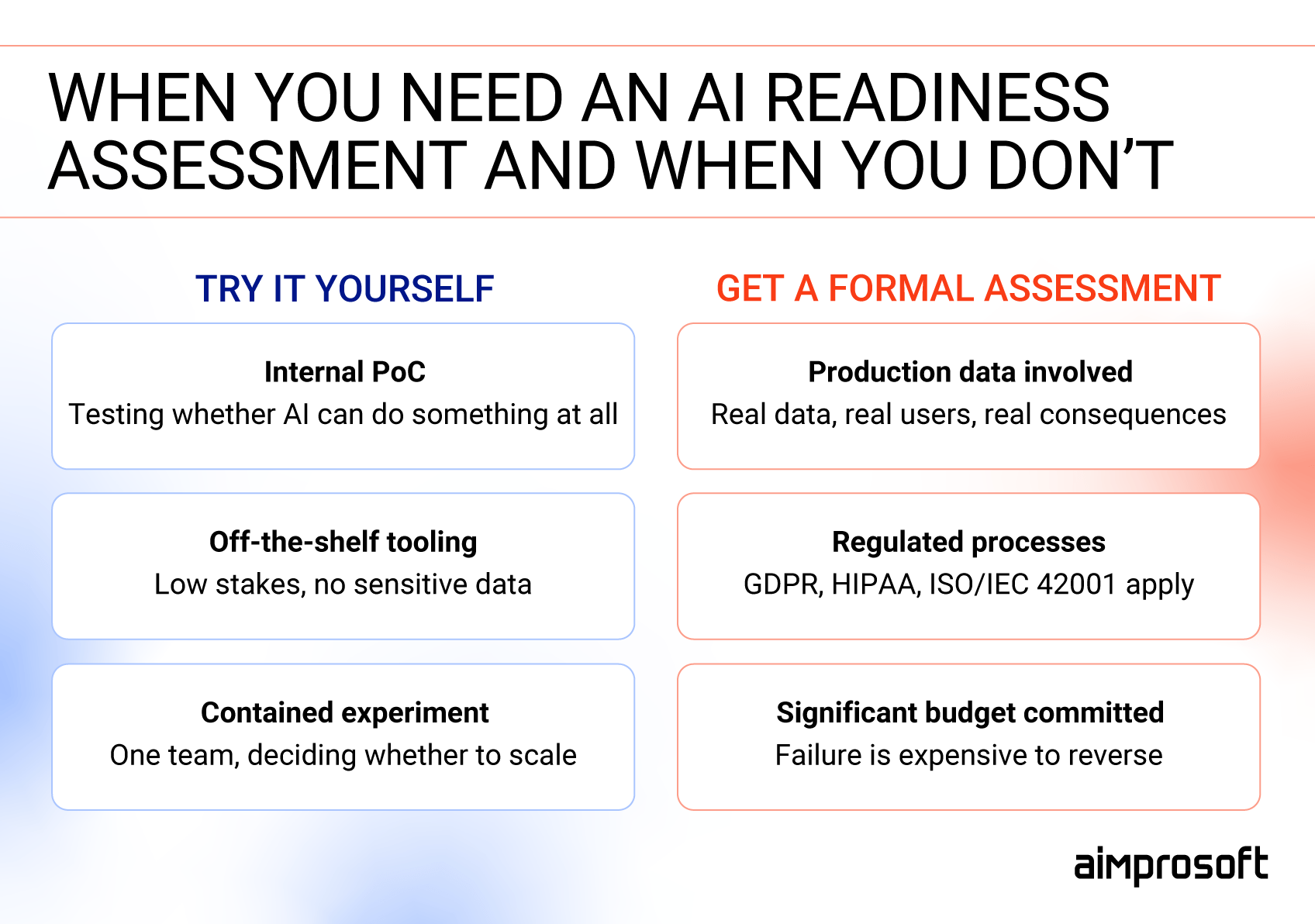
- Running an internal PoC to test whether AI can do something at all;
- Exploring a low-stakes use case with off-the-shelf tooling and no sensitive data involved;
- Experimenting with AI-assisted workflows in a contained team before deciding whether to scale.
The overload of a formal assessment with stakeholder interviews, documentation review, and governance evaluation outweighs the risk for such cases. It would be better for you to try things and learn from them.
But, if the initiative involves production data, regulated processes, or real budget – the six patterns below are exactly what you’re risking without an assessment.
The 6 failure patterns and the readiness gaps behind them
Pattern 1: Teams start with the wrong process
What it looks like: You apply AI to a broken or undocumented workflow. The system doesn’t fix the inconsistency; it executes it faster and at scale. Teams discover that the process the AI was designed to automate was never reliable to begin with – often mid-build, or even after launch.
Why it happens: Nobody evaluates process maturity before scoping. The assumption is that if a task is repetitive, it’s automatable. It’s only true if the task is also well-defined, documented, and measurable.
One of the five leading root causes of AI project failure is that stakeholders misunderstand or miscommunicate what problem needs to be solved. That confusion almost always starts in undocumented process logic – the informal steps, exception-handling rules, and judgment calls that live in people’s heads rather than in any SOP.
What an assessment catches: Whether workflows are documented, standardized, and measurable enough for AI to act on. Where decisions depend on individual knowledge rather than defined rules. Where exception cases are common enough to derail any model trained on the standard flow.
If you can’t describe a process precisely in writing, you can’t reliably hand it to an AI system.
Pattern 2: Knowledge is fragmented across systems and people
What it looks like: The data exists, but it lives in several separate systems and is formatted inconsistently across all of them. The fields that should match – don’t.
In a vendor demo running on a curated sample with a clean schema, none of this shows up. In a production environment built on years of poorly governed, under-documented, never-cleaned data, it shows up immediately.
Why it happens: Teams get excited about what AI can do and jump to model selection before getting data ready for AI and making sure it can support what they’re building. Data mapping gets skipped in favor of use-case selection.
Data quality and readiness have consistently been cited as the top obstacles to AI success.
What an assessment catches: Data silos and accessibility barriers. Inconsistent definitions across systems. Missing historical records for AI-ready data architecture. Format mismatches that degrade model accuracy. And whether the organization’s data actually meets the bar required for this specific AI application.
Pattern 3: ROI is declared but never measured
What it looks like: The business case claims ‘significant efficiency gains’ and the SteerCo approves the project. Twelve months later, nobody can say whether those gains appeared, because the baseline never existed.
No pre-AI cost per processed case. No baseline cycle time. No error rate to compare against. The AI system may be working poorly or well, and the organization has no way to tell the difference.
Why it happens: Companies treat KPI definition as a post-launch activity and put all their pre-launch energy into the build. When metrics get figured out during the pilot, you end up with a system that may function correctly but can’t be evaluated or defended in a budget review. Without numbers, you have no case to make to stakeholders.
What an assessment catches: Whether a KPI baseline exists for the specific process. Whether success metrics are defined in business terms such as cost per task, error rate, cycle time. Whether the organization has the telemetry in place to gather those metrics after launch.
A completed assessment produces a pre-project baseline so that what changes afterwards is clearly attributable to the AI initiative.
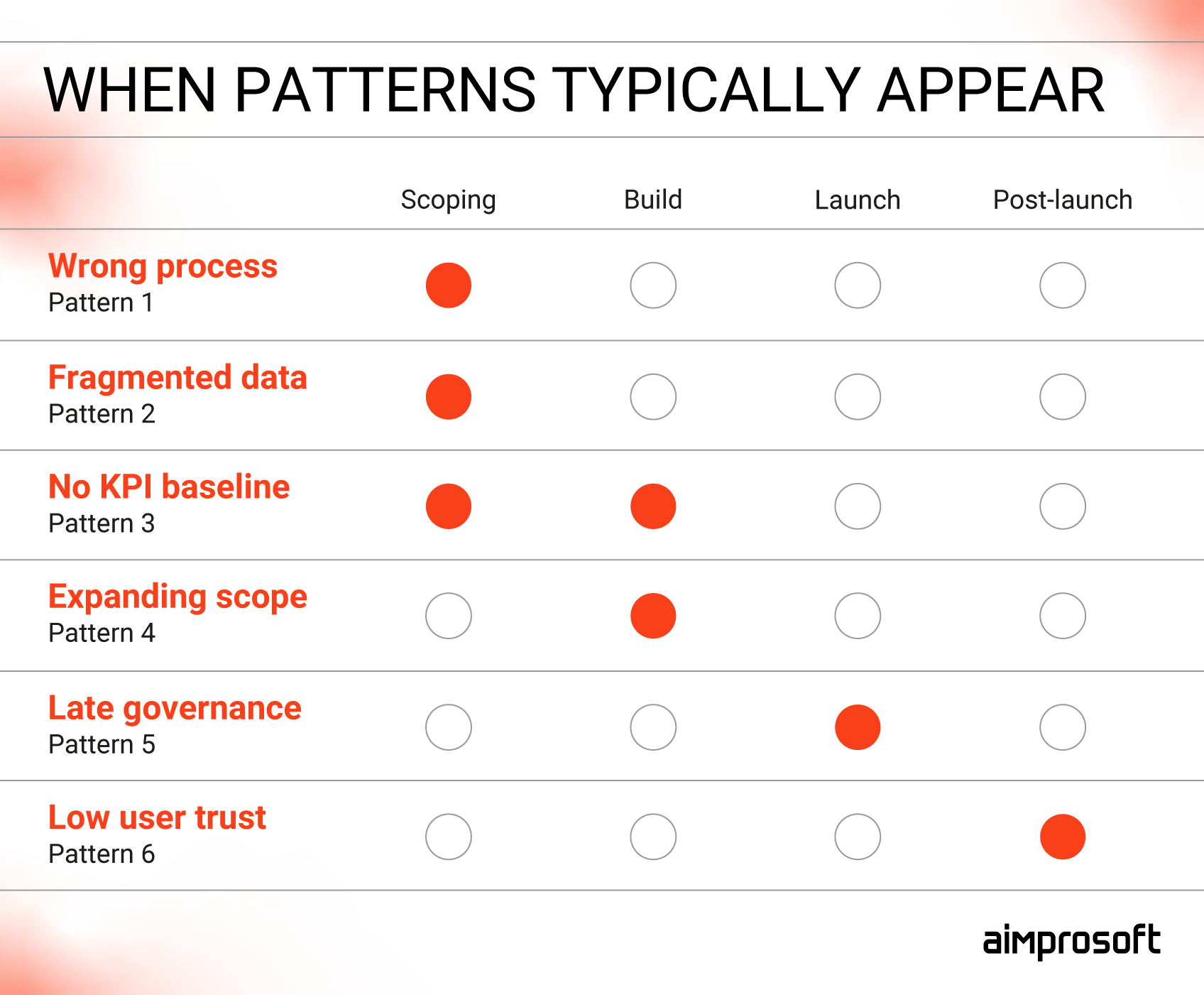
Pattern 4: Scope expands during the pilot
What it looks like: A focused automation pilot grows into a platform project. New stakeholders add new requirements. Integration dependencies that weren’t visible at scoping start surfacing. What was scoped as a two-month PoC becomes a twelve-month infrastructure project.
Why it happens: Companies set scope before understanding their technical limitations. They commit before mapping infrastructure capacity, integration complexity, and hidden system dependencies.
AI systems also accumulate technical debt faster than standard software. Adding a ‘simple’ data requirement can trigger model retraining, infrastructure changes, or even architecture rework that multiply both cost and timeline.
What an assessment catches: Infrastructure capacity issues and deployment readiness. Integration complexity and hidden dependencies. MLOps gaps.
The infrastructure dimension of a readiness assessment is specifically designed to catch this. Thanks to this step, scope doesn’t get committed before the environment evaluation.
Pattern 5: Governance and security show up late
What it looks like: Companies bring in legal, compliance, and security only after the system is nearly built. They flag data access issues, regulatory exposure, and audit trail gaps. Some parts get reworked, delaying the launch.
Sometimes the project gets suspended entirely.
This pattern has a name in enterprise AI: compliance debt. Many projects in 2026 are being legally suspended mid-build because nobody audited the models for bias or checked data residency requirements before development started.
Why it happens: Governance gets neglected during the design phase. Nobody asks what regulatory obligations apply to automated decisions, or what audit trail the system needs to maintain. By the time governance shows up after deployment, the damage is already done.
What an assessment catches: Access control gaps, data privacy risks, and the regulatory regime that applies – GDPR for European operations, HIPAA for healthcare, ISO/IEC 42001 for AI-specific governance. And whether the organization has defined who owns the system, who can access the data it runs on, and what audit mechanisms need to be in place.
Pattern 6: Users don’t trust the output
What it looks like: The system deploys and works, but staff bypasses it. They spend time verifying every output or stop using it altogether when nobody is watching.
Usage metrics look fine because the system processes requests, but it never becomes evidently efficient, because every output gets manually reviewed anyway. The project becomes a success only to get deprioritised six months later.
Why it happens: Nobody evaluates user readiness or change management before launch. Nearly two-thirds of AI implementation challenges come down to how people were trained, whether they trusted the system, and whether anyone helped them change how they worked. It’s especially critical for distributed teams.
What an assessment catches: The user trust baseline before launch, training gaps, and cultural resistance signals. Adoption risks appear during interviews: in how staff describe their current workflows, and in how much informal workaround behavior already exists.
A note on technical constraints
Besides the organizational patterns, AI projects can fail for purely technical reasons.
A use case that works in a pilot can become economically unviable at production scale once you’re paying for inference on real volume. Plus, models change faster than roadmaps do. A system built tightly around a specific model version can become unreliable or outdated before it’s fully deployed.
Eventually, some use cases are simply a poor fit for what LLMs can currently do, regardless of how well the organization is prepared.
Completing AI readiness assessment checklist won’t prevent these problems. But a good one will surface them early, and a good assessor will tell you when they’re reasonable enough to stop.
How to prevent your project failure with AI readiness evaluation?
All failure patterns are visible at the beginning. They show up in process documentation, data maps, stakeholder interviews, and infrastructure reviews, and just need someone to look before the commitments are made, and the money is spent.
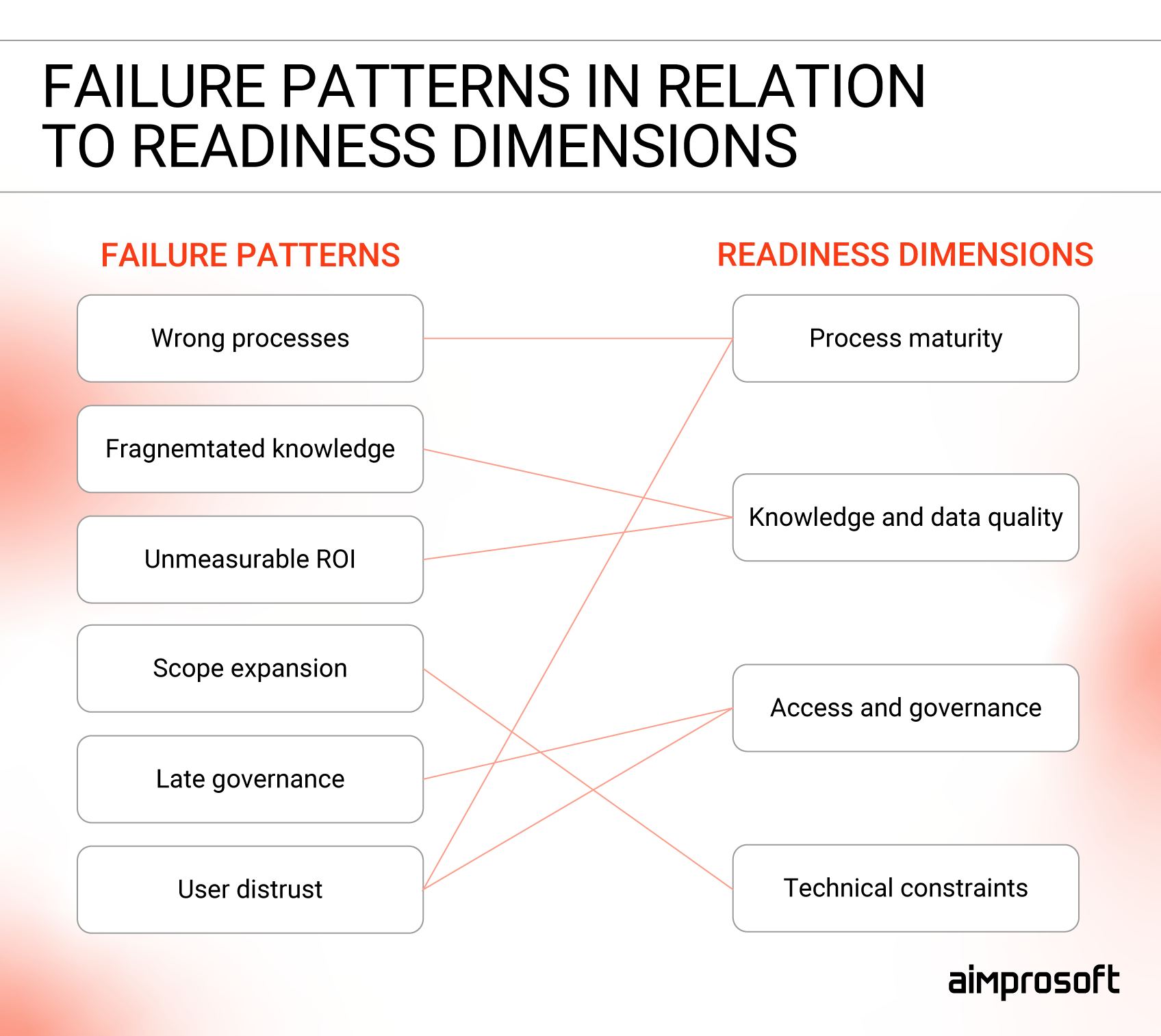
That’s what an AI readiness assessment for business does. It evaluates the organization’s process maturity, data quality, governance, and technical infrastructure, and produces an evidence-based judgment. Each failure pattern maps directly to at least one of those dimensions.
What an Evaluation Covers: AI Readiness Assessment Best Practices
Assessment of four dimensions. Infrastructure, data, governance, and process maturity need to be evaluated together and translated into a single verdict. An AI readiness assessment framework must be built around the understanding that a strong infrastructure score doesn’t compensate for broken process maturity, and one critical gap in any dimension can trigger a NO-GO.
Interviews with IT and business stakeholders. To avoid patterns 1, 3, and 6, you need input from the people who run the work, not only the system managers. Process documentation gaps, unmeasurable ROI, and user trust baselines are all invisible to a technical-only assessment.
A KPI baseline set before the build starts. The baseline should never be established during the pilot – it’s a precondition for any ROI number a CFO will accept. Recording the current state of metrics upfront is the basis for project evaluation after it goes live.
Deliverables defined upfront. Deliverables should be specific and agreed before the engagement starts. A credible assessment produces a readiness scorecard with evidence for each dimension, a gap and risk analysis, a KPI baseline, and a GO / CONDITIONAL GO / NO-GO recommendation.
For GO and CONDITIONAL GO verdicts, a ready-to-execute pilot plan comes with it.
Why these risks run deeper with generative AI readiness assessment
One of the biggest misconceptions about large language models is that they can compensate for fragmented knowledge, inconsistent documentation, or poorly defined processes. Generative AI depends on the quality of the information and workflows that support it. Weak foundations only get magnified.
The model produces wrong answers and sounds convincing doing it.
Trust is also harder to maintain. Traditional automation follows predefined rules, so it’s easier to spot and correct errors. With generative AI, a plausible but incorrect response can pass unnoticed.
As wrong outputs accumulate, employees and customers start questioning whether the system is at all reliable.
Generative AI also adds governance requirements on top of the usual data quality, security, and compliance controls. Those include output monitoring, hallucination management, model version control, and oversight of how generated content gets reviewed and approved.
A gen AI readiness assessment covers the same four dimensions – process, data, infrastructure, and governance – with additional checks specific to model governance layered on top.
Key Takeaways
- Over 80% of AI projects fail to reach production, at twice the rate of standard IT projects.
- Six failure patterns account for most failures: applying AI to undocumented processes, fragmented data, no KPI baseline, scope expansion from unassessed technical constraints, late governance involvement, and low user trust.
- AI contextual organizational knowledge is among the most common project failure reasons.
- A formal AI readiness assessment makes sense when failure is expensive. For early experiments and internal PoCs, it’s overhead.
- An AI readiness assessment evaluates all four dimensions and produces a GO / NO-GO recommendation.
See how Aimprosoft’s AI readiness assessment identifies these failure signals before they become expensive