What Is AI Readiness Assessment? (And Why It Matters Before You Build)
Published: – Updated:


Until recently, most companies were still experimenting with AI. Separate teams used generative tools to draft emails, review code, or summarize documents. That kind of work mainly lived in browser tabs and didn’t require a formal gen AI readiness assessment. Because when it went wrong, the consequences weren’t dramatic.
Now, AI is moving into core operations. Customer onboarding, compliance reviews, equipment monitoring, to name a few. Deploying in these environments without understanding your organization’s actual preparedness creates risk: operational, financial, and reputational.
That shift has made AI readiness assessment a core part of enterprise AI strategy. Before you automate decisions, push models into production, or scale AI across teams, you need to ensure that your processes, data, and infrastructure are ready to support it.
This article explains what is AI readiness assessment, who benefits most from it, what it covers, and when it moves from useful to essential.
What is AI readiness assessment?
An AI readiness assessment is a structured evaluation that defines whether your organization is ready to deploy AI on a specific business process. And, if not, what needs to change first. It usually sits on top of other evaluations your team may already be running and relies on their findings.
A software audit, for example, inventories your existing systems and infrastructure. Useful, but on its own, it doesn’t tell you whether those systems can actually support an AI deployment. The readiness assessment takes the audit’s findings and tests them against that specific question.
A strategy workshop defines which AI use cases the organization wants to pursue. Again, valuable, but a list of desired use cases is not the same thing as a list of feasible ones. The assessment tests each candidate against your real data quality, governance model, process maturity, and internal ownership.
The same logic applies to self-assessment questionnaires. The questionnaire captures perception since the organization is evaluating itself. The AI readiness audit validates it against evidence.
In practice, all these tools sit in a natural sequence. A software audit tells you what you have. A strategy workshop tells you where you want to go. A self-assessment questionnaire gives you an early sense of where the gaps might be.
An AI readiness assessment uses all that input and then connects theory with real state of things. It looks at your workflows and processes, the level of data readiness for AI, and gives a clear verdict that the business can act on confidently.
If you are ready for one AI system, are you ready for the next?
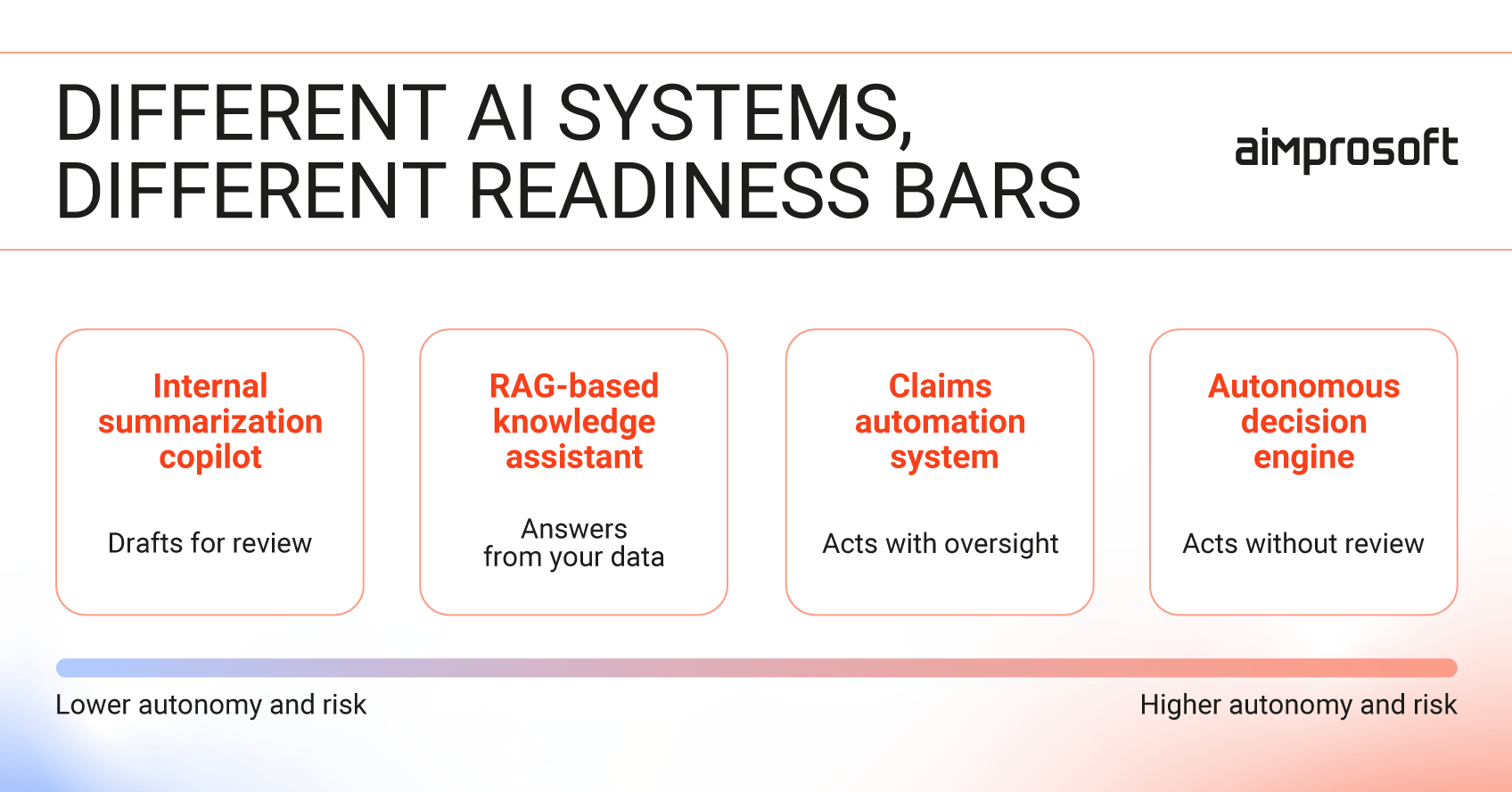
AI readiness is not a universal state. It depends on the kind of AI system you are deploying, how critical the business process is, and how much autonomy the system will have.
For example, an internal summarization copilot, a RAG-based knowledge assistant, a claims automation system, and an autonomous decision engine each have very different requirements.
A gen AI readiness assessment for a customer-facing chatbot looks nothing like a readiness assessment for a fraud detection model. The same is true at the data layer. Data readiness for generative AI (clean documents, retrievable chunks, version control on the source material) is a different bar than readiness for a model running on production transaction streams.
This is why an assessment is always scoped to a specific use case. When we are talking about AI readiness, we are talking about readiness for this AI system, on this process, at this level of autonomy.
The structure of AI readiness assessment framework: Four core dimensions
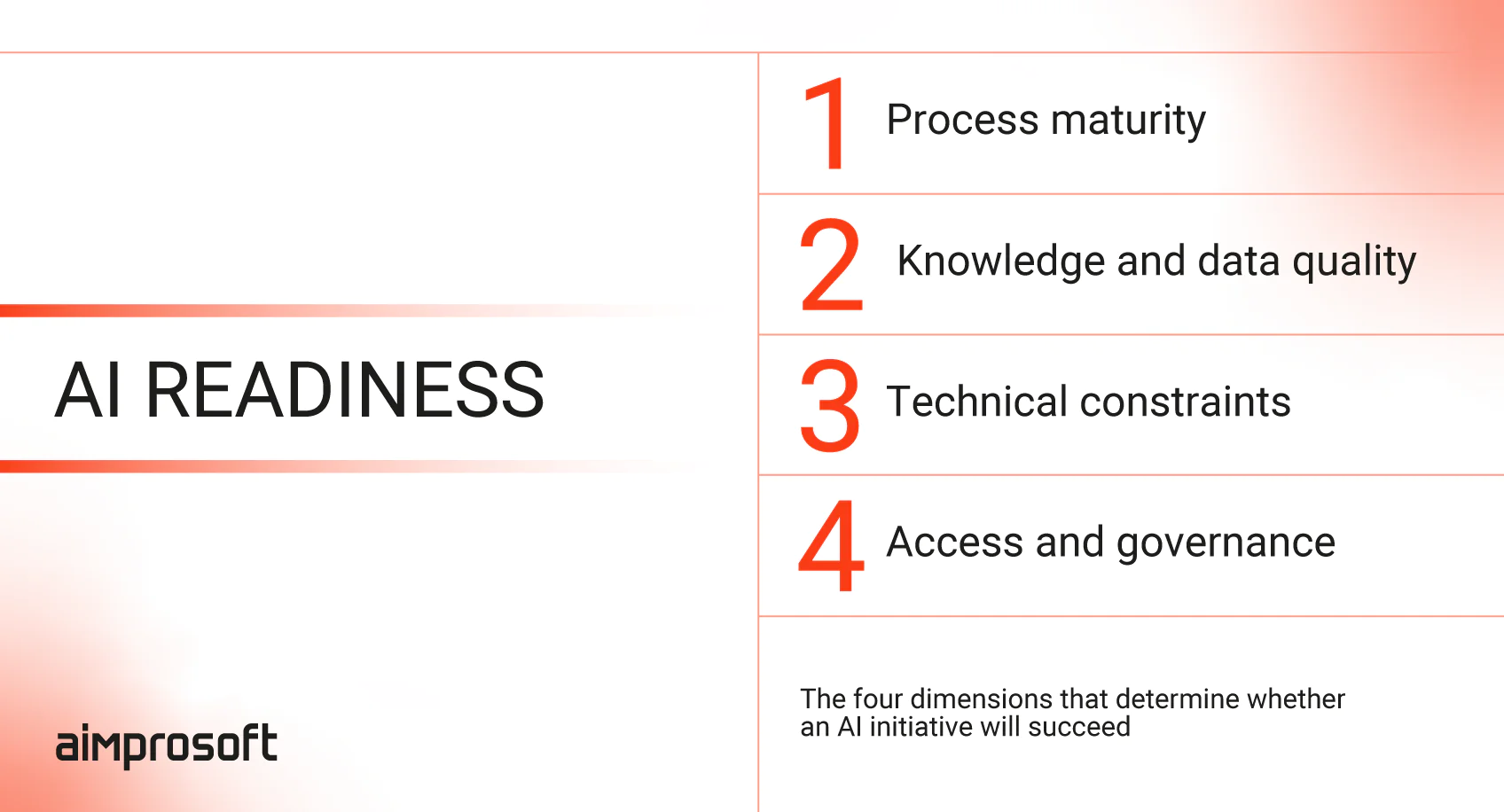
Assessment methods vary widely among providers. Aimprosoft’s framework is built around four dimensions. Each one answers a different question about whether AI can succeed in your organization.
Processes analysis defines how the work gets done. Data assessment shows what the system learns from. Infrastructure examination uncovers whether the system can run reliably. Governance checks define whether the deployment stays controlled and compliant over time.
What does the AI readiness checklist cover?
- Process maturity. It’s not enough to have processes written down – they must run the same way twice. A customer onboarding process can look standardized on paper. But, in practice, different teams apply different verification rules, depending on region, customer size, or individual judgment. An AI trained on those historical decisions inherits the inconsistency, not the operational logic.
Before AI can replicate the process, the process itself must be stable, have measurable rules, and handle edge cases in a controlled way.
- Knowledge and data quality. If critical knowledge is scattered across inboxes and shared drives, and the “source of truth” turns out to be three contradicting documents, the system will use whichever version it finds first, rather than the most up to date one.
One of the crucial AI readiness assessment components is to ensure that the data for your AI is available, accurate, consistent, and well-organized.
- Technical constraints. This section in an AI readiness assessment checklist covers integration readiness, API availability, data pipeline capacity, and the MLOps tooling needed to keep AI systems running.
It defines whether your infrastructure is ready to support the system you want to build and whether it has potential to keep supporting it once it’s live.
- Access and governance. Governance problems don’t appear during the pilot. Pilots run in a sandbox, with clean data and technical users, where nothing surprising happens. They appear at launch when the system meets real users, real workflows, and real regulators.
The question to settle before then: is compliance built into the architecture from day one? If not, you will be retrofitting it under pressure, and that is always more expensive and more painful than building it in.
How is an AI readiness audit different from other evaluations?
At first glance, an AI readiness assessment may look similar to other evaluations such as data audits, maturity models, or AI implementation roadmaps. They all exist for sound reasons, but each answers a different question at a different level.
A data readiness assessment is narrower. It focuses on just one of the four dimensions: knowledge and data quality. That makes it useful but blind to the process, governance, or infrastructure issues that eventually define whether the broader system around the model can function reliably.
A digital maturity assessment, in turn, is broader. It evaluates the organization as a whole across customer experience, cloud adoption, operational modernization, and organizational change. In other words, it measures how digitally mature the company is, not whether a specific AI initiative is realistically set up to succeed.
An AI implementation roadmap comes later. A roadmap defines what will be built, when, and in what sequence. A readiness assessment is the proof it rests on. Skipping that step is how organizations end up with detailed implementation plans for AI initiatives that their environment can’t realistically support.
What does an AI readiness evaluation deliver?
A well-run assessment produces concrete deliverables, each serving its specific purpose. Together, they form a decision package.
- A readiness scorecard evaluates each of the four dimensions against a defined set of AI readiness assessment criteria, with the underlying evidence attached to every score. This gives leadership visibility not only into the result itself, but also into why each dimension scored the way it did.
- A gap and risk analysis identifies which gaps are critical blockers, and which are simply sources of operational friction. It also establishes the order in which those issues should be addressed before implementation begins.
Every weak score on the scorecard is tied to the downstream risk it creates. That risk may take the form of regulatory exposure, poor data quality, integration friction, or low user adoption. Risks are then ranked by both impact and likelihood.
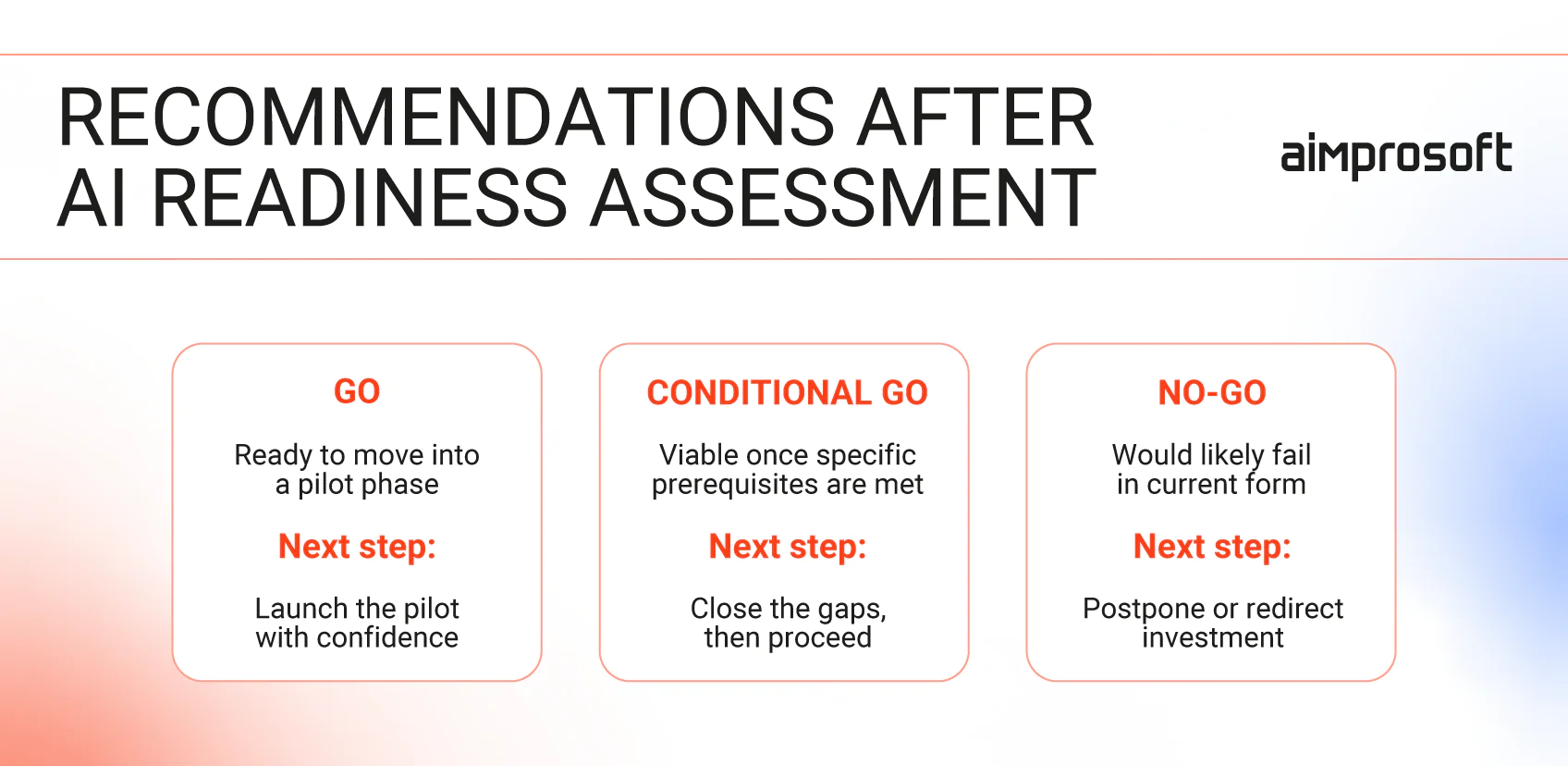
- The assessment concludes with a final recommendation: GO, CONDITIONAL GO, or NO-GO. This recommendation is the entire point of the assessment.
- If the recommendation is GO or CONDITIONAL GO, the assessment hands the team a ready-to-execute pilot plan. It defines the scope, KPIs, and success criteria, required data sources, minimum architecture, and implementation timeline.
In practice, it becomes the implementation team’s starting point and the framework for measuring their success.
Who actually needs an AI readiness assessment?
The first group that benefits most from AI readiness assessment is organizations approaching AI for the first time. They are considering AI implementation but have no internal precedent. No failed pilot to learn from. No working deployment to model against. No instinct for where the risks might hide. The assessment brings to the surface the blockers a more experienced team would catch by reflex.
Second, enterprise teams already weighing AI use cases – when the issue is no longer “whether” but “which.” For them, the assessment turns gut-feel ranking into grounded decision-making. It separates the use cases that sound good in workshops from the ones that can survive real data, workflows, and users.
Third, business leaders who need ROI visibility. When the CFO asks how you plan to prove the investment’s value, the assessment provides a baseline and a measurement framework. Without one, every budget talk turns into a debate over whether the system is “working” with no shared definition of what “working” means.
Fourth, IT, operations, and change teams preparing for automation. The team knows AI is coming, but the process itself is unclear. The assessment identifies which processes need documentation first, which datasets need consolidation, and which integrations must be in place before work begins.
Fifth, organizations where information is scattered across teams. When critical knowledge lives in inboxes, spreadsheets, disconnected systems, and employees’ heads, the cost of skipping the assessment snowballs quickly.
Finally, teams in high-stakes environments. Healthcare, finance, manufacturing, and other regulated or document-heavy industries fall into that group. An honest NO-GO or a timely CONDITIONAL GO can save them both money and reputation.
If none of these scenarios apply, you can probably skip a formal assessment for now. If at least two do, the assessment is almost certainly needed.
How long does an assessment take?
A scoped enterprise assessment runs two to three weeks end-to-end. The process includes stakeholder interviews, documentation review, data sampling, scoring across the four dimensions, and a findings session with leadership.
Three main factors decide where you land in that timeframe:
- Scope of work. The evaluation of a single process is fast; it takes days. Assessing readiness across operations, finance, and customer service simultaneously requires a couple of weeks.
- Stakeholder availability. Assessments depend on conversations with process owners, data stewards, and business leads – people who are usually hardest to schedule.
- Data accessibility. If knowledge is scattered, data readiness assessment turns into a discovery exercise. The more findable your materials are, the faster the assessment closes.
Key takeaways
- An AI readiness assessment is a structured, two- to three-week evaluation that tells you whether a planned AI initiative will succeed, and, if not, what is in the way.
- It is a decision gate, not a strategy document. The output is a GO, CONDITIONAL GO, or NO-GO recommendation.
- AI readiness assessment methodology is always scoped to a specific use case.
- The assessment scores four core dimensions separately: process maturity, knowledge and data quality, access and governance, and technical constraints.
- Deliverables include a scorecard, a gap-and-risk analysis, a decision, and, when viable, a pilot blueprint ready to execute.
See how Aimprosoft structures an AI readiness assessment