

Dedicated Team Structure: Roles, Responsibilities & Workflows
Published: – Updated:


You’ve likely hired teams before, some fast, some frustrating, all promising to “integrate seamlessly.” The difference between the ones that work and the ones that drain your time usually comes down to structure, which is often not prioritized until problems arise. The right mix of roles keeps priorities aligned, information flowing, and releases predictable. Miss one link in that chain, such as a BA, a QA engineer, or a DevOps expert, and bottlenecks surface where you least expect them.
In this article, we’ll look at what an effective dedicated development team structure actually looks like, how responsibilities connect, and how to avoid silent gaps that compound into visible delays.
Why does the software development team structure define delivery outcomes
A dedicated team isn’t defined by its size, but by how its members are organized. The structure determines who makes which decisions, how information travels, and how quickly the team reacts when priorities shift. That’s what separates a long-term, product-focused team from a short-term outsourced contract or staff augmentation setup.
When the dedicated development team structure works, communication feels natural, responsibilities stay clear, and progress doesn’t depend on constant supervision. When it doesn’t, even the best specialists can get stuck waiting for direction or duplicating effort. Here’s why getting the structure right matters from the start.
- Clarity of ownership. Every task or feature has a responsible lead, so decisions move forward without waiting for consensus. That single point of accountability reduces stalled tasks and conflicting instructions.
- Faster alignment. Clear communication paths mean priorities reach the team without getting lost in translation. Teams can respond to market or stakeholder changes within a sprint, not a quarter.
- Predictable delivery. Balanced roles prevent overloaded specialists and unrealistic estimations. With proper planning, QA coverage, and DevOps automation, sprints finish closer to plan, and fewer deadlines slip.
- Knowledge continuity. Dedicated teams retain business and technical context between releases. Institutional memory stays within the team, rather than being rebuilt after every turnover or handoff.
- Scalable collaboration. Once the development team structure is stable, scaling becomes additive rather than disruptive. You can grow the team or add expertise without resetting existing workflows.
- Accountability and transparency. A defined hierarchy of responsibility makes reporting effortless. You see what’s in progress, what’s at risk, and who’s handling it, without chasing updates or managing every detail.
A well-designed software development team structure turns a distributed team into one that actually works. It ensures that your time goes into guiding direction rather than untangling miscommunication. Next, we’ll break down the core roles and how each one keeps the team moving.
Key roles in a dedicated team
Every development team structure looks different, but the logic you need to follow is always the same: balance expertise with focus. The goal isn’t to hire every possible specialist, but to assemble the relevant set of roles that can deliver value without constant external dependency.
Below, we’ll describe the core positions that typically form a dedicated team. You’ll see what each role brings to the table, when it’s essential, and when it might be redundant for your setup. Most importantly, you will see how each role affects delivery, communication, and long-term product stability.
Dedicated dev team
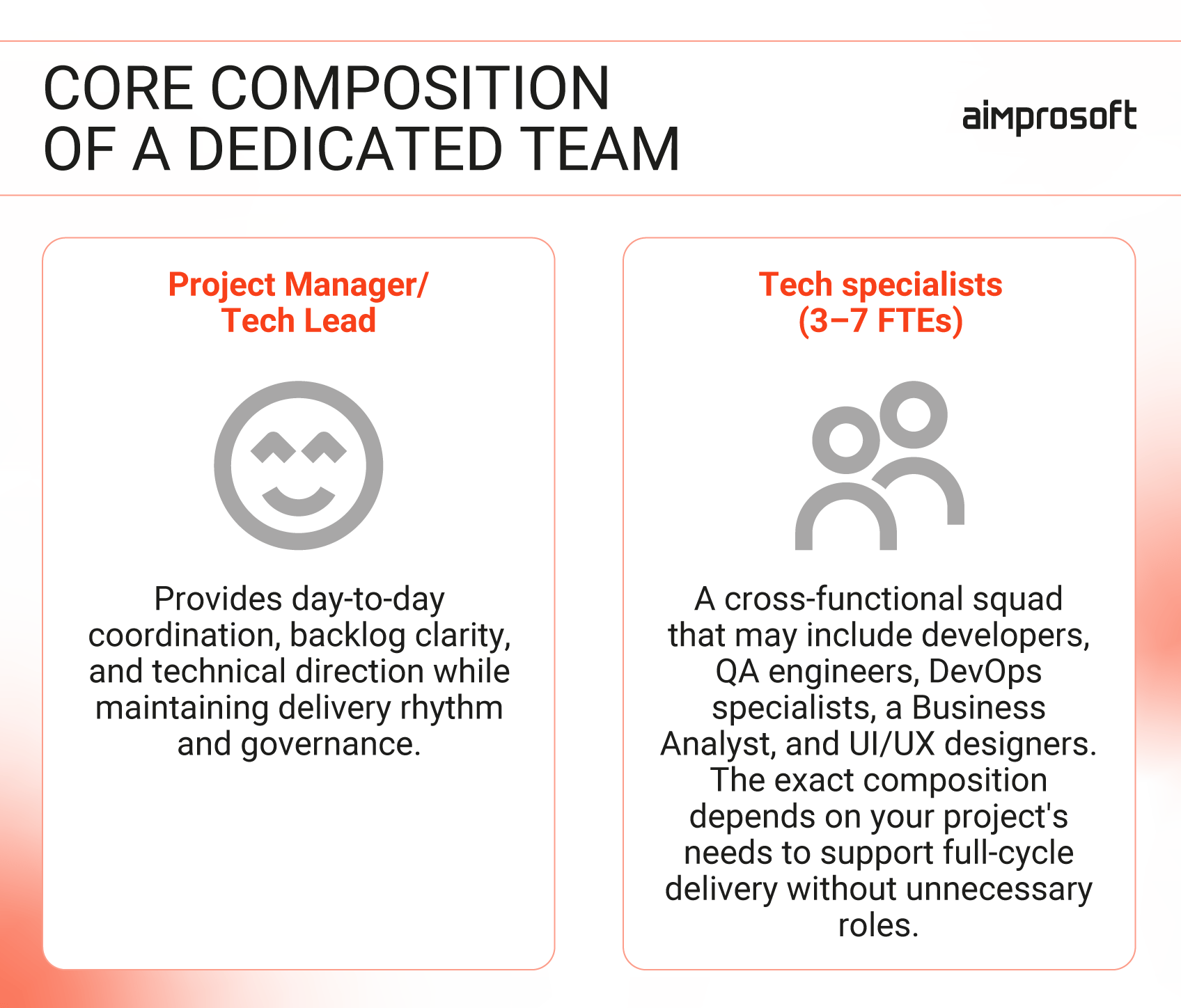
Project manager/Tech Lead
What they do
Every dedicated team needs someone who keeps it synchronized with your goals. This role often combines delivery management and technical oversight: planning sprints, maintaining backlog clarity, prioritizing tasks, and translating your product direction into actionable steps for all software development team members. A strong PM or Tech Lead ensures that technical decisions align with business priorities without creating friction.
Value they bring
- Keeps delivery predictable and transparent, reducing the number of unknowns in each sprint.
- Connects your business priorities with the team’s daily execution.
- Shields developers from conflicting inputs while keeping you informed on progress.
- Turns feedback loops into structured communication rather than ad hoc problem-solving.
When you might not need one
- You already have a full-time internal Product Manager or Delivery Lead who can coordinate daily operations and backlog management.
- The project is short (under two months) and limited to isolated development tasks with clear specifications and no evolving scope.
Role in collaboration flow
Communicates between your company and the development team to keep architecture, priorities, and timelines aligned.
Software engineers
What they do
Software engineers form the core of any dedicated team. They turn requirements and designs into working features. In a dedicated setup, they’re not just executors of tasks, but long-term contributors who learn the logic of your product and carry that context across releases.
Value they bring
- Translate business needs into reliable, maintainable features.
- Preserve technical consistency across modules and sprints.
- Reduce onboarding time for future engineers by documenting and refactoring code.
- Provide realistic input on timelines and technical feasibility early in the planning process.
When you might not need them
- Your in-house team is already fully staffed, and you only need specialized support, such as DevOps or QA.
- You’re outsourcing only for audits or architecture consulting, rather than full-cycle delivery.
Role in collaboration flow
Work closely with the Tech Lead or PM for task planning and estimation, coordinate with QA on testing and release readiness, and consult with DevOps for deployment stability. Their feedback loop with your Product Owner or internal team helps keep implementation aligned with business priorities.
QA engineer
What they do
QA engineers safeguard the quality of each release. These members of a software development team design test cases, verify functionality against requirements, and make sure updates don’t break existing features. In a dedicated team, they work in parallel with developers rather than after them, spotting issues early and keeping releases predictable.
Value they bring
- Prevent defects from reaching production, reducing the cost and time of rework.
- Maintain release stability even as the product scales or adds integrations.
- Provide objective feedback on product usability and performance.
- Support faster iterations by automating regression and smoke tests.
When you might not need one
- The product is in its discovery or prototype stage, and testing is limited to internal validation.
- You have a mature internal QA department handling test design and execution.
Role in collaboration flow
Within a well-organized technology team structure, QA engineers collaborate with developers and the Tech Lead to define acceptance criteria, run continuous testing throughout the sprint, and report directly to both sides on release readiness.
DevOps expert
What they do
A DevOps expert keeps the product stable, scalable, and deployable on demand. They handle the environments, automate builds, monitor system health, and make sure every release moves smoothly from staging to production. In a dedicated team, their work ties development and operations into one continuous delivery cycle instead of two separate efforts.
Value they bring
- Reduce deployment risks by automating testing, build, and release pipelines.
- Improve system reliability through monitoring, alerting, and proactive maintenance.
- Shorten feedback loops between code changes and production results.
- Optimize cloud usage and infrastructure costs over time.
When you might not need one
- The project is still in the MVP or early validation stage with minimal infrastructure.
- You host and maintain all systems internally with an existing DevOps or IT department.
- You’re using fully managed cloud services that require little to no configuration or deployment control.
Role in collaboration flow
Works closely with developers to automate integration and deployment, coordinate with QA on test environments, and communicate with your Engineering Lead on infrastructure security and scalability. Their contribution ensures that delivery remains consistent regardless of traffic spikes, code complexity, or release frequency.
Business analyst
What they do
A Business Analyst bridges product vision and technical execution. They translate business requirements into detailed specifications, clarify priorities with stakeholders, and make sure the team builds features that solve real user problems instead of just following assumptions. In a dedicated team, a BA helps your product move forward without constant clarification from your side.
Value they bring
- Transform abstract ideas into structured, actionable requirements.
- Reduce the risk of rework by validating the scope before development starts.
- Keep the team aligned with business objectives when priorities shift.
- Improve communication between your product representatives and the technical team.
When you might not need one
- You already have an internal Product Manager or Product Owner who defines and manages requirements.
- The project scope is small, fixed, and unlikely to evolve during development.
- The vendor team’s tasks are strictly technical, such as system migration or API integration.
Role in collaboration flow
As a part of a modern software development team structure, a BA collaborates with the Product Owner or business stakeholders to gather and refine requirements, works with the Tech Lead to translate them into technical tasks, and supports QA in defining acceptance criteria.
UI/UX designer
What they do
A UI/UX designer shapes how users interact with your product. They translate requirements and data into intuitive interfaces, ensuring that each feature not only works but feels natural to use. In a dedicated team, the designer acts as the voice of the user, making sure features are intuitive and easy to use.
Value they bring
- Improve conversion and retention by aligning functionality with user behavior.
- Create consistent design systems that speed up development and reduce redesign costs.
- Identify usability issues early, preventing expensive post-release fixes.
- Strengthen brand perception through visual and interaction consistency across platforms.
When you might not need one
- You already have an in-house design department that handles product UX and UI.
- The product has minimal user-facing interface work, such as backend systems, APIs, or basic internal admin tools.
- You’re using pre-built design templates to test the feasibility of MVP/PoC.
Role in collaboration flow
In an agile software development team structure, designers work closely with the Business Analyst and Product Owner to understand user journeys, collaborate with developers to ensure design feasibility, and support QA by validating the visual and interactive consistency of each release. Their work keeps the product intuitive and consistent across every release.
Let's build a structure that works, not just a list of people.
Each of these roles serves a specific purpose, but their real strength comes from how they work together. A well-composed development team structure is a network of dependencies that keeps delivery stable even when priorities shift. The clearer these roles are defined, the easier it becomes to maintain focus and avoid overlap.
Workflow & Collaboration practices
Knowing who does what is only half the story. Even a typical software development team structure can fail if collaboration isn’t designed intentionally. The real difference between a dedicated team that performs consistently and one that wastes time due to constant coordination issues lies in how that structure is supported: through clear communication, transparent workflows, and shared ownership. Hence, the software engineering team structure you saw earlier only works if the workflow keeps everyone aligned.
Collaboration flow and communication structure
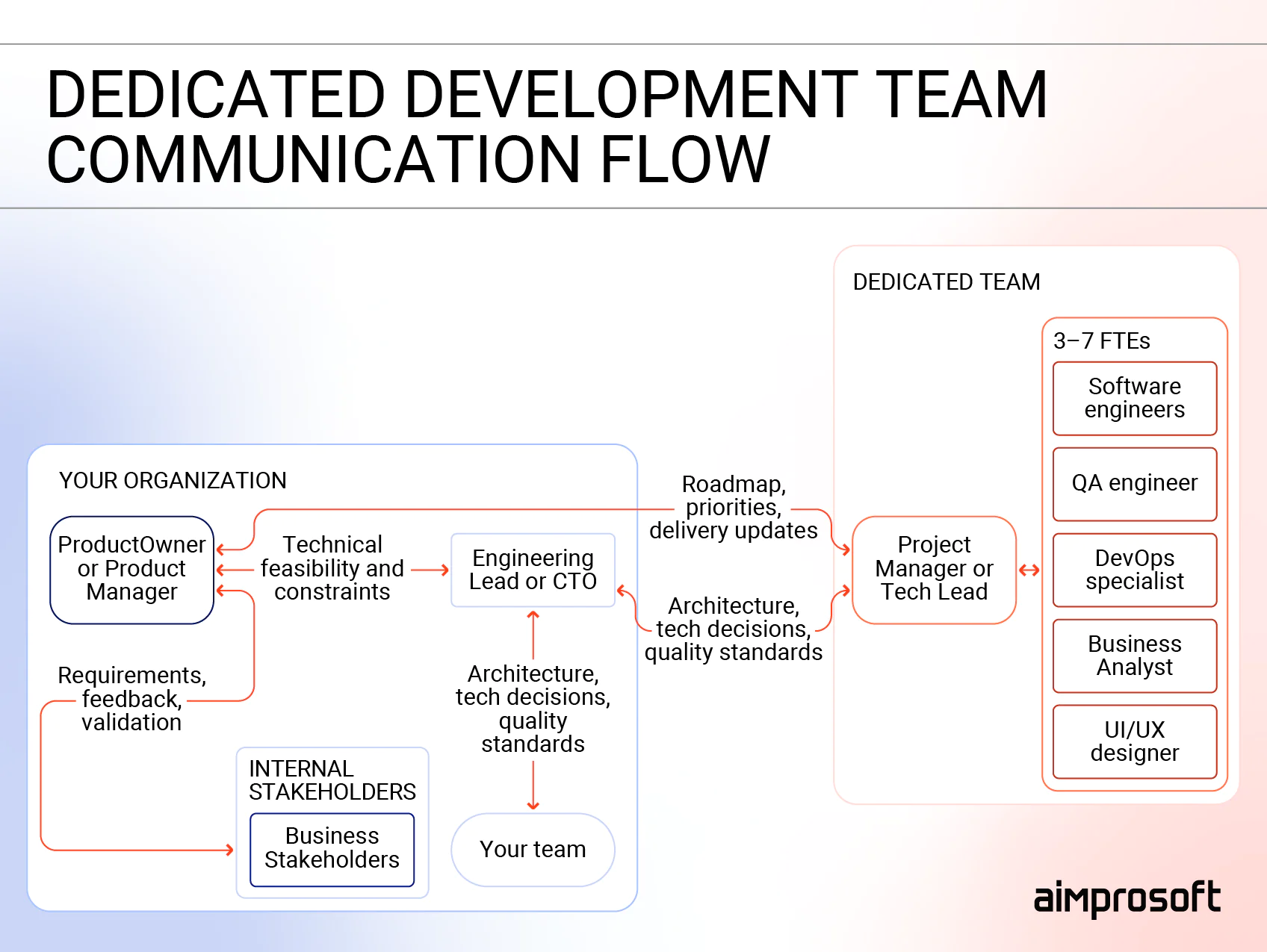
The diagram below shows how communication typically runs between your company and a dedicated team. It’s built on clear ownership rather than hierarchy; each role knows what they deliver and who receives it.
Dedicated dev team collaboration flow
At the top, your Product Owner or Product Manager defines priorities and passes them to the Tech Lead or Project Manager on the vendor side. The Engineering Lead or CTO aligns architectural decisions and quality standards with the same Tech Lead, ensuring your internal roadmap and the vendor’s technical choices evolve together. Meanwhile, while developers, QA, and DevOps work in synchronized sprints coordinated through shared tools and reporting. This structure adapts to different setups:
- In independent models, the dedicated team operates as a self-sufficient delivery unit, handling full-cycle development while staying aligned with your product leadership on roadmap, priorities, and goals.
- In embedded models, dedicated engineers join your existing in-house team, sharing the same tools, rituals, and reporting lines to function as one extended product team.
- In enterprise environments, multiple dedicated teams may work in parallel, each owning a delivery stream with its own PM or architect while following the same communication and quality standards.
The logic stays the same: every communication path has a single entry and a single exit. That’s what prevents scope creep, conflicting instructions, and fragmented ownership.
Collaboration practices that keep delivery efficient
A dedicated team becomes reliable only when the process supporting it is clear and structured. The same applies to any team structure in software engineering. Communication gaps and overlapping ownership can slow delivery long before anyone realizes what’s happening.
What goes wrong without a reliable workflow:
- Duplicated communication. Feedback arrives through several channels, forcing the team to figure out which input matters.
- Unclear ownership. No single person is accountable for decisions or deadlines, which blurs accountability across roles.
- Lost context. Requirements live across chats, emails, and tickets instead of one accessible source.
- Unrealistic estimations. Without joint planning, deadlines move faster than development.
- Invisible progress. Stakeholders can’t see what’s done or blocked, which erodes trust even when the team is performing well.
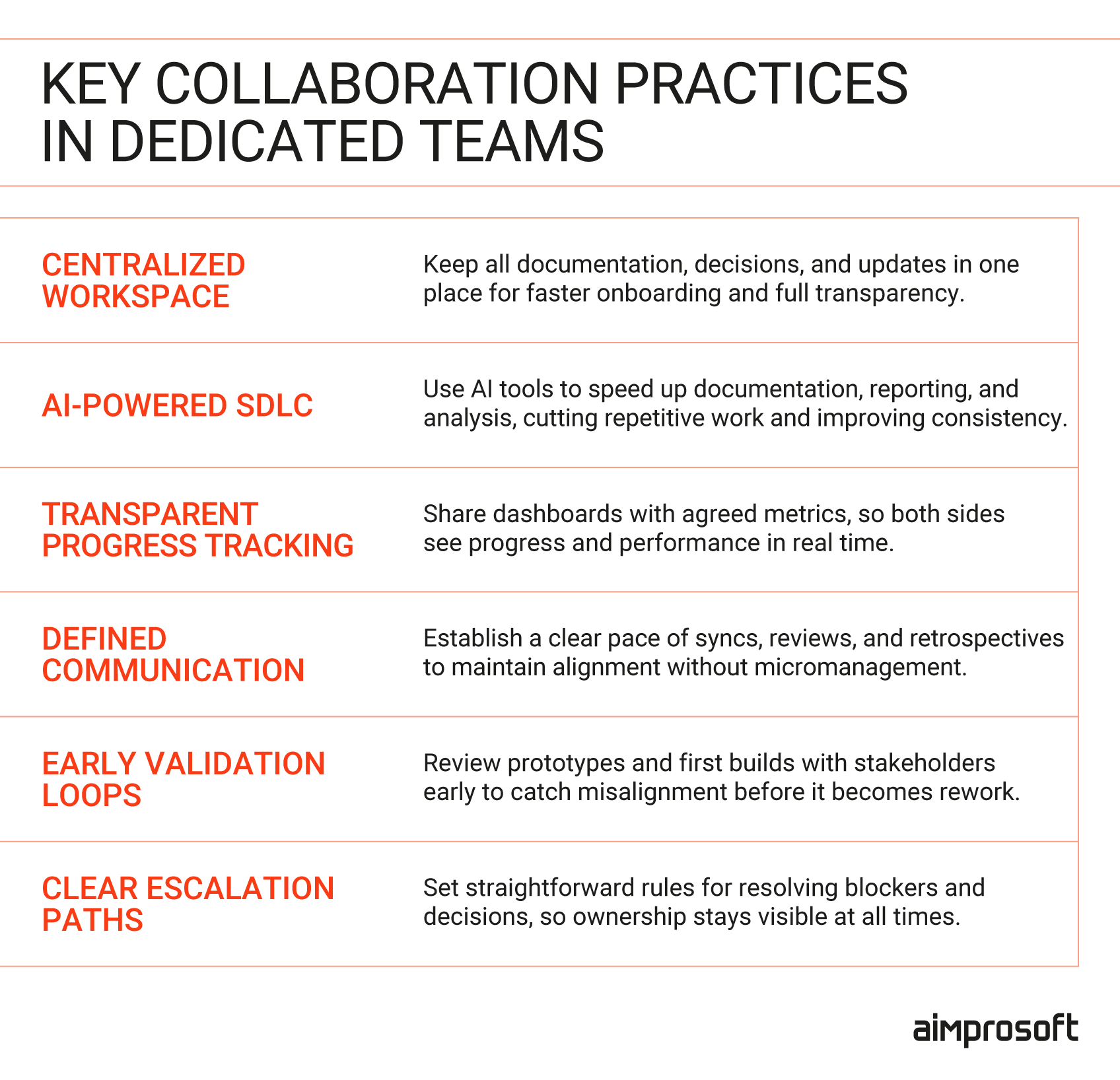
Here’s what actually works. These are the practices we recommend and use in our dedicated teams, tested across real projects.
Collaboration practices in dedicated teams
Centralized workspace and knowledge base
Every high-performing dedicated team needs a shared workspace that serves as its single source of truth. It brings together scope, KPIs, roadmaps, and documentation, so everyone understands both daily tasks and long-term goals. Without it, knowledge fragments across chats and tools, and decisions become dependent on memory instead of structure.
A centralized environment like Notion or Confluence makes collaboration transparent, rather than scattered across Slack threads and email. It shortens onboarding, reduces duplicated communication, and keeps delivery stable when roles shift. It also protects against knowledge loss since product context and decisions stay preserved even when people leave.
We applied this approach while working on a geo-intelligent business analytics platform for a Canadian company. Using Notion AI, we built a workspace that connected scope, KPIs, and documentation with ongoing team rituals. It became a hub for sharing AI-related best practices and prompts, ensuring consistent knowledge transfer across both teams. Supported by GitHub Copilot and custom GPT-based automations, the workspace improved code review, test authoring, and reporting consistency, one of the factors that helped the team deliver 171% of the planned sprint scope without extending the timeline.
AI-powered SDLC and automation
Even in well-structured teams, much of the delivery time is spent on routine: estimating effort, reviewing commits, writing documentation, and keeping tests current. These steps are essential, but don’t require full human attention. When properly configured and aligned with security policies, AI can handle them automatically, standardizing repetitive work, improving traceability, and giving specialists more space for problem-solving and design.
At Aimprosoft, we’ve developed an AI-powered Software Development Lifecycle (AI-SDLC) framework that combines human expertise with AI assistance across multiple stages of delivery.
- GitHub Copilot accelerates code generation and maintains consistent development patterns across repositories.
- Notion AI and Gemini assist PMs and BAs with summarizing meeting notes, drafting user stories, and identifying requirement overlaps.
- AI-driven CI/CD extensions help generate test cases and analyze commits to detect recurring issues early.
We applied this framework while working on a business intelligence platform for predictive analytics, using AI to analyze performance data and automatically generate sprint retrospectives. With visual reports from GitHub Insights and Jira metrics, the Tech Lead could identify recurring blockers and address them before they affected velocity. This setup improved transparency and shortened reporting cycles, giving leadership a data-backed view of delivery health. It showed how AI can enhance efficiency without disrupting established workflows.
Transparent progress tracking
Reliable collaboration depends on shared visibility. When every stakeholder sees the same metrics, discussions become concrete instead of speculative, or just “everyone works from the same data”. The best dedicated teams establish this transparency from day one, defining how progress will be measured, which tools will display it, and how often it will be reviewed. Tracking delivery through metrics like sprint velocity, lead time, issue resolution rate, and release stability keeps the focus on measurable outcomes rather than perceptions.
We do the same thing. Before development starts, we agree with each partner on specific delivery metrics relevant to the project instead of a generic KPI list. Progress is tracked in Jira, Linear, or Azure DevOps, depending on what’s already in place, and dashboards are accessible to everyone involved. For DevOps-heavy projects, Prometheus and Grafana monitor infrastructure performance in real time. This shared visibility eliminates unnecessary status meetings and turns performance reviews into data-driven conversations where both sides know exactly what’s done, what’s next, and where time is spent.
Defined communication cadence
Dedicated teams need consistent communication patterns, not just ad hoc check-ins. We recommend establishing a clear communication pattern from day one:
- Daily stand-ups for quick syncs
- Weekly sprint reviews for progress validation
- Monthly retrospectives for improvement planning
- Quarterly product syncs for strategic alignment
This cadence keeps collaboration predictable and prevents constant interruptions that break focus. When both sides stick to the schedule, time zones, and remote work become manageable instead of chaotic.
Early validation loops
The earlier the feedback enters the process, the fewer surprises appear later. Effective teams involve stakeholders at the prototype or early build stage to confirm that what’s being developed matches expectations. Regular validation turns vague assumptions into concrete adjustments before they become expensive rework.
At Aimprosoft, we apply this principle by bringing Product Owners and stakeholders into early design reviews, clickable prototypes, and first iterations. This shared visibility helps refine priorities and feature logic while there’s still room to adjust. It keeps timelines and budgets stable without adding bureaucracy.
Clear escalation paths
Every dedicated software development team structure needs clear escalation paths. They define who resolves what, avoiding the chaos of parallel instructions. Technical blockers move between the Tech Lead and Engineering Lead, while delivery or scope changes are handled by the Project Manager and Product Owner.
When everyone knows how to raise and resolve an issue, delays shrink, and accountability stays intact. Without this clarity, a blocked developer might ping three different people and still wait two days for a decision.
Let’s design a workflow that keep progress visible, communication structured, and delivery predictable.
Efficient collaboration isn’t something that happens once the team gets comfortable. It needs to be designed from the start. A well-defined, dedicated development team structure, supported by transparent workflows, shared workspaces, automation, and clear communication cadence, turns a distributed team into an integrated product unit. Once that foundation is in place, you stop managing tasks and start managing outcomes, which is the real value of the dedicated model.
Scaling the team: when & how
Once a dedicated team finds its pace, the next challenge is knowing when to grow. Scaling too early creates idle capacity; scaling too late slows delivery. The goal isn’t to add people, expanding dedicated project team structure, for the sake of speed, but to extend capability at the right moment, without breaking the structure that keeps delivery steady. A well-assembled team already works as a single system; scaling should make that system more capable, not more complicated.
Scaling dedicated team
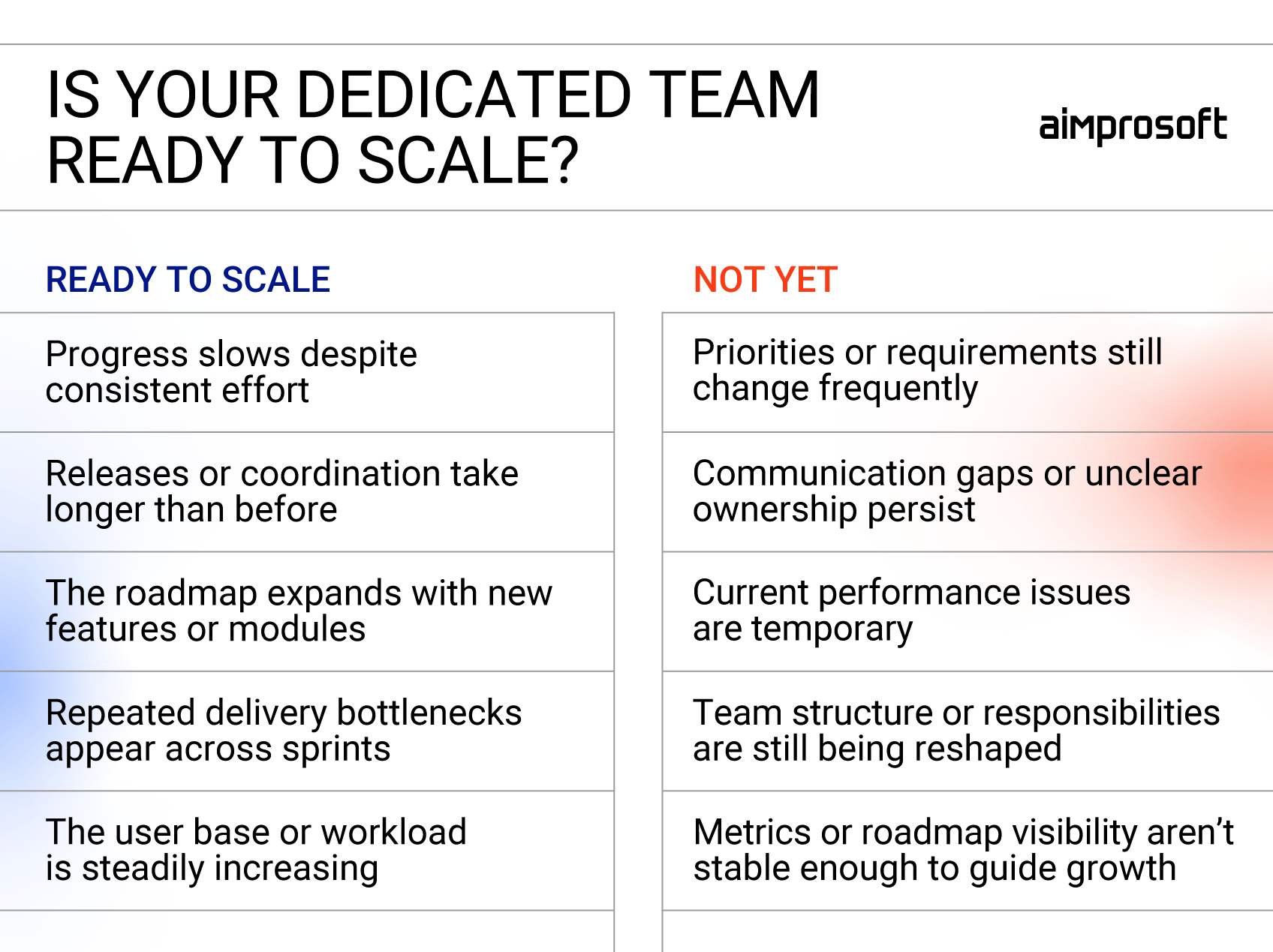
When it’s time to scale
The need to expand usually becomes clear when progress starts slowing despite consistent effort. Releases take longer, coordination starts eating into productive time, and decisions move through too many hands. A well-balanced research and development team structure can absorb a certain level of complexity, but once coordination starts replacing creation, it’s a sign the team has reached its limit, and that the next step is expansion, not optimization.
- Expanding product scope. New features, integrations, or entire modules demand additional engineering power or fresh expertise that the current team can’t fully cover.
- Coordination starts replacing creation. When communication overhead and review cycles start slowing delivery, adding capacity can help restore balance.
- Persistent delivery bottlenecks. If sprints regularly spill over because QA or DevOps can’t keep up with development, adding capacity can restore balance.
- Evolving priorities. Roadmap shifts toward analytics, AI, mobile, or security often require new roles to ensure quality and speed don’t decline.
- Scaling user base. More users mean increased load testing, maintenance, and customer feedback loops, which existing roles may no longer have bandwidth for.
Scaling the software development teams structure under these conditions can only strengthen your delivery, without disrupting the flow.
When it’s not time to scale
Just as dangerous as late scaling is premature expansion, adding people before the process is ready for them. Extra capacity doesn’t solve existing communication gaps or unclear ownership. Before considering the expansion of your software development organizational structure, make sure the foundation is solid.
- Unclear roadmap. If priorities or requirements are still shifting weekly, adding people only amplifies confusion.
- Unstable communication. A team that still struggles with coordination or misaligned reporting shouldn’t expand until those patterns are fixed.
- Temporary workload peaks. Short-term marketing campaigns or client requests might increase pressure, but don’t justify permanent hires.
- Ongoing reorganization. If you’re redefining responsibilities or replacing key roles, wait until the new structure stabilizes before scaling.
- Lack of measurable performance data. Expanding without clear metrics makes it impossible to tell whether growth improves results or simply inflates cost.
Scaling software team structure is effective only when the current setup already performs predictably. Otherwise, new members join a moving target, and productivity drops instead of rising.
How to scale without losing balance
Adding people to an already established software engineering team structure is easy; keeping clarity afterward is the real task. The best scaling happens incrementally, through the same principles that made the initial team effective: transparency, structure, and documentation.
Start with metrics, not headcount
Decide to scale based on measurable indicators, not intuition. Review sprint velocity, backlog size, defect rates, and cycle time trends. At Aimprosoft, we always agree on these metrics with our partners before expanding a team. When delivery speed stays consistent, but the backlog keeps growing, that’s the clearest sign it’s time to expand capacity.
Add roles before pressure peaks
Don’t wait until delivery starts slipping to introduce new specialists. For example, bring a QA or DevOps expert into the team as soon as release frequency increases, not after performance issues appear. Proactive scaling prevents burnout and stabilizes speed across sprints.
Replicate existing workflows
When new members join, they should integrate into the same communication rhythm, tools, and reporting standards. Rebuilding the process for every expansion creates fragmentation. Consistency across tooling (e.g., Jira for tasks, Notion for documentation, Slack or Teams for communication) keeps everyone aligned from day one.
Preserve institutional memory
Reinforce your centralized knowledge base as the team grows. The Notion AI workspace model we used for our partner’s project proved this approach works: every document, decision, and report was versioned and searchable. It let new developers onboard faster and prevented repetitive discussions because the entire project history was one click away.
Use parallel delivery streams for larger products
When the product outgrows a single team’s bandwidth, form multiple dedicated squads under shared leadership. At Aimprosoft, we often scale mature projects this way, creating new teams that share architecture decisions and communication cadence through one Tech Lead or PM. This parallel setup maintains stability even when the total headcount multiplies.
A dedicated team scales by design. The structure that makes it efficient at ten people should make it even stronger at twenty. When growth feels like an extension of existing rhythm rather than a reset, you know the system works.
Wrapping up
The key to making the most of a dedicated team is to see them as an extension of your core team and product vision instead of a group of contractors executing tasks. When a dedicated development team structure, workflow, and communication align, a team stops being “outsourced” and starts behaving like your own: focused, self-sufficient, and accountable for outcomes rather than hours. That’s what turns collaboration into a real partnership.
If you’re planning to assemble a dedicated team that shares your product mindset and can grow with your roadmap instead of just following it, our experts can help you design the structure, select the right roles, and build a unit that becomes a valuable asset.
FAQ
What is a software development roles and responsibilities matrix, and why is it important?
A software development roles and responsibilities matrix is a framework that outlines who is responsible, accountable, consulted, and informed for each task or decision in a project. It prevents overlap, clarifies ownership, and improves collaboration between teams. Creating a clear software development roles and responsibilities matrix helps keep communication structured, especially in distributed or dedicated team setups where accountability must be visible from day one.
How long does it take for a dedicated team to start delivering results?
Most teams reach full productivity within 3 to 6 weeks. The onboarding phase covers setup, access, process alignment, and initial sprint planning. When building a software development team, this period is crucial since it’s when communication habits and delivery rhythm are formed. Once workflows are aligned, delivery speed and predictability improve quickly with each iteration.
When should a company consider scaling a dedicated team?
It’s time to scale when consistent bottlenecks appear, the product scope expands, or new technical expertise is needed. Scaling should follow clear delivery metrics such as sprint velocity or backlog growth. Expanding too early or without structure can reduce efficiency rather than improve it.
How to structure a software development team for different types of projects?
The way you structure a team depends on the product’s focus and complexity. A web development team structure usually includes front-end, back-end, and QA engineers working closely with a UX designer and DevOps expert. A mobile app development team structure adds devs specializing in native or cross-platform/hybrid development, often supported by a shared backend and UI team. For AI-driven products, an AI development team structure involves data scientists, ML engineers, and software developers collaborating with domain experts. Understanding how to structure a software development team around your goals ensures faster delivery, fewer risks, and a product that scales smoothly.