

Agile POD Vs Scrum Team: Key Differences Explained
Published: – Updated:


Your team ships every two weeks. Velocity is stable. Retrospectives drive real improvements. Scrum is working exactly as designed. Yet development lead time keeps stretching, sprint forecasts miss by 20%, and features that should take days sit in “In Progress” for weeks. Why is that?
That’s a tricky question, because Scrum ensures execution cadence — it’s not about accelerating the delivery stage itself.
Scrum defines how teams plan, execute, and inspect work. It doesn’t prescribe how to reduce development lead time, stabilize velocity variation, or improve forecast accuracy. This isn’t Scrum’s fault. It’s simply outside its scope.
But there is a delivery acceleration model built for SLA-backed improvement of development execution. And that’s the Aimprosoft Product-oriented delivery (POD) team. Before you pick a winner in the “Agile POD vs Scrum team” debate, it’s worth clearing up a common misconception: these business models aren’t opposites. They just solve different problems.
In this article, we’ll break down the structural differences between Agile POD vs Scrum team, show where each model fits, and explain when a POD can complement — or even strengthen — your existing Scrum teams.
Let’s dig in.
What’s the difference between Agile POD and Scrum Team?
Before we move to a detailed comparison of Agile PODs vs Scrum teams, let’s ensure we’re on the same page about the definitions of Scrum and Aimprosoft’s Agile POD teams.
A Scrum team is a cross-functional unit focused on delivering working features in short development cycles. Working within the Scrum framework, the team plans sprints, inspects progress regularly, and adapts based on feedback. This helps them respond to change quickly and ship sprint after sprint.
The Scrum team includes three core roles:
- Product Owner — owns the product backlog, sets priorities, and defines what success looks like for each item.
- Scrum Master — coaches the team, helps them work within the Scrum framework, and removes obstacles that slow them down.
- Developers — everyone involved in building the product: engineers, QAs, designers, analysts, and other specialists needed to meet the sprint goal.
Scrum gives business a cross-functional unit in principle, and when collaboration is healthy, this works without dependency delays. But even with smooth handoffs and predictable iteration, certain delivery mechanics — development lead time, capacity predictability, work-in-progress control — don’t accelerate simply because the sprint rhythm is stable. They require dedicated intervention, not just healthy Scrum practices.
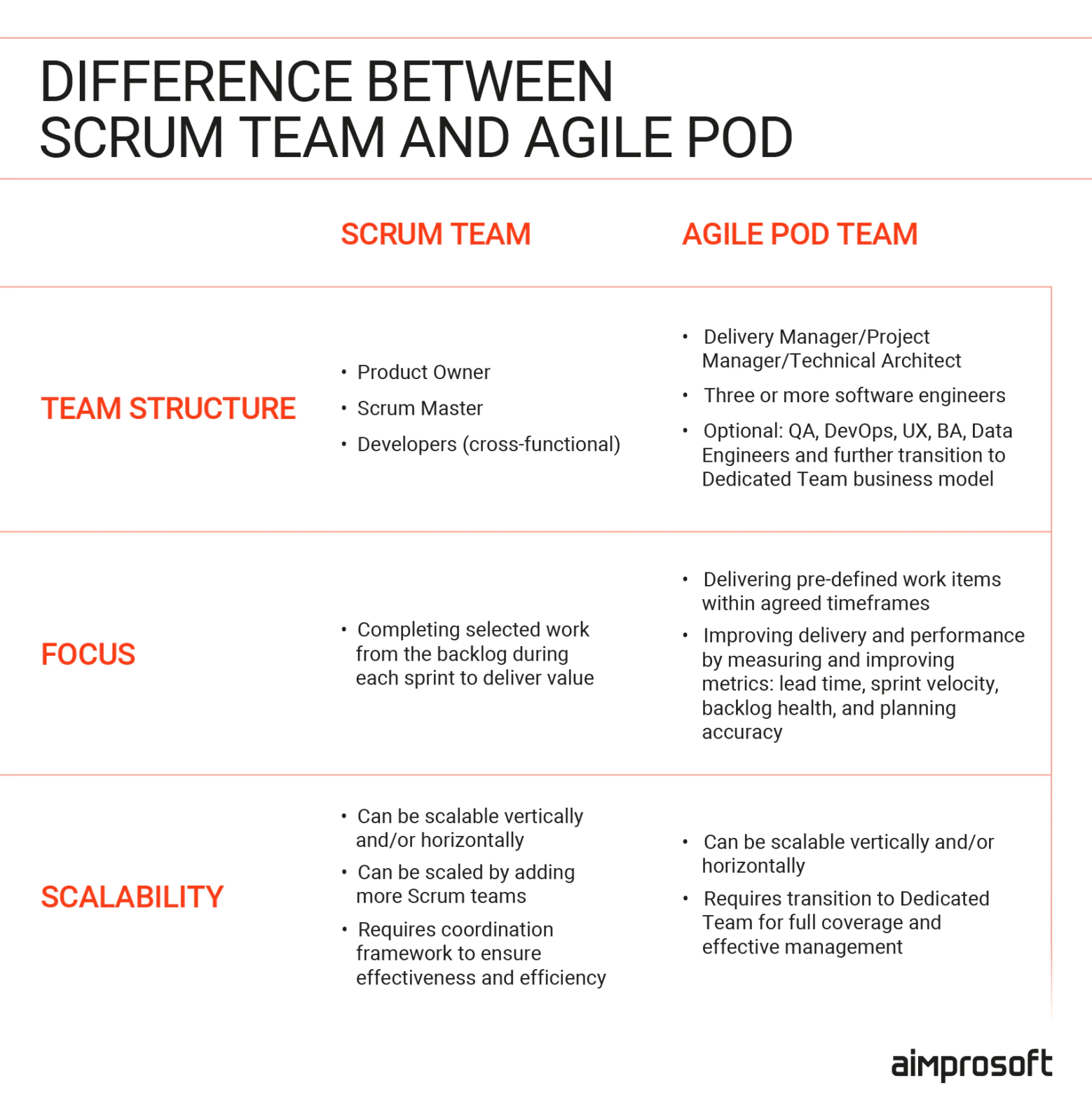
A POD (Product-oriented delivery) team is a compact, outcome-driven development unit designed to improve a specific dimension of the software delivery flow. Each POD includes built-in leadership — typically a Project Manager or Lead — but unlike traditional POD structures, it does not replace the Product Owner, restructure teams, or take over roadmap decisions.
PODs can operate using the Scrum framework alongside your existing Scrum teams. The difference is that PODs work exclusively on accelerating one delivery constraint: building the infrastructure, tooling, and practices that make your teams faster and more predictable. They track specific KPIs and report weekly on progress toward contractual SLA targets.
While the POD-based delivery model is development-dominant, it allows units to be flexible in size and composition. Each POD team is self-sufficient in acceleration. They include the capabilities required to improve their specific focus area without drawing additional staffing or reorganizing core product teams. A POD may consist of 1 PM + 3 engineers (Dev POD) or 1 QA Lead + 2 QA specialists (QA POD), depending on where improvement is needed.
As work evolves, product PODs can scale horizontally by adding specialists (e.g., DevOps, UX, BA, data engineers) or vertically with senior architectural oversight — all without reorganizing the core team.
Yet, it’s worth noting that turning POD into a cross-functional team leads to the model becoming a dedicated team. That is because in Agile POD we track specific metrics suited for each POD (e.g., development). If a team becomes fully cross-functional (Dev + QA + DevOps + UX), these metrics won’t fit.
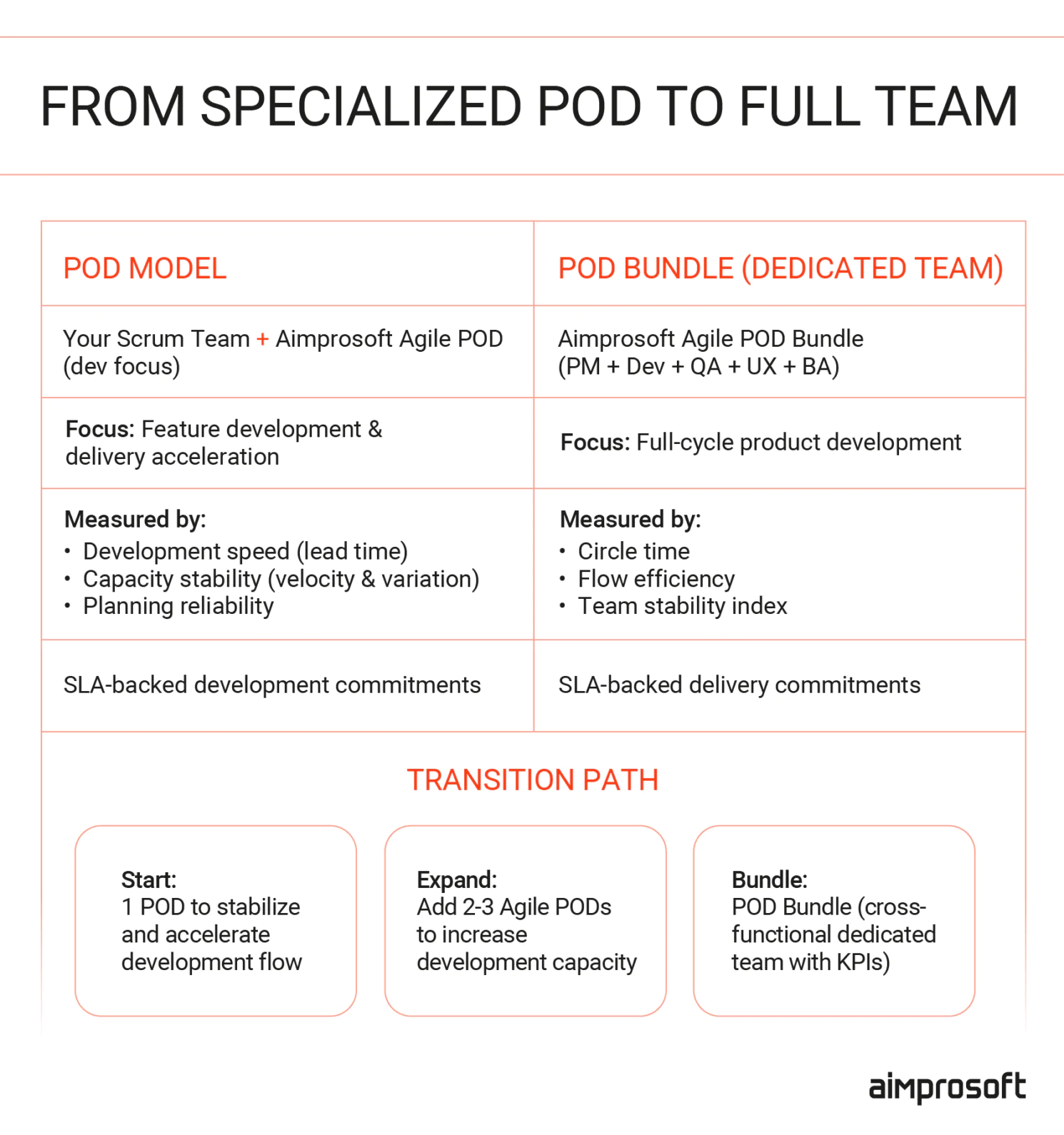
This focus and bounded scope are what distinguish our Agile PODs from both Scrum and traditional product oriented teams. Our Agile PODs can work in parallel with your Scrum teams using the same sprint rhythm but concentrate on improving the parts of delivery that do not naturally accelerate through iteration alone.
Now that we’re aligned on definitions, we can explore the difference between agile POD and Scrum team and the shared characteristics of both models.
What do PODs and Scrum teams have in common?
Agile squads that follow the Scrum framework share core execution practices with Scrum teams, including:
- Iterative sprint cycles with structured planning and review sessions.
- Product Owner-led prioritization.
- Regular ceremonies such as standups, retrospectives, and sprint reviews for continuous inspection and adaptation.
If Scrum is already part of your culture, PODs fit naturally into how your teams work. Their real advantage, however, is flexibility. PODs adapt to different delivery frameworks — Scrum, Kanban, or hybrid models — without forcing process changes.
They can integrate in several ways: maintain a separate development backlog, embed into an existing Scrum team, or work in parallel on independent features. PODs join your ceremonies, follow your sprint cadence, and align with your team’s culture. The difference lies in focus. Scrum teams own end-to-end feature delivery, while PODs specialize in accelerating development execution.
Now let’s move to features that distinct Agile PODs and Scrum teams.
1. Accountability
The most fundamental difference between traditional Scrum teams and Agile PODs isn’t process — it’s risk. Both models use sprints and track velocity. But when things slow down or estimates slip, who bears the cost? Yeah, and that’s where the two models diverge sharply.
| TRADITIONAL SCRUM | AGILE POD |
| Commitment: “We will deliver the sprint backlog” | Commitment: “We guarantee 30-40% lead time reduction by Sprint 4” |
| Client bears all delivery risk | Vendor shares risk through contractual SLAs |
| Success measured by sprint completion % | Success measured by engineering outcomes (tracked every 6 sprints) |
| If delivery slows, delays are absorbed internally | If SLA missed: early exit or free senior architect support (20h) |
Traditional Scrum includes retrospectives to identify strengths, weaknesses, and improvement opportunities. While continuous improvement is a core Scrum principle, it typically lacks formal financial commitments.
The Agile POD model introduces a different accountability layer by tying improvement directly to commercial terms. If acceleration targets aren’t met, clients pay only the baseline rate of 85% or receive senior support at no additional cost.
Consequently, Agile POD complements rather than replaces Scrum, creating financial alignment between delivery performance and business value.
2. Metrics
Scrum doesn’t require specific metrics by default. Teams may track performance indicators initiated by the Scrum Master or client, using them as signals of sprint health to reflect how delivery is planned and executed. However, these metrics carry no formal financial accountability.
Agile POD teams, by contrast, track metrics directly tied to their committed acceleration targets — creating measurable accountability for specific delivery outcomes.
| Metric | What’s that | Example target | Why it matters for business |
| Lead time | Time it takes for a development task to move from “work started” to “ready for release” | 30-40% reduction by Sprint 4 | Features reach customers faster |
| Forecast accuracy | How closely the team delivers what was planned for a sprint | Forecast error ≤ ±10% by Sprint 4 | Predictable releases and fewer last-minute surprises |
| Sprint velocity | The amount of work the team consistently completes in a sprint | Velocity variation ≤ 15% | Stakeholders can rely on delivery timelines |
| Backlog health | Readiness of near-term work: clear requirements, reasonable scope, and minimal blockers | ≥90% of items ready for development | Healthy backlog = less waiting, fewer urgent escalations, and faster start times |
| Defect rate | Number and severity of defects found during and after development | Critical defects trending down after release | Fewer incidents and lower hidden operational costs |
Agile teams typically report output through metrics like story points or completed sprint scope. PODs add a performance layer — tracking not just what was delivered, but how efficiently delivery happens. For example, ‘we completed 45 story points’ versus ‘the same 45 story points, with lead time reduced from 30 to 12 days.’
3. Pricing model
Most Scrum teams are priced on a time & materials basis. This method provides greater transparency and control over the project’s scope, budget, and timeline. Plus, with the time & materials, you can modify the project’s specifications and assign tasks a higher priority in accordance with shifting business demands. But there’s also a risk in this approach, as you pay for capacity regardless of whether delivery improves.
| TRADITIONAL SCRUM: Pay for team capacity No improvement guarantees Client carries all financial risk | AGILE POD: 85% baseline (monthly) 15% performance pool (earned only if SLAs hit) Reviewed every 6 sprints |
This isn’t just a different billing structure — it’s a different risk model. If the POD fails to provide the product-oriented delivery improvement you’re expecting, you pay less. If they do deliver, you pay the full rate — but you’re getting 30-40% faster delivery in return.
4. Risk and guarantees
When you engage a traditional Scrum team, contracts typically focus on capacity, roles, and delivery scope.
When a POD engagement is added, performance guarantees become part of the agreement by default. It is worth mentioning that POD isn’t a substitute for Scrum; it is a shared-risk acceleration layer applied when improving a specific delivery function becomes a priority.
| TRADITIONAL SCRUM | AGILE POD |
| Capacity-based model | SLA-based improvement model |
| Client carries performance risk | Risk shared based on KPI achievement |
| Standard escalation paths, but no acceleration clause | SLA miss → exit option or senior architect support (20h) |
| Standard retention terms | 90%+ retention guaranteed |
| IP terms vary by vendor | All code transfers to client |
These aren’t aspirational goals — they’re contractual commitments with consequences. It doesn’t mean Scrum teams lack accountability. Scrum teams are accountable for delivering working software for each sprint. PODs simply shift the accountability lens: instead of “did we deliver the increment,” it becomes “did delivery speed, stability, or release safety improve in the lane we were engaged to accelerate.”
This level of delivery-specific accountability is outside Scrum’s scope, which is why POD IT services use outcome-based agreements. You’re not paying for capacity — you’re paying for measurable improvements.
How Agile POD based delivery model works within Scrum
If you’re reading this and wondering whether your Scrum setup needs to be rebuilt — it doesn’t. Scrum remains the operating framework: sprint cadence, backlog ownership, prioritization, and iteration. The product-oriented delivery model doesn’t replace that core — it works alongside it when a specific delivery function needs measurable acceleration.
Lead time stretching? Velocity unstable? — An Agile POD optimizes development flow, tooling, and practices to make your Scrum team faster and more predictable. As development stabilizes, the POD can scale by adding QA specialists for test automation or DevOps engineers for deployment acceleration.
Scrum governs how the work moves across the increment. PODs operate in parallel, focused exclusively on how the slowest stage of that movement improves through contractual targets.
If you’re still weighing Agile POD vs Scrum, we’ve prepared a short overview with a checklist to help you determine whether to continue with pure Scrum or add a POD acceleration layer for a specific delivery function. Or schedule a free consultation with our CEO now to make the right choice.