

How a Dedicated Product Development Team Boosts Delivery and Innovation
Published: – Updated:


When you consider a dedicated product development team, most attention goes to setup: roles, delivery routines, management processes, and how work gets done day to day. What’s harder to anticipate is how that setup will hold up as the product grows, priorities shift, and complexity increases.
In this article, we cover what happens after the initial phase. We explore how dedicated teams contribute to delivery and innovation across product types, what limits their impact over time, and what keeps collaboration effective as products mature. Building a team that continues to work well as conditions change takes more than strong delivery in the first few sprints. The sections that follow focus on what usually makes the difference in the long run.
From setup to scale: the product engineering team lifecycle
When you start working with a dedicated product development team, the setup usually feels clear. Product development team roles and responsibilities are defined, decision paths are clear, and progress is visible. Over time, however, the product changes, dependencies increase, and the same setup no longer maps as cleanly to the work at hand.
This isn’t about getting the early phase wrong. It’s about how the product’s demands on the team change over time, and whether the team and working model evolve to support what the product now needs.
How the product engineering team evolves
Setup and early delivery
In the early phase, the work is execution-focused. Decisions are concentrated, priorities are relatively stable, and progress is easy to track. The team focuses on turning ideas into working software while building a shared understanding of the product and its constraints.
Product expansion
As the product expands, its scope broadens. More features, integrations, and stakeholders become part of the picture. Decisions increasingly involve tradeoffs rather than clear answers, and context begins to matter as much as speed. The team’s effectiveness depends less on individual tasks and more on shared knowledge and continuity.
Scale and long-term operation
At scale, delivery is shaped by judgment rather than velocity alone. The team operates within an established landscape of prior decisions, technical constraints, and business expectations. Progress relies on accumulated product knowledge and the ability to make informed decisions without constant escalation. Sustained throughput becomes more important than sprint velocity spikes.
Where problems usually begin
Most long-term issues appear when the product development team structure stays fixed while the product moves on. Ownership remains centralized. Decision paths stay narrow. Product team roles and responsibilities don’t expand, even though the product does.
From the outside, things still look functional. But underneath, decisions slow down, context thins out, and the team starts reacting instead of shaping the product. In the next section, we break down the most common mistakes that emerge when collaboration fails to adapt as the product evolves.
Common mistakes that kill integrated product team performance
Dedicated product development teams rarely struggle because of a lack of engineering talent or poor tooling. Most performance issues appear later, after the initial delivery pace has already been established. These mistakes do not stop work outright. They limit how far the team can take the product and how quickly it can adapt as complexity grows.
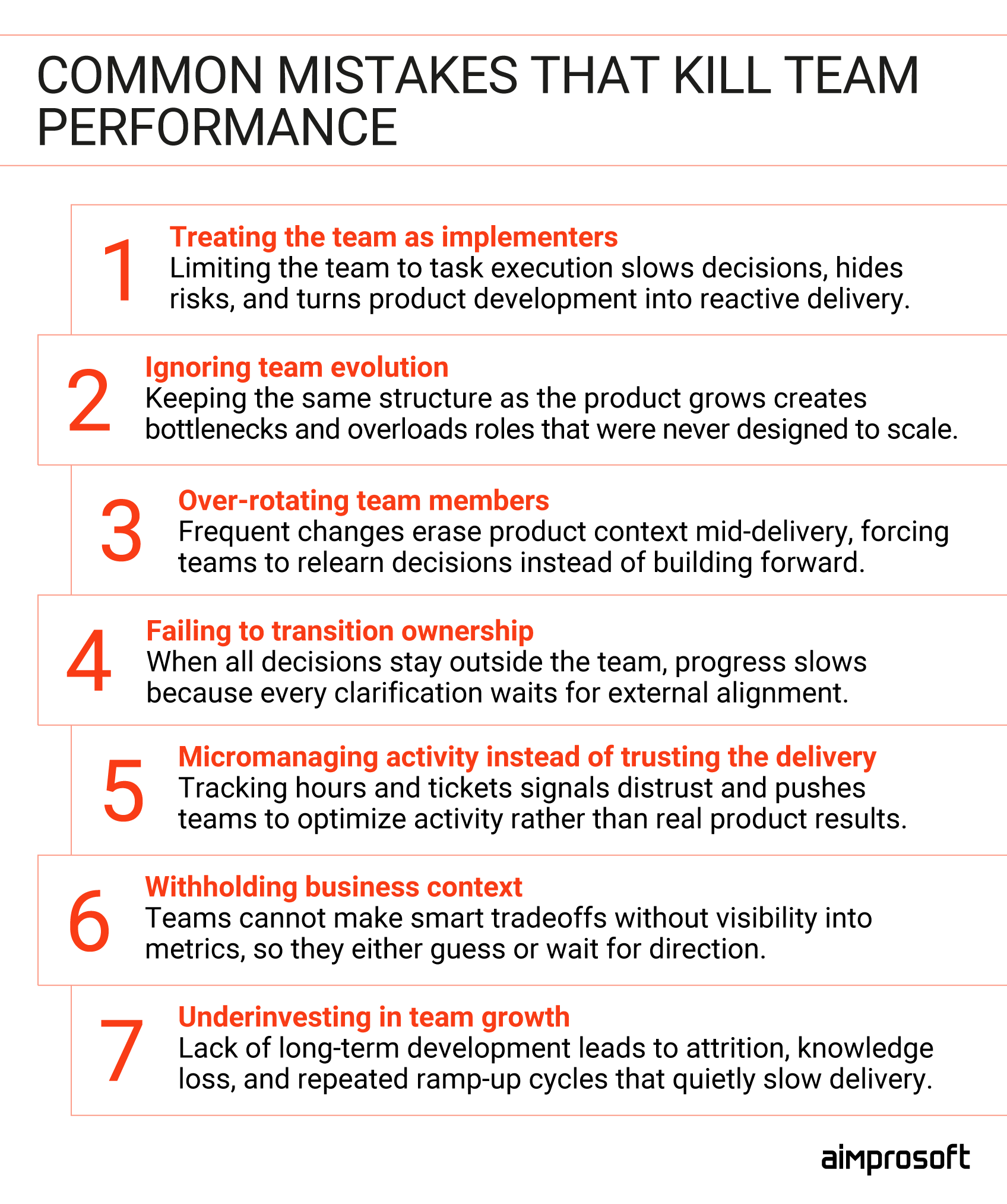
7 common management mistakes that kill team performance
Treating the team as implementers instead of product partners
When a dedicated team is brought in primarily to execute predefined tasks, its impact is capped early. Engineers receive requirements but lack visibility into user problems, business goals, or product tradeoffs. The immediate cost is slower decision-making. Every ambiguity requires escalation. Over time, the product pays a higher price. Opportunities for simplification are missed, technical risks surface late, and features are built exactly as specified, even when better alternatives exist.
Ignoring team evolution as the product matures
Team structures designed for an MVP phase often carry over into later stages without adjustment. Early delivery favors small teams with broad responsibilities and the ability to make fast decisions. As the product matures, that same setup struggles to support clearer ownership boundaries, deeper specialization, and stronger technical leadership.
When the product team structure does not evolve, bottlenecks emerge. Architecture decisions stack up around a few people. Product managers become overloaded. Quality issues surface later in the cycle. The team is not underperforming. It is operating with a setup designed for a smaller and simpler product.
Over-rotating team members and losing product context
Frequent team changes are often framed as flexibility, but they steadily erode product knowledge during active delivery. Each rotation removes context about past decisions, edge cases, and tradeoffs that were never fully documented. The impact shows up mid-project. Velocity becomes uneven. Decisions are revisited. The team spends time reconstructing why things were built a certain way instead of moving forward. Even short gaps in continuity can compound into delays when the product surface area grows.
Failing to transition ownership as the team matures
In early phases, product ownership often lives outside the delivery team. This can work temporarily, but problems arise when that model never evolves.
Teams that never transition continue relying on external product managers for every clarification, prioritization, or tradeoff. Mature teams shift ownership inward over time. Engineers propose improvements based on user behavior. Tech leads shape roadmap feasibility. Decisions happen closer to execution. When this transition does not occur, progress slows not due to skill gaps, but because every decision waits for external alignment.
Managing delivery through control rather than trust
You may attempt to control delivery through activity tracking, such as hours logged, tickets closed, or detailed time reporting. While this creates visibility, it also signals distrust. The result is a compliance-driven culture. Teams optimize for measurable activity instead of meaningful results. Initiative drops. Risk avoidance increases. Dedicated teams perform best when accountability is tied to outcomes such as shipped features, performance gains, or user impact, not to how busy the team appears.
Keeping the team in the dark about the business context
Product thinking cannot emerge without context. When teams receive requirements but lack visibility into business metrics such as revenue drivers, churn patterns, or activation goals, they cannot make informed trade-offs. This creates a pattern. Teams either guess or wait for direction. Decisions become conservative. Optimization focuses on technical correctness rather than business impact. Over time, you may start to perceive the team as passive, while the real issue is missing information, not capability.
Underinvesting in team growth and long-term motivation
Dedicated teams are designed for long-term collaboration, and not being managed with short-term expectations. When growth paths, skill development, and role progression are ignored, engagement declines.
Unlike rotation during active delivery, this problem surfaces gradually through voluntary turnover. Each departure removes accumulated domain knowledge and resets understanding of the product, users, and technical landscape. Replacements require time to ramp up, and delivery slows even when headcount remains unchanged.
We can help you design a dedicated team setup that supports clear ownership and long-term delivery, not just early execution.
Each of these mistakes keeps the team operating as if the product were still small, even when it no longer is. In the following section, we explore how this plays out across different product types: where continuity matters most, what tends to break without it, and how dedicated teams change the outcome.
Use cases by product type
Dedicated teams become critical in products where continuity shapes outcomes. When systems evolve over years, decisions compound, and context carries real weight, delivery speed comes from understanding the product deeply, rather than constantly rebuilding knowledge.
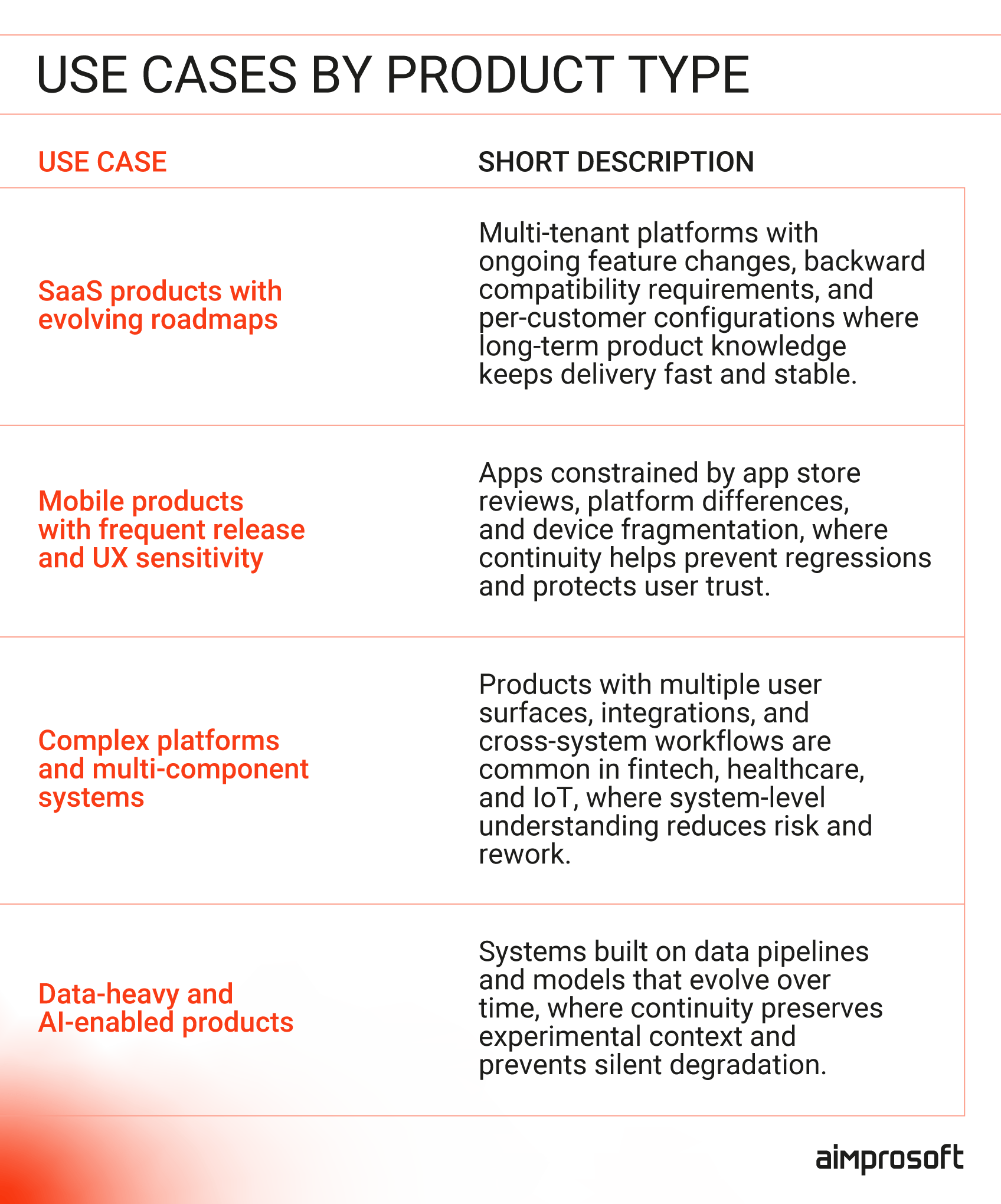
Use cases of dedicated development team
SaaS products with evolving roadmaps
SaaS platforms tend to change continuously. They release updates on an ongoing basis while serving multiple customers on shared infrastructure, often with different configurations, permissions, and usage patterns.
Why continuity matters
SaaS products operate under constraints that accumulate over time. Multi-tenant architecture, backward compatibility requirements, feature flag management, and per-customer configuration all introduce technical and product complexity. Decisions made early continue to affect the platform years later, especially when upgrades must happen without downtime.
What breaks without it
When teams rotate, knowledge about why certain architectural decisions were made disappears. Workarounds are added to support new customers, feature flags accumulate, and edge cases grow harder to track. Engineers become cautious about removing legacy behavior because it’s unclear who depends on it or what it might affect. Over time, every change requires more verification and coordination, which slows delivery.
What dedicated teams enable
Stable teams understand which compromises were intentional, which can be reversed, and which customers are affected by change. They improve the platform incrementally, reduce unnecessary complexity, and release faster because fewer decisions need to be rediscovered or revalidated.
Mobile products with frequent releases and UX sensitivity
Mobile products release updates under platform-specific constraints. Updates go through app store review cycles, users adopt them at different speeds, and small UX or performance issues can affect ratings long before fixes reach everyone.
Why continuity matters
Mobile apps depend on platform-specific behavior, device fragmentation, and strict distribution channels. App store review cycles prevent instant fixes. Differences between iOS and Android introduce divergent logic. Offline-first behavior requires careful state management across sessions and devices.
What breaks without it
Short-term teams often underestimate these constraints. Small changes introduce regressions that cannot be hotfixed quickly. Performance issues surface only after release. Ratings drop before teams can respond. Over time, product leaders become more risk-averse, slowing experimentation and iteration.
What dedicated teams enable
A dedicated application development team develops intuition about platform behavior and release risk. They anticipate review delays, test edge cases earlier, and make safer tradeoffs between speed and stability. As a result, releases remain frequent without sacrificing user trust.
Complex platforms and multi-component systems
These products span multiple interconnected components: user-facing applications, admin panels, APIs, integrations, and background services. A single change can affect workflows across systems, making delivery dependent on system-wide understanding rather than isolated feature work.
Why continuity matters
Over time, the behavior of a complex platform is shaped less by individual features and more by how components interact. Data flows, transaction boundaries, and background processes rely on assumptions formed through earlier decisions. Without continuity, teams lose sight of these assumptions and struggle to predict how changes will ripple through the system.
This becomes especially important in platforms that handle transactions, real-time processing, or device integrations, such as fintech, healthcare, or IoT products. In these environments, continuity helps teams preserve reliability, maintain data integrity, and avoid regressions that only surface after deployment.
What breaks without it
Without system-level understanding, teams optimize locally. Features work in isolation but fail under load, edge cases, or integration scenarios. Bugs appear far from their source, slowing diagnosis and resolution.
In domains like fintech or healthcare, this can affect transaction integrity, reporting accuracy, or compliance-related workflows. In IoT systems, failures often surface only after deployment, when devices behave inconsistently in real-world conditions.
What dedicated teams enable
A stable delivery unit develops shared mental models of how the platform behaves end-to-end. Engineers understand dependency chains, data flows, and failure modes across components.
This allows teams to make safer tradeoffs, anticipate cross-system impact, and scale the platform with fewer regressions. For complex, multi-surface products, dedicated teams reduce risk not by adding controls, but by preserving deep system knowledge over time.
Data-heavy and AI-enabled products
Data-driven products evolve through experimentation rather than linear feature delivery.
Why continuity matters
Data pipelines, feature engineering, model training, and infrastructure choices are tightly coupled. Model performance degrades over time due to data drift. Training and inference environments diverge. Debugging often requires understanding the domain as much as the code.
What breaks without it
Rotating teams lose more than experimental history. They lose intuition. Data pipelines break silently. Models decay without obvious signals. Teams struggle to determine whether issues originate in data quality, model logic, or infrastructure. Iteration slows as problems are repeatedly rediscovered.
What dedicated teams enable
A product innovation team preserves domain knowledge and experimental context. They monitor model behavior over time, recognize early signs of drift, and improve pipelines incrementally. This allows faster experimentation and more reliable outcomes without constant resets.
Across all these product types, continuity is the common multiplier. When products depend on accumulated knowledge, cross-functional coordination, and informed long-term decisions, dedicated product development teams enable progress to compound rather than restart with every handover. In these cases, sustained collaboration is what unlocks both delivery speed and meaningful innovation.
Case studies: how dedicated teams grow with complex products
Case study #1: building and scaling a wholesale telecom platform over 15 years
Product context
The product is a wholesale telecommunications platform used by partners across the UK to manage connectivity services, orders, and network assets. What began in 2010 as a startup portal for a small telecom provider later evolved into the core platform of PlatformX Communications, following two acquisitions and significant business expansion. Today, the platform supports over 1,000 partners and serves as the operational backbone for large-scale telecom service delivery.
How the product evolved
Over time, the platform moved through several distinct stages. Early development focused on enabling basic partner operations. As the business grew, requirements shifted toward centralization, automation, and reliability at scale. The product had to support a rapidly expanding partner base, introduce new services without disrupting existing ones, and withstand increasing load and security demands. After the acquisition by TalkTalk in 2022, the platform also had to align with a broader ecosystem while preserving its core value.
Decisions that supported long-term collaboration
As the product grew more complex and business priorities shifted, our collaboration stayed effective because several structural and technical decisions were made early and revisited over time. These choices focused less on short-term delivery speed and more on preserving continuity, ownership, and adaptability. Key decisions that shaped our long-term partnership included:
- Evolving team responsibility with product maturity
As the platform moved beyond early delivery, our dedicated team gradually took on deeper ownership of architectural and platform-level decisions, not just feature implementation. - Incremental modernization instead of disruptive rewrites
The transition from a monolithic Liferay-based portal to a microservices architecture was planned and executed in stages, allowing us to modernize the product without interrupting daily operations. - Maintaining team continuity through acquisitions and rebranding
Stable roles and long-term involvement ensured that product knowledge was preserved during two acquisitions and a major strategic shift, reducing risk and decision latency. - Aligning autonomy with growing platform criticality
As the platform became central to partner operations and revenue, greater autonomy was placed with our team, supported by trust built over years of collaboration. - Investing in infrastructure and automation at the right moment
Introducing CI/CD pipelines, containerization, and DevOps practices helped us scale the platform reliably while supporting faster, safer releases.
Long-term outcomes
Sustained collaboration and gradual evolution turned the platform into a stable, scalable foundation for long-term growth. Architectural and organizational decisions made over the years continue to support expansion without compromising reliability or day-to-day operations. Key outcomes of this long-term approach include:
- Scalability proven at the partner level
The platform now supports over 1,000 partners across the UK, handling growth without major architectural resets. - Operational scale without loss of stability
More than 500,000 completed orders and around 14,000 active users are supported while maintaining high availability for real-time telecom services. - Expansion-ready architecture
The transition to microservices enables faster onboarding of new partners, independent feature rollout, and continuous platform evolution without disruptive rewrites. - Enterprise-grade reliability and security
Modern infrastructure, automation, and improved security standards support nationwide coverage of 98%, even as load and complexity increase.
A platform that outgrew its original scope - What started as a startup portal has evolved into one of the UK’s leading wholesale telecom platforms, capable of supporting acquisitions, rebranding, and new market entry.
Case study #2: growing a startup into a global healthtech ecosystem
Product context
While the previous case shows how a dedicated team operates within a large enterprise environment, this collaboration reflects a very different starting point. In 2012, Qardio, a U.S.-based startup, approached us with an idea for a single mobile application connected to a small set of health monitoring devices.
Over the next 12 years, that initial product evolved into a full IoT-based healthcare ecosystem used by millions of people worldwide and adopted by hospitals and medical professionals. Our dedicated team supported this transition from early experimentation to a mature, scalable platform.
How the product evolved
Our collaboration began with the development of a core mobile application and device integrations for tracking basic health metrics. As Qardio’s business grew, the product expanded well beyond its original scope. New devices were added, a web platform for healthcare professionals was introduced, subscription models were implemented, and integrations with third-party systems became essential.
What started as a consumer-facing app gradually turned into a multi-layer ecosystem that included mobile apps, web portals, e-commerce, device management, and secure data processing. Supporting this growth required a shift toward microservices architecture, stronger DevOps practices, and infrastructure designed for continuous expansion.
Decisions that supported long-term collaboration
As the product matured, several decisions helped our partnership scale without losing focus or stability:
- Evolving from MVP delivery to ecosystem ownership
Our team’s role expanded from building a single application to shaping and maintaining a complex system of interconnected services, devices, and platforms. - Designing for future device and service growth
Architecture decisions were made with upcoming device integrations and new product lines in mind, reducing friction as the ecosystem expanded. - Introducing microservices to support scale and flexibility
Moving toward a microservices-based architecture made it possible to scale individual components, introduce new functionality, and manage increasing data volumes without destabilizing the system. - Balancing continuous development with platform stability
New features and integrations were delivered alongside ongoing improvements to performance, security, and infrastructure, rather than postponing modernization. - Gradually increasing team autonomy
As trust grew, Qardio relied on our dedicated team to make architectural and tooling decisions independently, accelerating delivery and reducing coordination overhead.
Long-term outcomes
Sustained collaboration allowed the product to scale from a startup concept into a globally used healthcare platform, without repeated resets or structural rewrites. Key long-term results include:
- Ecosystem scale proven in real-world use
The platform supports over 3 million active users and processes billions of health data points collected from connected devices. - Infrastructure built for growth and resilience
A microservices-based architecture and modern DevOps practices enabled a 30% improvement in system efficiency while maintaining high availability. - Quality and reliability at scale
Around 80% unit test coverage and continuous monitoring helped maintain platform stability as complexity increased. - A long-term partnership that grew with the product
Over 12 years of collaboration, our dedicated team evolved alongside Qardio’s business, supporting expansion into new devices, services, and revenue models.
We work with partners on products at different stages, staying involved beyond task execution and adjusting the team’s role as needs evolve.
Seen together, these two cases reveal the same pattern under very different conditions. In one, we worked within an enterprise environment shaped by acquisitions, scale, and operational criticality. In the other, we supported a startup as it grew into a global IoT healthcare ecosystem. But what made both collaborations last was allowing the team to change as the product changed: taking on more ownership over time, making relevant technical decisions, and adjusting the setup instead of clinging to the original one.
Making the partnership work long-term
As the case studies above show, long-term success rarely depends on how a dedicated team is set up at the start. It depends on how the collaboration is maintained, adjusted, and protected as the product evolves. The practices below are drawn from our own long-term partnerships, where we assembled dedicated teams and supported products over many years. They focus on sustaining ownership, preserving context, and keeping delivery effective well beyond the first year of development.
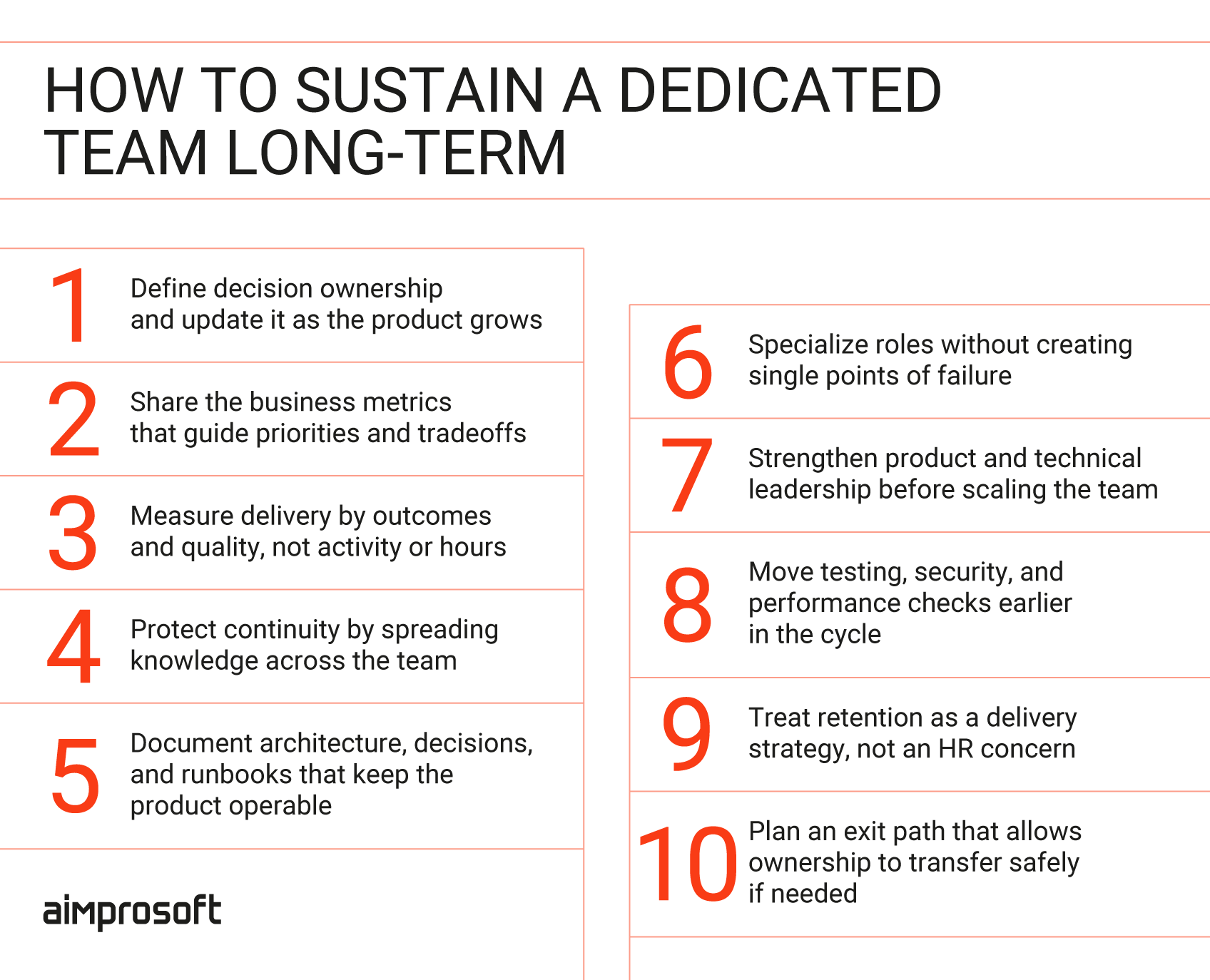
Strategies to build and sustain high-performing teams
Define decision ownership and revisit it as the product grows
Clear ownership is not something you define once. Early on, centralizing decisions helps move faster. Later, the same setup slows everything down. As scope and complexity increase, decision-making needs to move closer to the work. Regularly revisiting who owns architectural choices, prioritization, and tradeoffs prevents bottlenecks from becoming structural.
Share the business context that drives priorities
Teams can’t make good decisions in isolation. When you share the metrics that actually matter, prioritization becomes faster and more aligned. Without that context, even experienced teams default to execution instead of proper assessment, waiting for direction rather than anticipating needs.
Measure delivery by outcomes and quality, not activity
Tracking hours or ticket counts creates compliance, not progress. Understanding what a product team does means focusing on outcomes: stability, predictability, user impact, and quality over time. This shifts the conversation from “what was done” to “what changed,” and gives teams room to optimize intelligently rather than execute mechanically.
Protect continuity by spreading knowledge across the team
Long-running products accumulate decisions that aren’t obvious from the code alone. When that knowledge lives with one or two people, delivery becomes fragile. Actively spreading context through documentation, reviews, and shared ownership protects the product against turnover and keeps progress steady as the team evolves.
Document decisions that keep the product operable
Documentation is about preserving the reasoning behind key choices: why something was built this way, what was rejected, and what constraints still apply. Lightweight but consistent documentation makes future changes safer and reduces the cost of onboarding new team members.
Specialize roles without creating single points of failure
As products mature, specialization becomes necessary. At the same time, over-specialization creates risk. The goal is depth without redundancy: clear ownership combined with enough shared understanding that work doesn’t stall when someone is unavailable. This balance keeps delivery resilient without diluting expertise.
Strengthen product and technical leadership before scaling
Adding people amplifies existing patterns. If leadership roles aren’t clearly defined or supported, scaling the team multiplies confusion rather than capacity. Investing in strong product and technical leadership early creates alignment that holds as the team grows.
Move quality, security, and performance checks earlier
Issues caught late are expensive and disruptive. Teams that stay effective over time build validation into everyday work, not release phases. Shifting testing, security, and performance checks earlier reduces risk and keeps delivery predictable even as complexity increases.
Treat retention as part of the delivery strategy
Turnover slows products more than missed deadlines. Retention isn’t just an HR concern; it’s a delivery concern. Stable teams preserve context, reduce ramp-up time, and make better decisions under pressure. Long-term performance depends on keeping the people who understand the product deeply.
Plan for change, including a responsible exit if needed
Even strong partnerships change. Planning how ownership, documentation, and decision-making would transfer if the setup changes protect both sides. Knowing there is a clear path forward reduces risk and makes the collaboration more resilient, not less committed.
Wrapping up
A dedicated product development team works best when it’s treated as part of the product’s lifecycle, not a fixed delivery mechanism. Across the series of blog posts on dedicated teams, we’ve looked at how teams are structured, how they’re managed, where collaboration breaks down, and what keeps them together over time. The common thread is consistent: long-term results come from evolving ownership, clear decision-making, shared context, and the willingness to adapt the setup as the product itself changes.
If you’re building a product that needs continuity rather than short-term capacity, the team you work with matters as much as the model you choose. At Aimprosoft, we’ve spent years building and scaling dedicated teams that grow with products and partners alike. If you’re looking for a long-term collaboration built around real ownership and sustained delivery, we’re ready to help you build the team that fits your product for the long run.
FAQ
When should decision-making move closer to the team?
Decision-making should shift as soon as the product reaches a point where central approval becomes a bottleneck. This usually happens during growth, when features interact, technical trade-offs multiply, and delays carry higher costs. Moving decisions closer to the dedicated app development team doesn’t remove accountability; it shortens feedback loops and allows experienced contributors to act on the context they already hold.
How do you avoid dependency on individual team members in long-term collaboration?
Dependency is reduced by deliberately spreading knowledge rather than relying on informal awareness. Shared documentation, regular technical reviews, overlapping ownership of critical areas, and transparent decision records ensure that understanding lives within the custom software development dedicated team instead of with specific individuals. This approach protects delivery even when roles change or people rotate.
Can a product delivery team still work if product priorities change frequently?
Frequent change doesn’t break dedicated teams; unclear context does. An agile product team structure helps teams absorb shifting priorities when they understand the business reasons behind changes and have visibility into what matters most at a given time. When priorities are explained through metrics and constraints rather than ad hoc requests, teams adapt without losing focus or morale.
What signals that a dedicated team setup needs adjustment?
Common signals include slower decision-making, repeated clarification cycles, growing reliance on escalations, and teams executing work without questioning its relevance. These symptoms usually indicate that product team roles, ownership boundaries, or communication patterns haven’t evolved alongside the product. Addressing them early helps prevent gradual performance decline.