

What Is POD in Agile? A Beginner’s Guide to Product Oriented Delivery
Published: – Updated:


There’s rarely a company that wouldn’t face such development chaos: stakeholders dump features faster than teams can build them, clients have no idea what’s actually happening, and developers drown in an ever-growing backlog.
The usual response is predictable — scale the team, add more project managers, schedule more meetings. But the problems don’t go away. They multiply.
Not because teams can’t do the work, but because the structure can’t support it. More people won’t help if the process is misaligned, progress is unclear, and delivery is unpredictable.
And this happens in every Agile flavor — Scrum, Kanban, hybrid, you name it.
As a result, organizations began experimenting with new structures and product-oriented delivery (POD) models emerged. But what is POD in Agile exactly? Depending on whom you ask, a POD might mean a squad, a feature team, or simply a renamed Scrum team. And honestly, it doesn’t help much.
In this article, we’ll clarify the POD meaning in business, outline why the term is often misunderstood, and show how they help businesses achieve faster outcomes. If you’re considering this approach, the guide will help you understand what a POD truly delivers, and whether it’s the right solution for your team.
Why traditional teams can’t keep up even when Scrum works
Even well-run engineering teams hit the same wall. The business pushes new ideas, feature requests, and “must-haves” faster than teams can turn them into production-ready outcomes. Developers are productive, sprints run smoothly, yet a feature still takes 30-45 days to move from idea to production.
Hear me out, the work is getting done — just not at the speed the business expects — and this gap leads to slipped releases, competing priorities, and planning that feels more like guesswork than prediction.
The problem isn’t effort, but a demand that outpaces the delivery system’s ability to respond predictably.
And the business isn’t backing down because of it. If the entire engineering team is working, when will customers see the value? Their expectations are quite straightforward:
- Faster launch cycles
- Clearer, data-backed progress reporting
- Predictable delivery timelines
- The ability to respond quickly to market pressure
- Confidence that engineering can absorb new demand without chaos
It may sound like too much, but these expectations are no longer optional. In fintech, ecommerce, IoT, EdTech, and digital health, a single-month delay results in lost Annual Recurring Revenue (ARR), missed revenue windows, and slower customer activation. For SaaS scale-ups growing 50%+ annually, the impact is even sharper — every postponed release pushes monetary value further down the timeline.
And this pressure only intensifies. AI-powered SDLC tools are raising the bar — competitors are shipping faster with AI-assisted coding, automated testing, and continuous deployment. The baseline for “acceptable delivery speed” has risen, and organizations that can’t demonstrate measurable improvement risk falling behind.
So, now it makes sense that leadership expects not just assumptions, but proof: “What exactly improved?” “How much faster are we now?” “What does our flow time look like month over month?”
These questions can’t be answered with mere activity metrics, but POD models in Agile answer the challenge directly. They improve delivery flow, make progress measurable, and align engineering output with business timelines.
How? Let’s take a closer look.
What is POD in Agile?
The term “POD” (product-oriented delivery) has become so overloaded that asking, “What is POD in Agile?” or “What is POD in software development?” will get you five different answers from five different teams. Some call them feature squads. Some just relabel their Scrum teams and call it a day. This ambiguity makes it hard to evaluate whether the POD model truly solves the delivery problems we outlined above or not.
So before going further, let’s make sure we’re on the same page with Agile POD’s meaning.
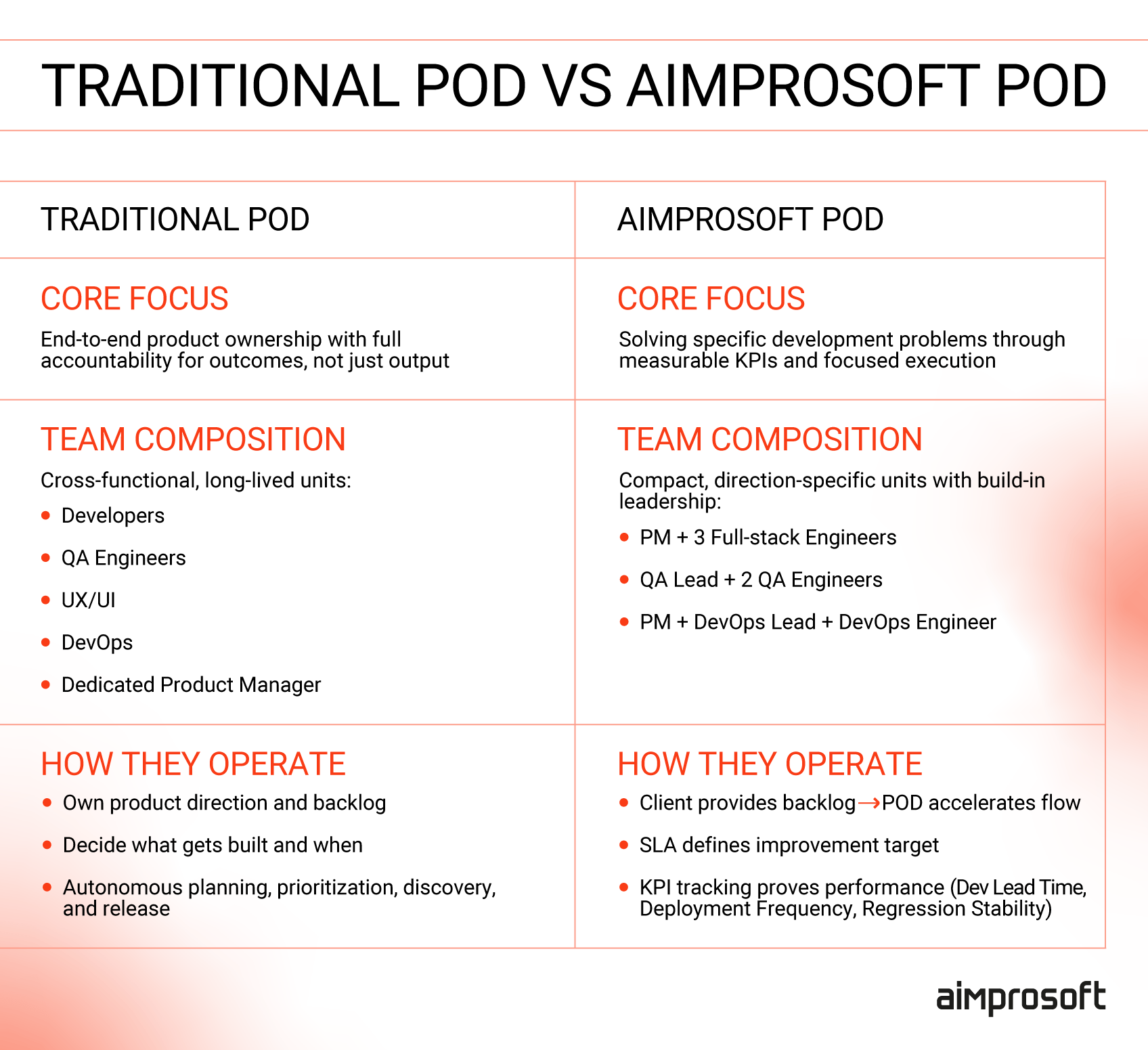
The most common industry definition describes POD as a cross-functional team that owns a product — we’ll call Traditional PODs here.
But there’s another way to use the POD concept. Not as a full product micro-organization, but as a delivery function designed for flow, speed, and predictability. And that’s what Aimprosoft’s Agile PODs are.
Traditional POD model
A popular Agile POD definition comes to a small unit that owns a product or capability end-to-end. These teams are long-lived, operate autonomously, and carry full accountability for outcomes, not just output.
A traditional POD brings together all roles needed to ship and support a product:
- Developers
- QA
- UX
- DevOps
- And a dedicated Product Manager to lead the team
Rather than contributing to a broader delivery pool, the team owns a defined product slice or domain from start to finish, with authority over planning, execution, prioritization, and release decisions.
It’s a strong fit for companies with multiple product areas that need stable teams who can own them long-term and ship independently. In that context, a traditional POD team in agile can reduce cross-team friction, strengthen alignment between product and engineering, and build durable expertise within the domain it serves.
Ultimately, traditional POD in Agile means not a delivery tactic but an organizational design strategy. It reshapes how work moves through the company, how decisions are made, and how teams are structured over time. To succeed, it also requires shifts in budgeting, ownership, leadership roles, and, in many cases, the entire operating model.
And this is where Aimprosoft’s approach differs. Our Agile POD teams don’t require reorgs, new reporting lines, or internal restructuring. They can plug into your existing delivery flow or operate independently and help you ship faster in both cases.
Aimprosoft Agile POD delivery model
Agile POD teams in our model are compact, high-performing teams built to ensure product-oriented delivery and achieve specific business outcomes. Unlike traditional Agile POD methodology that focuses on ownership, ours solve specific development problems: increasing delivery speed, fasten rollbacks, or cutting critical bug thanks to established KPIs and focused execution.
Here’s one example of how a team might look:
- PM + 3 full-stack engineers
- QA Lead + 2 QA engineers
- 1 DevOps Lead + 1 DevOps engineer
The composition and number of engineers can vary but, in our work, each POD is self-sufficient. Instead of one team owning everything, each POD accelerates a specific delivery bottleneck — feature development, testing, or deployments — and proves improvement in its lane. Thanks to built-in leadership (PM or Lead), prioritization and decisions happen in real time.
So, is it like staff augmentation? No, nor is it consulting. Agile PODs bring the speed of staff augmentation without coordination overhead, the leadership of consulting without long ramp-ups, and the measurable accountability of SLA-backed performance.
How does it work?
First, a client chooses one POD that addresses their biggest bottleneck. (There’s no need to start with all three PODs at once).
For Development PODs we start with a discovery to review the existing backlog, confirm that there is enough prioritized work to start, and record the current delivery baseline (e.g., how long it takes for a feature to move from development start to production release). This step results in agreed outcome based metrics, improvement targets, and a defined expectation for how the POD will be evaluated during the pilot. Only after we fix the baseline we sign the SLA, and it reflects outcome based product roadmap, not assumptions.
Once the baseline is established, the POD begins operating against it — whether that means faster releases, shorter testing loops, or more frequent deployments. Our AI-assisted SDLC, enables them to start on day one.
How do you track progress?
Progress is measured against the agreed KPIs, not general statements of “speed” or “efficiency.” Each POD direction tracks its own core indicators, aligning to an outcome based delivery model, not effort.
For developers, such metrics can be dev lead time, sprint velocity, or forecast accuracy. For QAs, test execution efficiency or automation coverage. And DevOps deploy frequency, cut-to-prod time, and MTTR.
Once the client can see that the improvements are factual and consistent, cooperation continues; if not, the engagement can end, or the terms can shift.
If later the clients understand they need multiple capabilities working together (developers + QA + DevOps in one unit), they can scale into a cross-functional team. At that point, however, the engagement shifts to a different model: a dedicated team with shared KPIs, rather than three separate PODs.
The measurement logic also changes. We no longer track development lead time inside QA or QA coverage inside DevOps. Each role still carries responsibility for its own discipline, but effectiveness is evaluated at the team level. Such metrics can include:
- Cycle time (task start → production)
- Flow efficiency
- Deployment readiness
- Defect leakage during the whole flow
This ensures that the client still sees transparent performance, but the metrics match the real nature of the work.
Our team is here to talk
Why Aimprosoft PODs deliver better business outcomes
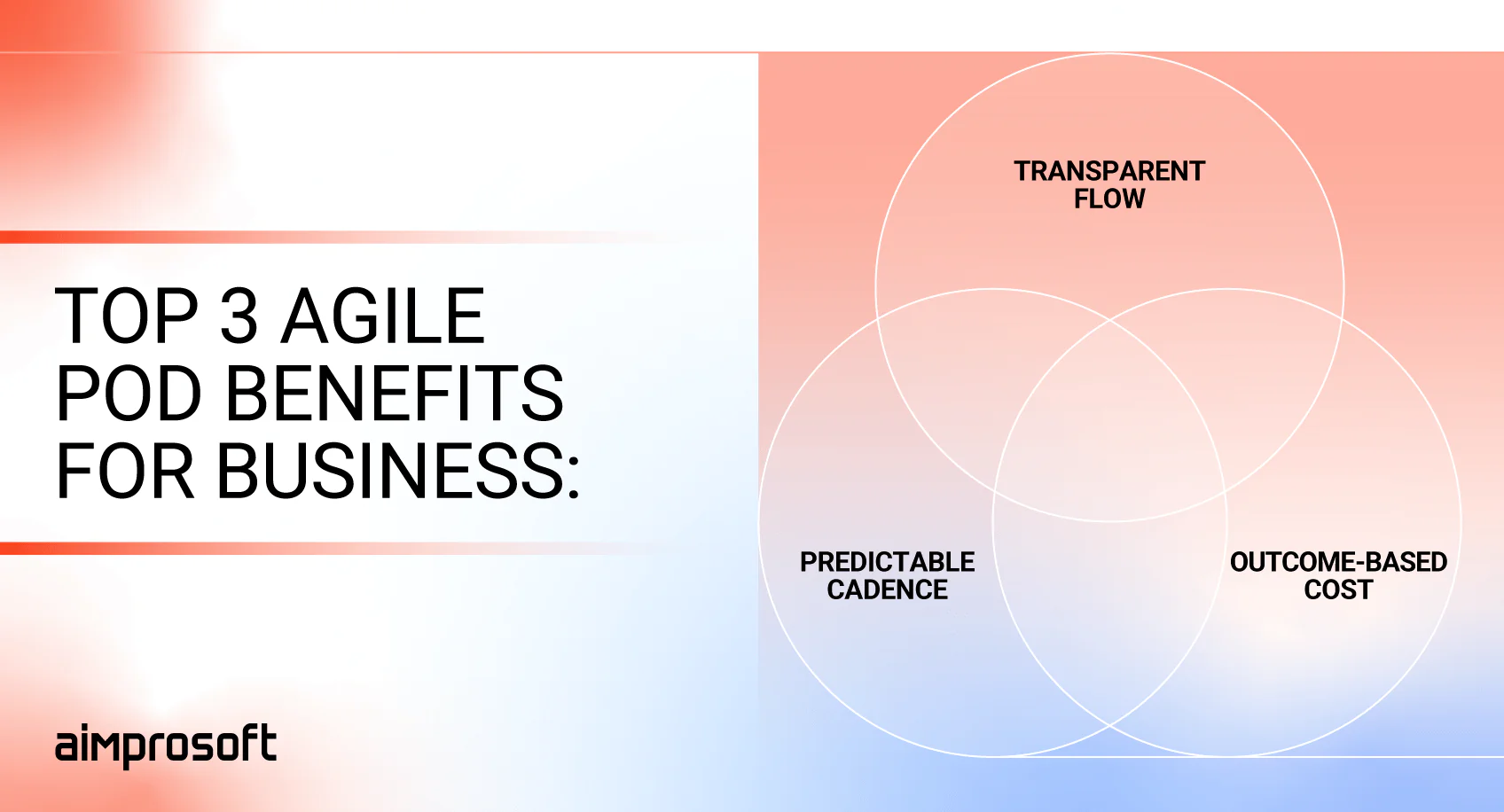
Our POD approach solves three problems that drain value from traditional delivery models: unclear progress, unpredictable timelines, and misaligned incentives. Agile POD benefits come from transparency, predictability, and outcome-based accountability — turning engineering delivery into a measurable, manageable business function. Here’s how it works in detail.
Transparency through specialization
POD in software development has a single job and specific metrics to prove it’s working.
- Development POD improves delivery speed.
- QA POD improves release reliability.
- DevOps POD improves deployment flow.
The benefits of Agile PODs for business are clear: they remove the uncertainty that typically surrounds engineering progress. Real-time dashboards show exactly how fast work moves, whether backlogs are shrinking, and if the investment is translating into delivered features. No more accepting “we’re working on it” as an answer. If a performance slips, you see it immediately and can act. If it improves, you have the data to justify continued investment.
Predictability through measurable SLAs
When delivery is predictable, the business can move faster. Sales can commit to launch dates. Marketing can plan campaigns around real timelines. Finance can tie budget releases to actual feature delivery instead of hopeful estimates — all this is possible because delivery runs under clear SLA commitments. A clear example of Agile PODs benefits in action.
This matters because delivery uncertainty costs real money. A feature delayed by one month isn’t just a missed sprint — it’s a stalled partnership deal, a competitive window that closed, or a sales cycle that reset. When one can forecast releases with confidence, they can align an entire go-to-market strategy around them.
Most of our clients see measurable results by Sprint 4 — meaning faster time-to-market, reduced delivery risk, and the ability to capitalize on opportunities when they appear, not three months later.
Outcome-based pricing
Our Agile POD delivery model differs from others — we don’t get paid for effort, we get paid for results. Clients pay a baseline engagement fee, but 15% of our compensation depends on hitting agreed KPIs: faster cycle times, higher deployment frequency, lower defect rates.
If we deliver, the client pays more. If we don’t, our client pays less.
Every 6 sprints (≈3 months), we measure performance against SLA KPIs. And if after three months we haven’t met the targets, client can exit without penalty — or take 20 hours of senior architect support at no charge.
This way our clients know they can trust our experience.
Are Agile POD services for you?
Not every company needs PODs, and that’s okay. The model works best when the problem is delivery execution, not product direction. Here’s how to know if Aimprosoft’s POD software development approach is the right fit.
Ideal fit:
- You already have a defined backlog. Your product team knows what needs to be built — the challenge is getting it shipped consistently and predictably.
- You know (or suspect) where delivery slows down. Maybe QA takes too long. Maybe deployment is a bottleneck. Maybe development finishes, but nothing goes live for weeks.
- You’re comfortable with performance-based pricing. You’d rather pay for results than hours. If the engagement delivers, it’s worth paying more.
- You need visibility and predictability. Leadership wants dashboards, clear metrics, and the ability to forecast releases — not vague status updates.
Not a match:
- You need full product ownership. If you’re looking for someone to define features, shape roadmap priorities, gather requirements, or own product discovery, PODs aren’t built for that. The backlog must already exist — we accelerate it, not create it.
- Your main issue is organizational structure or culture. POD in Agile improves delivery flow, but they don’t supervise your engineers, restructure cross-functional collaboration, or realign team incentives. If that’s your case, the delivery accelerator will do no good.
- You prefer fixed engagement models regardless of outcomes. PODs are built around performance-based accountability. If you want fixed-price or time-and-materials billing with no link to delivery results, this model loses its purpose.
Not sure?
If the backlog exists, but the bottleneck isn’t obvious, a short diagnostic can confirm whether acceleration is needed. Our team can analyze your current delivery metrics, identify where constraints actually live, and recommend the model that matches your situation: software development PODs, Dedicated Team, or a hybrid approach.
No sales pitch. Just a clear assessment of whether product oriented delivery (POD) model will solve your problem — or if something else makes more sense. Contact us.