

Custom AI Development: From Business Challenge to Solution
Published: – Updated:


If you are wondering how effective your AI implementation is, let us break down the difference when AI works and when it slays.
Despite the uptick in embracing AI in the workforce, there are still some mistakes made, preventing it from reaching its full potential. For example, not properly evaluating its real financial merit or relying on AI as a magical fix without custom adjustments to your needs can be core blockers. And finding a perfect solution that fits your business is a main goal of custom AI development.
In this article, we’ll walk through the main business challenges that demand tailored AI solutions, the phase-by-phase process that prevents expensive failures, and the real costs. By the end, you’ll know exactly when custom AI software development makes sense for your business, and how to make it right.
The Custom AI Reality Check: When Generic Tools Fail
In our extensive expertise, saying ‘communication is key’ applies not only to interpersonal relations within your teams. When your ERP doesn’t connect to your warehouse system and customer data is scattered across multiple platforms, maintaining a smooth workflow becomes nearly impossible. Off-the-shelf AI solutions aren’t designed to handle this level of complexity, leading to miscommunication and inefficiency.
Yes, generic AI gives you what everyone else has: fast deployment, lower costs, standardized features. But custom AI solutions can give you what nobody can replicate: intelligence built around your data, integrated with your systems, optimized for your workflows. AI software engineering makes this possible by designing AI for business operations that truly align with your reality.
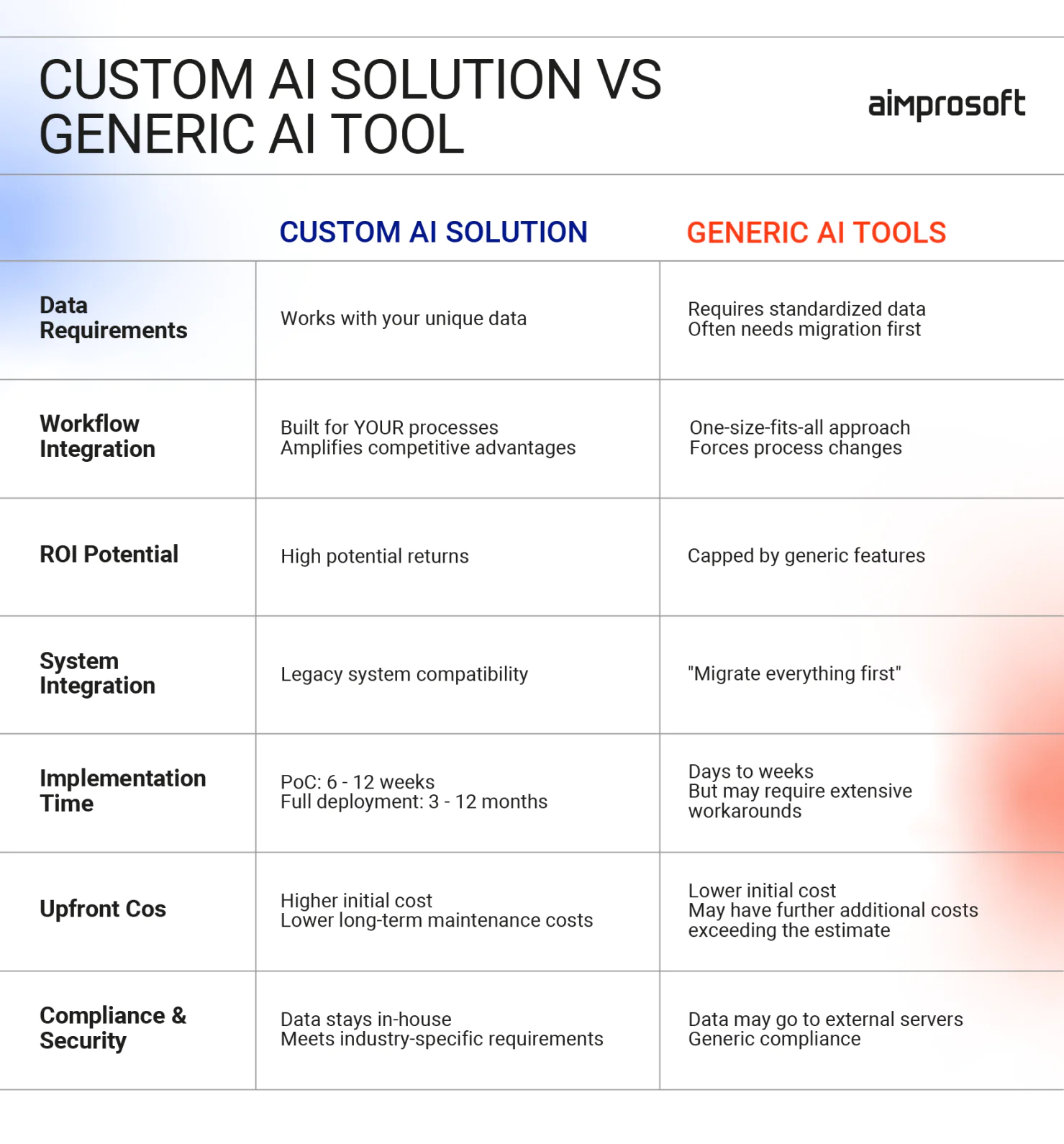
You see, custom AI solutions development works differently. Instead of forcing your operations into a pre-built box, AI solutions development company teams design around your actual data reality. They build connectors for your outdated SAP instance, parse your industry-specific documents, and create models trained on your unique patterns. The best thing for you to do here is to look closely at your needs and decide which solution will benefit you in the long run.
Business Challenges That Demand Custom AI Development
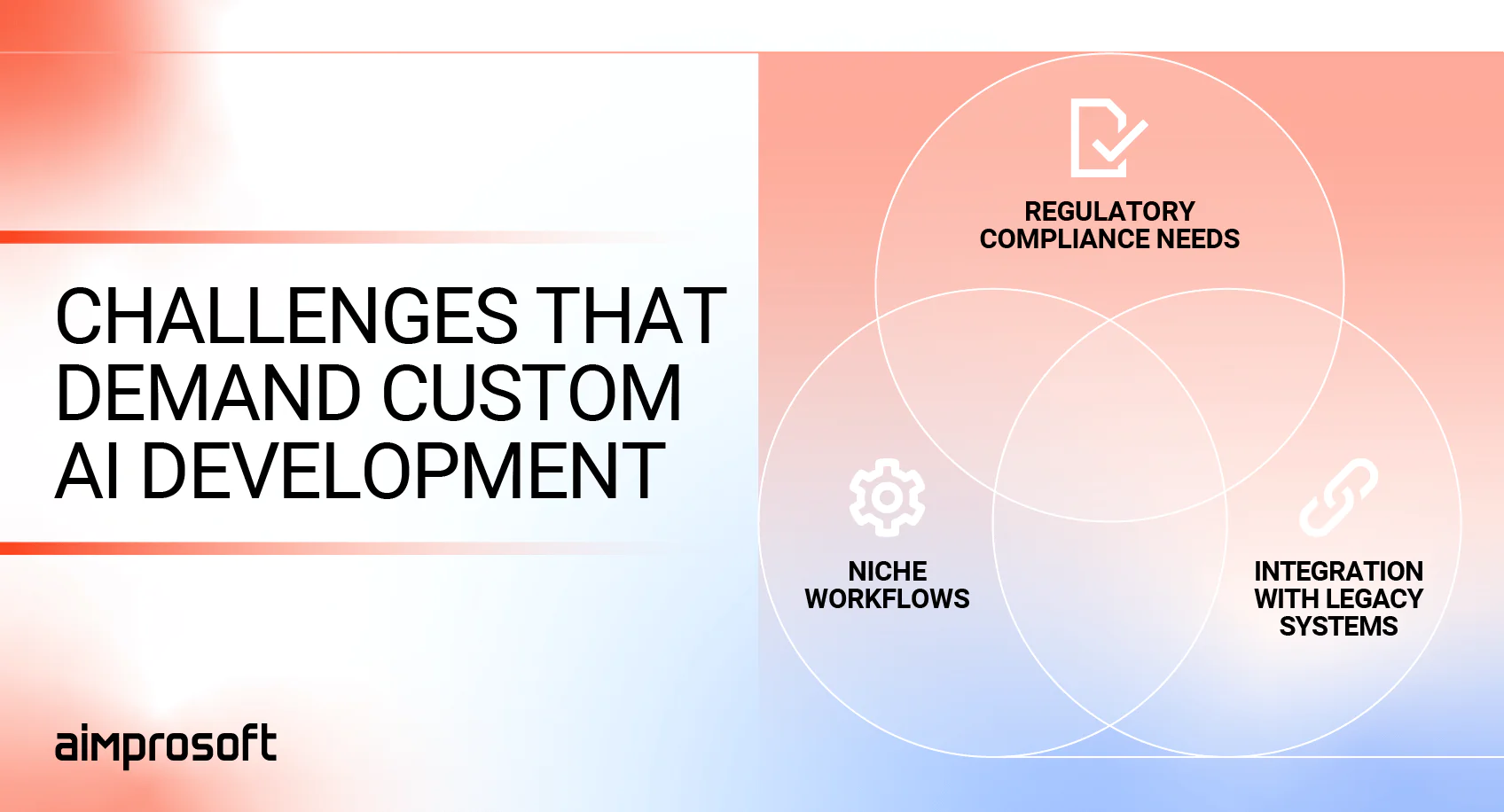
While some challenges are better solved through configuration, integration, or better project management, there are scenarios where custom AI business solutions are vital to your efficiency.
Challenge 1: Regulatory Compliance Needs
In industries like healthcare and finance, there are strict rules (e.g., HIPAA, GDPR) that generic tools may not meet due to data sovereignty issues or inflexible security. But even if your business has more flexible policies, data compliance and security remain the main concerns when relying on AI.
Custom builds will keep sensitive information in-house, with AI business solutions architected around your compliance framework instead of forcing you to retrofit security after the fact.
Challenge 2: Niche Workflows
Proprietary or niche datasets, such as internal transaction logs or equipment sensor data, cannot be effectively used by generic AI trained on public data. You need to train your AI model of choice on your exclusive data to achieve precise predictions, such as fraud detection in finance or predictive maintenance in manufacturing. This way, you will turn the unique features of your business operation from a bottleneck to an advantage when using custom AI instead of a generic one.
Challenge 3: Integration With Legacy Systems
When your tech stack is a combination of SAP from 2015, Salesforce customized by three different consulting firms, homegrown tools, and spreadsheets, integrating AI smoothly and effectively will definitely be a challenge. Off-the-shelf AI often disrupts legacy systems or requires costly adaptations, leading to inefficiencies.
Custom development designs seamless APIs and workflows that fit existing infrastructure, minimizing downtime and raising operational efficiency.
If facing one or more of the above challenges, your best course of action is to reach for a helping hand and partner up with an experienced AI solutions development company and finally start leveraging AI to its full potential.
From Challenge to Solution: The Custom AI Development Process
Is your goal to get an AI for the sake of AI, because everyone else got in, or do your investors demand you have it because it looks good on paper? Or you’ve conducted a deep dive into your business needs, found pain points that are better solved with AI, and calculated that it is the best scenario to elevate your ROI? If it is the latter, you are ready to start your path from challenge to solution, and we are happy to share with you the systematic approach that works.
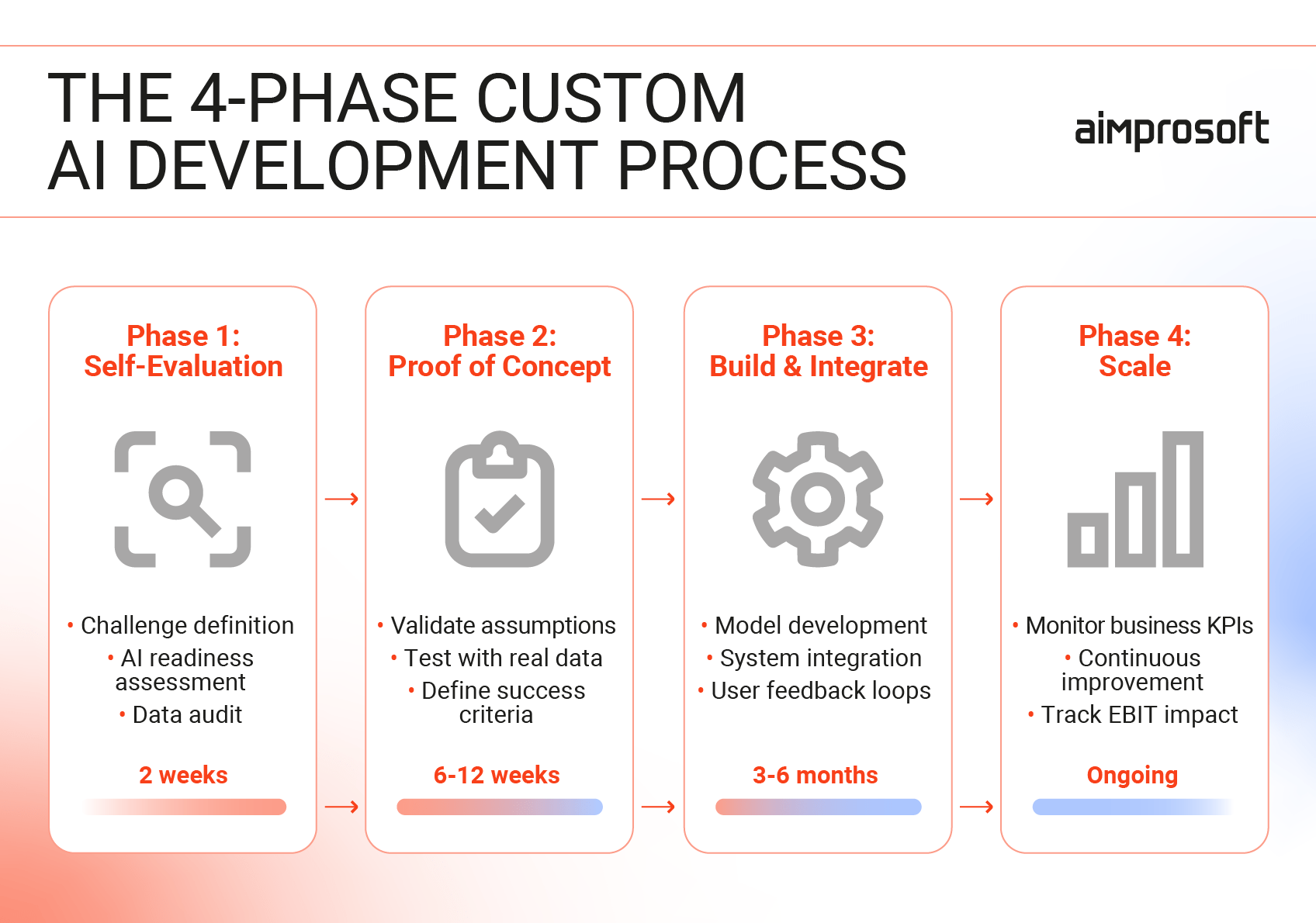
Phase 1: Challenge Definition & AI Readiness Assessment
Custom AI development is the entire implementation process that starts with planning, data prep, process redesign, and training. All of it is required to make any AI tool effective for a specific business, not just building a model from scratch.
So, before writing a single line of prompt/code, answer three questions: What specific business outcome are we targeting? What does success look like in numbers? Is our data fully ready for this?
Data prep is a critical first step. AI is only as good as its data, and 57% of organizations with data that isn’t AI-ready usually discover this in month 4 of a 6-month project. In our professional opinion, it is much better to find out during a two-week assessment.
Red flags that scream “not ready yet”:
- unclear success metrics
- no data governance
- expectations that AI will “figure it out” without clean inputs
According to McKinsey’s research, what stands out in high performers is that they redesign workflows first, then build AI to amplify those changes.
When NOT to build custom: The problem is generic (use off-the-shelf), you need results in under three months (configure existing tools), or you’re unwilling to change how work gets done (AI won’t fix broken processes).
Phase 2: Proof of Concept — Test Before You Scale
What you must always keep in mind is that AI is a tool, not magic, and like any other tool, it needs crash tests before deployment. So, after you’ve done your due diligence and decided that the custom AI tool is the most relevant solution to your business need and triple-checked that your data is ready for it, it is time to test this theory.
When compiling a proper proof-of-concept, you find answers to crucial pain points, like whether this approach works with your actual data, whether it can be integrated with existing systems, and what the real accuracy is vs. demo accuracy.
Phase 3: Build, Integrate, Iterate
Custom AI development services teams mainly focus on three parallel tracks:
- custom AI model development
- system integration
- user feedback loops
For instance, Microsoft’s Azure AI Foundry enables enterprises to build custom agents connected to their actual business data—not generic datasets. API-first architecture, microservices patterns, and solid data pipelines lie at the core of successful AI engineering services in practice.
Another important point here is that you should always make sure not only that you have adapted your workflows and business processes to the new tool, but also that you have trained real people for the change. That will minimize the resistance, which can be a big pitfall on the way to real efficiency.
Phase 4: Scale With Confidence
As businesses grow, new needs and challenges may surface, so staying flexible and having the capacity for further improvement is a must.
45% of high-maturity organizations keep AI systems operational for 3+ years. They monitor various business KPIs (revenue, cost reduction, time savings), alongside model accuracy.
Let’s start with an AI readiness assessment
Common Pitfalls and How to Avoid Them
Building something unique often comes with additional risks and pitfalls that are hard to predict. But understanding why some AI projects fail may help organizations navigate common traps, reducing the most recurrent risks.
Pitfall 1: Treating AI as a Cure-All
We’ve already highlighted that if your goal is just to implement AI and not achieve business results, there won’t be any magic in your profits. You should remember that AI, even a custom AI tool, is an algorithm, not a new business model.
How to avoid: Prioritize business issues over AI skills. Before exploring potential solutions, quantify the problem. Verify that, in comparison to more straightforward options, AI is the best course of action.
Pitfall 2: Legal Restrictions
Business owners risk deploying custom AI that inadvertently violates regulations like GDPR, HIPAA, or new emerging AI laws, leading to fines, data breaches, or shutdowns. Rushed custom builds may overlook jurisdiction-specific rules on data privacy and algorithmic bias.
How to avoid: Conduct an early legal audit and embed compliance-by-design from the start. Partner with experts to map regulations against your data flows and use cases, ensuring scalable adherence as laws evolve.
Pitfall 3: Speed of New Tech Emerging
In the AI world, new, better, and sometimes even cheaper technologies emerge faster than development cycles, rendering solutions outdated before full deployment.
How to avoid: Adopt modular, future-proof architectures with easy model swapping. Build in continuous retraining pipelines and monitor tech horizons through partnerships or AI trend subscriptions to pivot swiftly.
Pitfall 4: Neglecting Maintenance
Business owners investing in custom AI often face post-launch abandonment, where developers vanish or lack capacity for ongoing maintenance, leaving systems brittle to bugs, data drifts, or scaling issues that halt operations.
How to avoid: Secure long-term support contracts with clear SLAs upfront. Choose vendors with proven track records in iterative updates and build internal AI expertise to reduce dependency.
Pitfall 5: Hidden Cost Escalations
Initial custom AI budgets can quickly exceed the estimate due to scope creep, extended testing, or unforeseen integration expenses, straining finances without proportional ROI.
How to avoid: Define strict scopes with phased milestones and contingency buffers. Track costs against KPIs in real-time to course-correct early.
Pitfall 6: Disconnected Tribes
Organizational conflict results from technical teams operating independently of business stakeholders. Business executives are unable to assess technical trade-offs, while data scientists lack an understanding of business context.
How to avoid: Establish cross-functional teams with clear communication channels. Include domain experts in technical discussions. Translate between business language and technical specifications.
Pitfall 7: Insufficient Change Management
Businesses implement AI without educating users about the changes to the workflow. When that happens, even technically successful efforts are undermined by resistance and low uptake.
How to avoid: Invest in change management from the project start. Involve end-users in design. Provide training and support. Address concerns proactively. Measure adoption alongside technical metrics.
Pitfall 8: Vendor Lock-In
More than 80% of cloud-migrated organizations face vendor lock-in issues. Switching providers typically costs twice the initial investment.
How to avoid: Design for portability where possible. Use open standards and formats. Evaluate switching costs before committing. Consider multi-cloud or hybrid approaches for strategic applications.
Pitfall 9: Security and Compliance Gaps
When organizations rush to deploy AI without adequate security measures or compliance validation, data breaches caused by human factors, such as phishing and social engineering, can cost them millions in revenue and serious reputational damage.
How to avoid: Build security in from the design phase. Implement encryption, access controls, and audit logging. Validate compliance requirements before deployment. Plan for regulatory changes.
Is Custom AI Worth the Investment? The ROI Data Says Yes
Let’s talk business. The first question we usually hear when consulting on custom AI model development is ‘Is it worth it?’ Short answer — yes, but who needs short when we can back it up with actual data.
“Customization is mandatory for ROI. For business value, customization is required in 99.99% of cases. Simply buying a subscription without additional adjustment work is a vanity project, not an investment.” — Alex Machnev, Head of R&D and Delivery Manager at Aimprosoft
Custom AI solutions generally deliver higher long-term ROI than generic off-the-shelf tools, with studies showing 3.5x greater productivity gains and 200-500% returns versus often negative or lower ROI for generics due to scalability limits and ongoing fees. Custom AI excels in tailored accuracy (99%+ vs. 70-80%) and ownership, while generics offer quick starts but incur hidden costs like rework and subscriptions.
Additionally, custom AI algorithms are developed to better manage expansion. In contrast to off-the-shelf platforms, which can only support 1.7x growth in data volume and user base, businesses with customized AI architectures can support 3.4x growth before requiring significant adjustments.
Sure, custom AI has higher upfront costs, but in the long run, without the constant need for subscriptions, updates, and other escalating expenses that are so often seen in generic AI solutions, you will get your payback and then some when your ROI will become exponentially higher, achieving payback in 10-18 months.
Conclusion
By 2026, 40% of enterprise applications will include task-specific AI agents, according to Gartner.
Start with an honest assessment: Do we have a business need that will be better solved by custom AI? If yes, is our data ready? Do we have one high-impact use case we can nail? Are we willing to change workflows, not just digitize them?
Find partners who understand your domain, show you their implementation scars (not just their success stories), and can articulate why your project might NOT need custom AI.
Then build, measure, and scale. Focus on real problems, build targeted solutions, and dare to redesign how work gets done and get your business’s winning advantage with AI.
FAQ
How long does custom AI development typically take?
Most projects span 3-12 months, starting with a 2-week assessment, followed by proof-of-concept (1-2 months), building (2-6 months), and scaling. Keep in mind that timelines may vary by complexity, data readiness, and scope.
What makes custom AI better than generic tools for my business?
In situations when off-the-shelf solutions lack accuracy or adaptability, like regulatory compliance, specialized workflows, or legacy system integration, custom AI shines. Unlike generics trained on public datasets, it employs your proprietary data for customized accuracy.
What are the biggest pitfalls in custom AI projects and how to avoid them?
Treating AI as a panacea, legal oversights, technological obsolescence, maintenance negligence, and cost overruns are among the most common pitfalls. Use cross-functional teams, long-term SLAs, modular designs, compliance audits, and staggered milestones to mitigate.
What are the real costs of custom AI, and when do I see ROI?
Upfront costs range from $ 50,000 to over $500,000, covering data prep, development, and integration, but payback is often seen within 10-18 months. But be aware that hidden escalations from poor planning inflate budgets.